
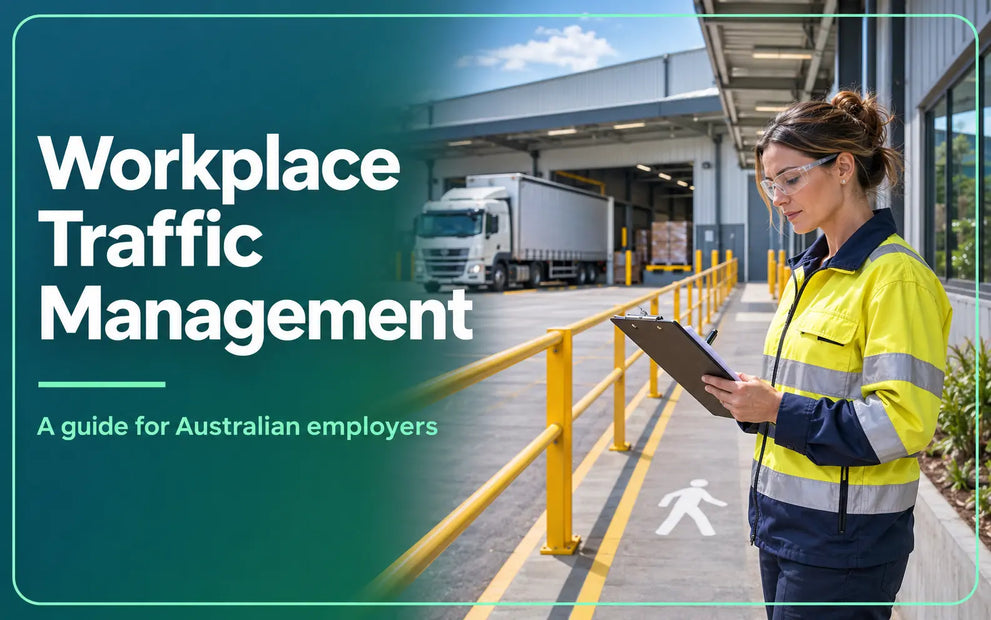
A delivery arrives while workers cross the yard to start their shift. Without clear arrangements, an ordinary movement can expose someone to a serious collision.
Workplace traffic management plans and controls how people and vehicles move around workplaces. It covers pedestrians, visiting drivers, parked vehicles and powered mobile plant. Employers should identify interactions, consult workers, implement suitable controls and review their effectiveness.
Changes in deliveries, staffing or layouts can make familiar routes unsafe. This guide explains traffic controls, site plans and checks Australian employers can use.

What Does Workplace Traffic Management Involve?
Workplace traffic management applies wherever people and vehicles could interact during work. Warehouses, workshops, loading yards and construction sites all need suitable arrangements. The approach should reflect actual activities, vehicle movements and people using each area.
People, Vehicles and Powered Mobile Plant
Consider everyone entering or moving through the workplace, including visitors and delivery drivers. Workers walking between amenities and work areas can cross busy vehicle routes. Customers and contractors may misunderstand arrangements that regular workers already know.
Powered mobile plant includes equipment such as forklifts operating around the workplace. Parked vehicles also need attention, particularly during loading, unloading and driver access. Look beyond marked roadways to doorways, parking areas and temporary storage spaces.
A forklift traffic management plan should address the tasks performed around that equipment. A broader workplace plan may also cover trucks, cars and shared access points. Make sure these arrangements work together wherever routes meet.
Employer Responsibilities and Public-Road Boundaries
Employers need to manage traffic risks under the laws applying to their workplace. National guidance helps explain controls, while state and territory regulators enforce local requirements. WorkSafe Victoria explains employer duties and forklift traffic controls within its state framework.
Consult workers and relevant health and safety representatives when developing arrangements. Include contractors and visiting transport businesses where their activities overlap. Agree who communicates arrival instructions and who controls loading access.
Public-road traffic control can involve additional road-authority requirements and role-specific training. Identify these requirements before workplace activities affect a road or public footpath. Do not assume an internal yard plan covers every road interface.
For construction, check whether the activity also triggers relevant high-risk construction requirements. ACT's guide to safe work method statements for high-risk construction work explains the distinction. A workplace traffic plan does not replace an applicable SWMS.
How to Identify Traffic Hazards and Select Controls
Start by watching how the workplace operates during representative busy periods. Compare written rules with the routes and shortcuts people actually use. Ask workers and drivers where traffic arrangements become unclear or difficult.
Map Actual Movements and Collision Points
Mark vehicle entries, pedestrian entrances, loading areas and parking on a simple layout. Trace journeys between workstations, amenities, reception and driver waiting areas. Include temporary storage or queues that could obscure sightlines.
Examine reversing movements, blind corners, overhead obstructions and changes in ground conditions. Consider darkness, glare and whether open doors expose pedestrians to vehicle routes. Check whether the largest expected vehicle can move without entering protected pedestrian areas.
Safe Work Australia's guidance on identifying and controlling traffic risks supports this assessment. It recommends reviewing incident records and asking workers, drivers and pedestrians about problems.
Consider how likely a harmful interaction is and how serious its consequences could be. Frequent crossings can increase exposure, while unfamiliar drivers may need clearer instructions. Use the findings to prioritise controls rather than simply assigning a risk score.
Separate People and Vehicles Wherever Practicable
First consider whether the hazardous movement can be removed. Could materials arrive at another location, eliminating vehicle access to a pedestrian area? Could a different handling method reduce exposure without introducing other uncontrolled risks?
Where interaction remains, consider physical separation, protected routes and suitable engineering controls. Design crossings around actual journeys, visibility and vehicle movements. Select barriers suitable for the vehicles and conditions they may encounter.
Signs, floor markings and high-visibility clothing can support the arrangement. They cannot physically prevent a vehicle entering a pedestrian route. Avoid relying on people noticing each other as the main protection.

Use the following examples to connect controls with practical checks. Role allocations are illustrative and should match your organisation's actual responsibilities.
| Traffic situation | Suitable control options | Responsible role | Verification check |
|---|---|---|---|
| Pedestrians cross a vehicle route | Redesign routes; provide protected crossings where needed | Site manager | Observe whether people use the intended route |
| Delivery vehicle reverses near workers | Remove reversing where practicable; restrict access during remaining movements | Yard supervisor | Check the movement area stays clear |
| Driver enters an unloading area | Provide a protected waiting area and clear communication | Loading supervisor | Confirm driver location before handling starts |
| Temporary storage blocks a walkway | Remove the obstruction or establish a protected alternative | Area supervisor | Check the route before traffic resumes |
These examples apply principles from Safe Work Australia's workplace traffic management guide. Controls still require assessment against actual site conditions.
Manage Reversing, Loading and Visiting Drivers
Consider one-way routes and separate entrances and exits where reasonably practicable. Keep unnecessary people away from loading and vehicle manoeuvring areas. Position driver waiting areas so drivers can reach them without crossing uncontrolled operating zones.
Agree how drivers and loading personnel communicate before work starts. Make the instruction clear when someone needs to leave the waiting area. If communication fails, pause the activity until safe arrangements are restored.
Choose site speeds through assessment of the layout, visibility, people and vehicles. Avoid copying another workplace's speed limit without checking its suitability. Review how limits are communicated and whether operating conditions support them.
Build your understanding of workplace hazards, risk assessment and control selection. Explore ACT's Workplace Hazard Identification and Risk Assessment course.
Workplace Hazard Identification and Risk Assessment
Learn how to identify workplace hazards and assess associated risks. Explore practical approaches to selecting and reviewing safety controls.
What Should a Workplace Traffic Management Plan Include?
A workplace traffic management plan explains how the site's traffic risks are managed. Include a readable layout alongside instructions people can follow during normal work. Match the detail to the workplace's activities and complexity.
Routes, Rules, Responsibilities and Emergency Arrangements
The plan should bring the following information together:
- Show pedestrian and vehicle routes, entrances, exits, crossings, parking and loading areas.
- Identify barriers, exclusion zones, waiting areas, signs and relevant vehicle restrictions.
- Explain booking, arrival, unloading communication and departure arrangements.
- Allocate responsibility for supervision, maintenance, visitor instruction and unexpected arrivals.
- Describe emergency access, temporary changes, reporting and control reviews.
Comcare's guidance on planning workplace traffic arrangements covers responsibilities, instructions and emergency procedures. Its legal references concern the Commonwealth framework; check the laws applying locally.
Keep the current plan accessible where workers and contractors need it. Remove superseded instructions and explain changes before introducing new arrangements. Check that emergency access remains usable when vehicles queue or deliveries overlap.
Example: Managing a Delivery Through a Shared Yard
Consider a small warehouse where deliveries pass near a staff entrance. The following example illustrates arrangements to assess, rather than prescribing a universal layout.
Before arrival: Send the driver entry instructions and a named site contact. Explain where to stop and how to request access. Check the expected vehicle suits the available space and unloading arrangement.
At arrival: Confirm the unloading area and protected pedestrian route are available. Direct the driver to the agreed position using the site's established procedure. Keep unrelated workers outside the operating area.
During unloading: Confirm the driver's safe location and agree communication with the loading supervisor. Maintain the exclusion arrangement while the forklift operates. Pause if a pedestrian enters or the agreed communication breaks down.
Before departure: Confirm handling has finished and equipment is clear. Follow the agreed procedure for the driver to return safely. Check the departure route before releasing the vehicle.
If an unexpected vehicle arrives, use a safe holding arrangement already assessed for that purpose. Avoid improvising an unloading area across the pedestrian route. Reassess when the planned arrangement cannot safely accommodate the delivery.

Explain the Plan Before Work Starts
Workers need instructions that match their tasks and the routes they use. Visiting drivers and contractors need information relevant to their access and activities. Demonstrate important arrangements where written instructions alone may be unclear.
Check understanding through questions and observation rather than relying only on signatures. Supervisors should address shortcuts and conflicting instructions when they arise. Keep a useful record of the instruction provided and any follow-up needed.
For coordinated learning across teams, consider ACT's team training options. General learning should support site-specific instruction and supervision. Completing a course does not demonstrate that the site's controls work.
How to Check Controls and Keep Arrangements Effective
Traffic arrangements need checking during real operations, including busy periods. A clear diagram can become ineffective when storage, routes or delivery patterns change. Give someone responsibility for identifying problems and arranging corrective action.
What Happens When Traffic Controls Fail?
Poorly managed movements can cause collisions, crushing injuries and fatalities. Workers and visiting drivers can be exposed when expected separation breaks down. An uncontrolled loading area can also interrupt operations and damage equipment.
Failure to meet applicable safety duties can lead to regulatory action. The response depends on the jurisdiction, circumstances and relevant legal requirements. Avoid treating a completed plan or training record as proof of compliance.
Review Changes, Incidents and Ineffective Controls
WorkSafe Victoria's guidance on developing a forklift traffic management plan addresses consultation and review. It recommends revising arrangements when forklift or pedestrian work practices change.
Review relevant controls after incidents, near misses or signs that arrangements are ineffective. Also assess changes involving vehicles, pedestrian routes, tasks, barriers or delivery volumes. Follow applicable legal review triggers and establish monitoring suited to the workplace.
Ask whether the revised arrangement solves the problem without creating another uncontrolled interaction. Explain changes to affected people before they use the new route. Follow up during operations to confirm the controls remain workable.
Employer Readiness Checklist
Use these checks before introducing arrangements or reviewing an existing system:
- Pedestrian and vehicle movements reflect actual tasks and busy periods.
- Protected routes and crossings are suitable, clear and maintained.
- Reversing and loading arrangements keep unnecessary people away.
- Drivers know arrival, waiting, communication and departure procedures.
- Workers and contractors understand the instructions relevant to their tasks.
- Emergency access and unexpected arrivals have suitable arrangements.
- Named people check controls and follow up reported defects.
-
Changes, incidents and ineffective controls prompt appropriate review.

Conclusion
Start with the places where people and vehicles could meet. Implement suitable separation, explain the arrangements and check them during work. Update the plan when conditions change, and address weaknesses before the next movement.


