
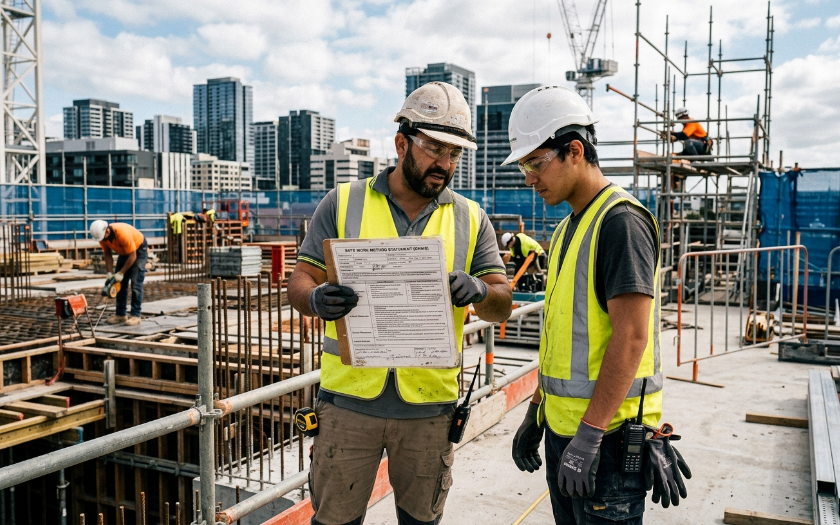
Construction work can expose workers and others to serious hazards. Falls from height, structural collapse, excavation work, asbestos, energised electrical services, confined spaces and mobile plant are just some of the risks that may arise on Australian construction sites.
When construction work falls within the definition of high-risk construction work (HRCW) under applicable work health and safety requirements, a Safe Work Method Statement (SWMS) is an important—and in relevant jurisdictions, legally required—part of planning that work.
But a SWMS should not simply be paperwork prepared to satisfy a site-entry requirement.
When properly developed and implemented, it is a practical safety planning document that identifies the high-risk construction work, relevant hazards and risks, the control measures that will be used, and how those controls will be implemented, monitored and reviewed.
For builders, contractors, subcontractors, project managers, site supervisors and WHS professionals, understanding how SWMS work is therefore an important part of managing construction safety.
This guide explains Safe Work Method Statements in Australia, including when a SWMS is required, what it should contain, who is responsible, common SWMS mistakes and practical steps for improving SWMS quality on construction sites.
What Is a Safe Work Method Statement (SWMS)?
 A Safe Work Method Statement, commonly called a SWMS, is a document used for high-risk construction work.
Under the model Work Health and Safety Regulations, a PCBU carrying out high-risk construction work must ensure that a SWMS has been prepared before that work commences.
The SWMS must:
-
Identify the work that is high-risk construction work
-
Specify hazards relating to that work and the associated health and safety risks
-
Describe the measures that will be implemented to control those risks
-
Explain how the control measures will be implemented, monitored and reviewed
The document must also take relevant workplace circumstances into account and be expressed in a way that is readily accessible and understandable to the people who need to use it.
A SWMS therefore answers four fundamental questions:
What high-risk work are we doing?
What could go wrong?
How will we control those risks?
How will we make sure those controls remain effective?
That is the practical purpose of a SWMS.
When Is a SWMS Required in Australia?
A SWMS is required under the model WHS framework for high-risk construction work.
This distinction matters.
Not every construction task automatically requires a SWMS simply because construction work involves hazards.
Instead, the requirement is linked specifically to work that meets the definition of high-risk construction work.
Safe Work Australia provides guidance explaining the categories of construction work considered high risk.
Examples include construction work that:
-
Involves a risk of a person falling more than 2 metres
-
Is carried out on a telecommunications tower
-
Involves demolition of a load-bearing structural element
-
Involves demolition affecting the physical integrity of a structure
-
Involves or is likely to involve disturbing asbestos
-
Involves structural alteration or repair requiring temporary support to prevent collapse
-
Is carried out in or near a confined space
-
Is carried out in or near a shaft or trench deeper than 1.5 metres or a tunnel
-
Involves the use of explosives
-
Is carried out on or near pressurised gas mains or piping
-
Is carried out on or near chemical, fuel or refrigerant lines
-
Is carried out on or near energised electrical installations or services
-
Is carried out in an area that may have a contaminated or flammable atmosphere
-
Involves tilt-up or precast concrete
Other categories of high-risk construction work also exist.
Before relying on any general list, businesses should check the requirements applying in their jurisdiction and to their specific activity.
Why Are Safe Work Method Statements Important?
A good SWMS has two connected purposes.
The first is compliance.
Where a SWMS is required, the relevant duty holder needs to ensure it is prepared before high-risk construction work begins.
The second—and more important operational purpose—is risk control.
A useful SWMS encourages the people planning and performing the work to think carefully about:
-
The actual work sequence
-
Site conditions
-
Hazards
-
Interfaces with other workers and trades
-
Plant and equipment
-
Electrical services
-
Access and egress
-
Falls
-
Structural stability
-
Emergency arrangements
-
Control measures
This process can identify problems before workers are exposed to them.
A well-designed SWMS therefore functions as a practical planning and communication tool, not merely a compliance form.
Who Is Responsible for Preparing a SWMS?
Under the model WHS Regulations, a person conducting a business or undertaking (PCBU) whose business or undertaking includes carrying out high-risk construction work must ensure that a SWMS for the proposed work is prepared, or has already been prepared, before that work commences.
In practice, preparation may involve people such as:
-
Contractors
-
Subcontractors
-
Builders
-
Project managers
-
Site supervisors
-
WHS professionals
-
Workers with relevant practical experience
The person preparing the document needs enough knowledge of the proposed work and workplace conditions to identify meaningful hazards and controls.
Worker involvement is particularly valuable.
Workers performing the task often understand practical issues that may not be obvious from plans or office-based assessments.
The aim should be to produce a SWMS that reflects how the work will actually be carried out.
What Must a SWMS Include?
Under the model WHS Regulations, a SWMS must address four core areas.
1. Identify the High-Risk Construction Work
The SWMS should clearly identify the high-risk construction activity being undertaken.
Avoid vague descriptions.
For example:
Too vague:
“Working on site.”
More useful:
“Installation of roof sheeting where workers may be exposed to a fall greater than two metres.”
Specific descriptions help workers understand exactly which work the SWMS applies to.
2. Identify Hazards and Associated Risks
The SWMS should identify hazards relating to the high-risk construction work and the health and safety risks associated with them.
Depending on the task, hazards might include:
-
Unprotected edges
-
Open excavations
-
Overhead powerlines
-
Underground services
-
Moving plant
-
Structural instability
-
Falling objects
-
Hazardous atmospheres
-
Asbestos
-
Energised electrical equipment
-
Confined spaces
Hazard identification should reflect actual site conditions rather than generic assumptions.
3. Describe the Risk Control Measures
The SWMS needs to explain the measures that will be implemented to control identified risks.
Controls should be practical and sufficiently specific.
For example, writing:
“Use appropriate fall protection.”
may provide workers with little practical direction.
A stronger SWMS would specify what fall prevention or protection system will be used, where it will be installed and how it relates to the particular task.
The objective is clarity.
A worker reading the SWMS should be able to understand the controls expected during the work.
4. Explain How Controls Will Be Implemented, Monitored and Reviewed
A SWMS is not complete simply because control measures have been listed.
It must also describe how those controls will be:
-
Implemented
-
Monitored
-
Reviewed
This is essential because site conditions can change.
Equipment moves.
Weather changes.
New contractors arrive.
Excavations develop.
Access routes change.
Different stages of construction introduce new hazards.
The SWMS therefore needs to operate as a live safety document connected to actual work.
Keep the SWMS Practical and Understandable
More pages do not automatically create a better SWMS.
Safe Work Australia advises that a SWMS should focus on the specific hazards associated with the high-risk construction work and the controls needed to perform that work safely.
Overly long or unnecessarily detailed documents can become difficult to understand, implement, monitor and review.
This is an important point.
A 40-page generic SWMS that workers cannot easily interpret may be far less useful than a concise document clearly describing:
Task → Hazard → Risk → Control → Responsibility
Clarity should be prioritised over unnecessary complexity.
Site-Specific SWMS vs Generic SWMS
Generic SWMS templates are widely used in construction.
Templates can be useful starting points.
The problem arises when a generic document is copied from one project to another without considering the actual workplace.
Different sites can involve different:
-
Access arrangements
-
Ground conditions
-
Plant
-
Electrical services
-
Structures
-
Traffic movements
-
Weather exposure
-
Contractors
-
Work sequences
-
Public interfaces
A SWMS therefore needs to account for the circumstances of the workplace where the high-risk construction work will actually occur.
For example, a generic excavation SWMS might mention underground services.
But the site-specific planning process should consider:
-
Which services are actually present
-
Where they are located
-
How their location has been verified
-
What excavation method will be used
-
What exclusion zones or controls are required
The document becomes useful when it reflects reality.
Can One SWMS Cover Multiple High-Risk Activities?
Construction tasks sometimes involve more than one category of high-risk construction work.
For example, a single activity could involve:
-
Working at height
-
Operating near energised services
-
Structural alteration
Whether these activities are addressed in one SWMS or separate documents should depend on whether the chosen approach allows the work, hazards and controls to be communicated clearly and effectively.
The priority is not the number of documents.
It is whether the SWMS adequately addresses the relevant high-risk work and can be understood and followed by workers.
SWMS and the Hierarchy of Controls
A SWMS should not simply identify hazards.
The central question is how risks will be controlled.
The hierarchy of controls provides an important framework for choosing risk controls.
In broad terms, higher-order controls are generally preferred over controls that rely heavily on individual behaviour.
The hierarchy typically considers:
Elimination
Can the hazard be removed entirely?
Substitution
Can a safer method, material or process be used?
Isolation
Can people be separated from the hazard?
Engineering Controls
Can physical systems or design measures reduce exposure?
Administrative Controls
Can procedures, scheduling, signage or supervision reduce risk?
Personal Protective Equipment
What PPE is required for remaining risk?
Construction risk management should consider the most effective controls reasonably available rather than defaulting immediately to administrative instructions or PPE.
Example: Applying SWMS Thinking to Working at Height
Consider a roofing activity where workers may fall more than two metres.
A weak SWMS might say:
Hazard: Falling from roof
Control: Wear PPE and be careful
This provides little useful information.
A more effective planning process would consider:
-
How workers access the roof
-
Whether edge protection can be installed
-
Whether scaffolding is required
-
Whether openings or penetrations exist
-
Whether fragile roofing materials are present
-
How materials will be moved
-
Whether fall-restraint or fall-arrest systems are required
-
What training and competency workers need
-
Weather conditions
-
Rescue arrangements where applicable
-
Who will verify controls before work begins
This demonstrates the difference between simply filling in a template and actually planning high-risk construction work.
Worker Consultation and SWMS
Workers should understand the SWMS that applies to their work.
This is difficult to achieve when workers are simply asked to sign a document they have not meaningfully discussed.
Effective consultation can help determine whether proposed controls will work in practice.
Workers may identify issues such as:
-
Equipment that cannot be positioned as planned
-
Access limitations
-
Conflicts with another trade
-
Changes in site conditions
-
Inadequate exclusion zones
-
Unexpected services
-
Unsafe sequencing
A pre-start discussion or toolbox meeting can provide an opportunity to review the relevant SWMS and ensure the work team understands the controls.
Signing a SWMS should never replace understanding it.
Implementing a SWMS on Site
Preparing a SWMS is only the beginning.
Under the model WHS Regulations, arrangements must be in place to ensure the high-risk construction work is carried out in accordance with the SWMS.
If the work is not being carried out in accordance with the SWMS, the model Regulations require the work to be stopped immediately—or as soon as it is safe to do so—and resumed only in accordance with the SWMS.
This requirement reinforces an important principle:
The SWMS needs to match the work, and the work needs to follow the SWMS.
Supervisors should therefore monitor actual site practices.
If workers need to depart from the planned method because circumstances have changed, the response should not simply be to ignore the SWMS.
The risks and controls need to be reconsidered.
When Should a SWMS Be Reviewed?
Construction sites change constantly.
A SWMS may need to be reviewed and revised when circumstances indicate that existing controls are no longer appropriate.
Examples might include:
-
The work method changes
-
New plant is introduced
-
Site conditions change
-
New hazards are identified
-
Existing controls are found to be ineffective
-
Work sequencing changes
-
An incident or near miss reveals a weakness
-
Other trades affect the work area
-
Relevant risk controls are revised
Under the model WHS Regulations, a SWMS must be reviewed and, where necessary, revised when relevant control measures are revised.
Workers affected by changes should also understand the revised controls before work continues.
SWMS Record-Keeping Requirements
SWMS documents also have record-keeping requirements.
Under the model WHS Regulations, the relevant PCBU must generally keep a copy of the SWMS until the high-risk construction work to which it relates is completed.
If a notifiable incident occurs in connection with the high-risk construction work, the SWMS must be retained for at least two years after the incident.
Businesses should therefore have an effective document-control process.
This may include:
-
Document titles
-
Project details
-
Version numbers
-
Revision dates
-
Responsible persons
-
Approval records
-
Worker communication records
-
Archived versions
Digital systems can make document control easier, but the SWMS still needs to remain accessible to the people who need it.
Principal Contractors and SWMS
Principal contractors also have important responsibilities on construction projects.
Under the model WHS Regulations, the principal contractor must take all reasonable steps to obtain a copy of the SWMS relating to high-risk construction work before that work begins.
This makes contractor coordination important.
A principal contractor may need visibility over:
-
Which contractors are undertaking HRCW
-
Whether SWMS have been prepared
-
Whether the documents reflect site conditions
-
Whether different contractors' activities create new interface risks
-
Whether site arrangements are consistent with the controls described
For example, one contractor's exclusion zone may conflict with another contractor's access route.
Managing these interfaces requires communication between parties.
SWMS vs JSA: What's the Difference?
A common question in Australian construction is:
Is a SWMS the same as a Job Safety Analysis (JSA)?
Not necessarily.
A JSA, Job Hazard Analysis or similar document may be used as a general workplace risk-management tool.
A SWMS has a specific role under WHS legislation for high-risk construction work.
Calling a document a “JSA” does not remove the SWMS requirements where high-risk construction work is involved.
Similarly, simply putting “SWMS” at the top of a generic risk assessment does not automatically make the document adequate.
The content and implementation need to meet the applicable requirements.
SWMS vs Risk Assessment
A risk assessment and SWMS are also related but not identical concepts.
A risk assessment generally involves identifying hazards and considering the risks associated with them.
A SWMS goes further in the high-risk construction context by documenting:
-
The relevant HRCW
-
Hazards and associated risks
-
Control measures
-
How controls will be implemented
-
How controls will be monitored
-
How controls will be reviewed
Risk assessment therefore supports SWMS development, but the SWMS has its own specific function.
Common SWMS Mistakes on Construction Sites
Many SWMS problems arise not because a document is completely absent, but because the document does not accurately represent the work.
1. Copying a Generic SWMS Without Reviewing It
A document prepared for another site may contain irrelevant hazards while missing critical site-specific risks.
Better approach: Use templates as a starting point and review them against the actual work environment.
2. Using Vague Control Measures
Statements such as:
-
“Take care”
-
“Use PPE”
-
“Follow procedures”
-
“Work safely”
provide limited practical direction.
Better approach: Describe specific controls that workers can understand and supervisors can verify.
3. Preparing the SWMS Without Worker Input
Office-based preparation can miss practical hazards.
Better approach: Involve people who understand the work and site conditions.
4. Treating the SWMS as a Signature Exercise
A worker's signature does not automatically demonstrate that the worker understands the hazards and controls.
Better approach: Discuss relevant controls and verify understanding.
5. Failing to Update the SWMS
A SWMS can become outdated when site conditions change.
Better approach: Establish clear triggers for review and revision.
6. Including Too Much Irrelevant Information
Overly complicated SWMS documents can make important information difficult to find.
Safe Work Australia advises that SWMS should be short and focused on the specific HRCW hazards and controls.
Better approach: Keep the document relevant, clear and usable.
7. Listing PPE as the Main Control for Every Hazard
PPE is important, but it is generally lower in the hierarchy of controls.
Better approach: Consider whether higher-order controls can eliminate or reduce the risk first.
How to Prepare an Effective SWMS: Step-by-Step
A practical SWMS development process can follow these stages.
Step 1: Define the Scope of Work
Describe exactly what work will be undertaken.
Consider:
-
Location
-
Task
-
Equipment
-
Work sequence
-
People involved
Step 2: Determine Whether the Work Is HRCW
Compare the proposed work with the applicable high-risk construction work categories.
If one or more categories apply, ensure the SWMS requirements are addressed before work begins.
Step 3: Break the Work Into Logical Steps
Understanding the sequence makes hazards easier to identify.
For example:
Delivery → Set-up → Access → Installation → Inspection → Pack-down
Step 4: Identify Hazards and Risks
Consider what could cause harm during each relevant stage.
Look at:
-
People
-
Plant
-
Structures
-
Services
-
Environment
-
Other trades
-
Public access
-
Changing conditions
Step 5: Select Effective Controls
Use risk-management principles and the hierarchy of controls to identify appropriate measures.
Controls should be practical and relevant to the actual site.
Step 6: Assign Responsibilities
Where useful, identify who is responsible for implementing or verifying critical controls.
This may include:
-
Supervisor
-
Site manager
-
Plant operator
-
Competent person
-
Worker
-
Contractor
Step 7: Consult Workers
Discuss the proposed work method and controls with the people who will perform the work.
Use their practical experience to identify gaps.
Step 8: Communicate Before Work Begins
Make sure relevant workers can access and understand the SWMS.
A pre-start meeting can be useful for confirming:
-
Work sequence
-
Hazards
-
Controls
-
Responsibilities
-
Stop-work triggers
Step 9: Monitor the Work
Supervisors should verify that work is actually being performed according to the SWMS.
A document that is ignored on site provides little safety value.
Step 10: Review When Conditions Change
If the work or control measures change, review the SWMS and revise it where necessary.
Communicate revisions before affected work continues.
SWMS Checklist for Australian Construction Businesses
Before high-risk construction work starts, consider asking:
-
Have we identified whether the task involves HRCW?
-
Has a SWMS been prepared where required?
-
Does the SWMS clearly identify the high-risk work?
-
Are the relevant hazards and risks documented?
-
Are the controls specific and practical?
-
Have we considered the hierarchy of controls?
-
Does the SWMS reflect the actual site?
-
Have relevant workers been consulted?
-
Can workers easily understand the document?
-
Are responsibilities clear?
-
Are controls in place before work begins?
-
Is the work being monitored against the SWMS?
-
Do workers know what to do if conditions change?
-
Is there a process for reviewing and revising the SWMS?
-
Is the current version accessible on site?
-
Are appropriate records being retained?
If several answers are “no”, the SWMS process may need improvement before the high-risk work proceeds.
Why SWMS Training Matters
 Knowing that a SWMS is required is different from knowing how to develop and use one effectively.
Construction professionals responsible for planning or supervising high-risk work need to understand how legal requirements connect with practical site safety.
Effective SWMS training can help build understanding of:
-
Australian SWMS requirements
-
High-risk construction work
-
Hazard identification
-
Risk assessment
-
Hierarchy of controls
-
Site-specific risk management
-
PCBU and contractor responsibilities
-
Worker consultation
-
SWMS implementation
-
Monitoring and review
-
Document control
This is particularly relevant for people responsible for preparing, reviewing, approving, communicating or implementing SWMS.
Who Can Benefit From SWMS Training?
SWMS knowledge can be valuable for a wide range of people working in Australian construction, including:
-
Construction workers
-
Site supervisors
-
Project managers
-
Construction managers
-
Principal contractors
-
Subcontractors
-
Builders
-
Tradespeople
-
WHS officers
-
Safety advisors
-
Health and safety representatives
-
Compliance professionals
-
Construction business owners
The depth of responsibility will vary between roles, but understanding how SWMS operate can support better safety communication and risk management.
Build Practical SWMS Knowledge for High-Risk Construction Work
A SWMS should help people plan high-risk construction work safely—not simply satisfy a paperwork requirement.
Australian Compliance Training's Safe Work Method Statements for High-Risk Construction Work course provides practical online training focused on Australian construction safety and SWMS requirements.
The course covers areas including:
-
Australian WHS and OHS requirements for SWMS
-
High-risk construction work categories
-
PCBU, principal contractor and worker responsibilities
-
Hazard identification and risk assessment
-
Applying the hierarchy of controls
-
Preparing site-specific and task-specific SWMS
-
Worker consultation and communication
-
Pre-start briefings
-
Supervising and verifying controls
-
SWMS review and document management
-
Auditing SWMS quality and workplace compliance
Strengthen Your SWMS Capability — Enrol Today
Enrol in Safe Work Method Statements for High-Risk Construction Work
100% Online | Self-Paced | Assessments Included | Digital Certificate
There are no formal prerequisites required to complete the course.
Upon successful completion and final assessment, learners receive a Digital Certificate from Australian Compliance Training.
Develop practical knowledge to prepare, review and implement stronger SWMS and support safer high-risk construction work.
Final Thoughts
Safe Work Method Statements are an important part of managing high-risk construction work in Australia.
Under the model WHS Regulations, a PCBU carrying out high-risk construction work must ensure a SWMS is prepared before the work starts. The document must identify the high-risk work, relevant hazards and risks, control measures, and how those controls will be implemented, monitored and reviewed.
But compliance should not be reduced to producing another document.
An effective SWMS needs to reflect the actual work.
It should be clear enough for workers to understand, specific enough for supervisors to verify and flexible enough to be reviewed when conditions or controls change.
Construction businesses can strengthen their SWMS processes by identifying HRCW correctly, consulting workers, applying the hierarchy of controls, avoiding generic documents, monitoring implementation and reviewing SWMS when circumstances change.
The objective is straightforward:
Plan the work. Understand the hazards. Control the risks. Make sure the agreed controls are actually used.
That is what turns a SWMS from paperwork into a practical construction safety tool.


