
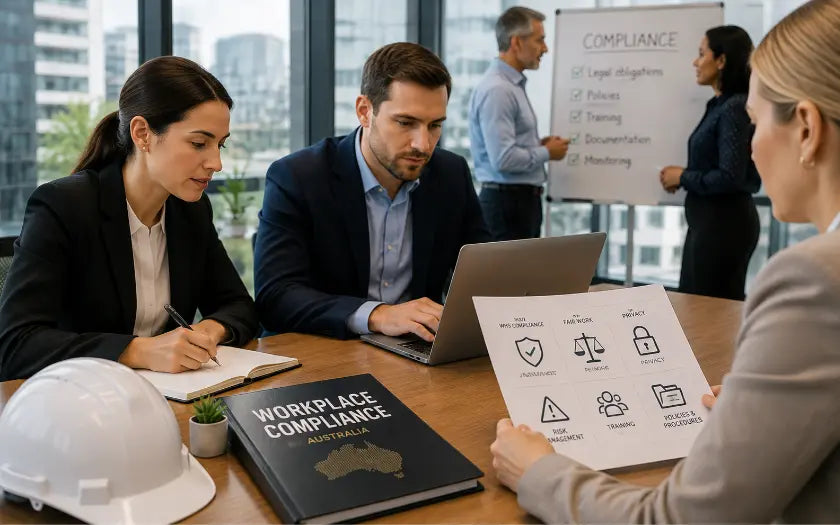
Compliance doesn't announce itself before something goes wrong. It lives in daily decisions — how a manager responds to a complaint, how a team handles customer data, how a supervisor reacts when someone raises a safety concern. In Australian workplaces, 2026 has brought sharper regulatory edges to all three of these areas: work health and safety, privacy, and anti-harassment obligations.
This guide is for managers, HR professionals, business owners, and employees who want to understand what best practice looks like right now — not in theory, but in the real world of Australian workplaces.
Why 2026 Is a Pivotal Year for Workplace Compliance in Australia
 Three forces are reshaping how Australian organisations approach compliance simultaneously.
First, regulators are more active. Safe Work Australia, the Office of the Australian Information Commissioner (OAIC), and the Fair Work Commission are all operating with expanded mandates and, in some cases, stronger enforcement tools than they held even two years ago.
Second, expectations have shifted. Employees — particularly younger workers — have a clearer understanding of their rights and a lower tolerance for workplaces that treat compliance as a minimum standard rather than a cultural value. Organisations that approach it differently are finding they struggle to attract and retain good people.
Third, the nature of work itself has changed. Hybrid and remote arrangements, AI-assisted workflows, and gig-based employment relationships have created compliance grey areas that employers are only beginning to properly navigate.
Understanding what's required across WHS, privacy, and anti-harassment isn't just a legal obligation in 2026. It's a competitive advantage.
Part One: Work Health and Safety (WHS) in 2026
The Shift From Physical to Psychosocial Safety
For decades, WHS in Australia was primarily understood as a physical matter — preventing slips, falls, equipment injuries, and chemical exposures. That understanding hasn't disappeared, but it has been significantly expanded.
Safe Work Australia's model code of practice on managing psychosocial hazards placed a formal obligation on employers to treat psychological risks with the same seriousness as physical ones. In practical terms, this means that workloads, interpersonal conflict, role ambiguity, poor management support, and workplace isolation are now legitimate hazards that must be identified, assessed, and managed.
A retail manager in Adelaide discovered this the hard way. After months of roster instability — where staff never knew their hours until days before — the team's performance deteriorated, two employees resigned citing burnout, and a third raised a formal WHS complaint. What the manager had treated as a logistics problem turned out to have a compliance dimension that nobody had mapped.
That scenario plays out in some form across Australian workplaces every week.
What WHS Compliance Actually Requires in 2026
The obligation isn't to eliminate all risk — it's to manage risk so far as is reasonably practicable. That phrase carries legal weight and has been tested in courts and tribunals across Australia.
Meeting that standard in 2026 means having documented risk assessments for both physical and psychosocial hazards, genuine consultation processes with workers, clear incident reporting channels, and regular review of control measures. Training isn't optional — it's part of the due diligence record that regulators look at when investigating whether a workplace met its duty of care.
Construction, Healthcare, and High-Risk Environments
Some industries carry heavier WHS obligations than others. Construction sites in Australia require General Construction Induction (White Card) certification before workers can set foot on a live site. Healthcare environments must manage infection risks, manual handling injuries, and — increasingly — the psychological load carried by clinical and care staff.
Asbestos remains a live issue in Australian construction and remediation work. Buildings constructed before the 1990s may contain asbestos-containing materials, and workers who encounter them without proper training and controls are at serious long-term risk. Asbestos awareness training isn't bureaucratic box-ticking — it's the kind of education that protects lives.
Practical WHS Tips for 2026
The most effective WHS programs in Australian workplaces share a few traits: leadership takes it seriously at every level, not just when an audit is coming; workers feel genuinely safe raising concerns without fear of consequences; and training is kept current as the regulatory landscape evolves.
Organisations that review their WHS documentation once a year and leave it sitting in a drawer until something happens are not managing risk — they're creating the illusion of it.
Part Two: Privacy Compliance in Australian Workplaces
 The Privacy Act Is Changing — And Most Businesses Aren't Ready
The Privacy Act 1988 has been through more scrutiny in recent years than at any point since its introduction. The Attorney-General's Department's review process has driven proposals that would, among other things, introduce a direct right for individuals to take action for serious privacy breaches, expand the definition of personal information, and tighten consent requirements for data collection.
While not all proposed reforms have been legislated at the time of writing, the direction is unambiguous: Australian privacy obligations are becoming more demanding, and organisations that built their practices around the minimum requirements of a decade ago are increasingly exposed.
What Australian Privacy Principles Mean for Everyday Employees
The Australian Privacy Principles (APPs) sit at the heart of the Privacy Act and govern how organisations — including private sector businesses with annual turnover above the threshold, and all government agencies — collect, use, store, and disclose personal information.
Employees across functions handle personal data without always realising the compliance implications. A marketing coordinator sending a list of customer email addresses to a third-party platform, an HR assistant emailing payroll details to the wrong recipient, a manager keeping handwritten notes about an employee's medical condition in an unsecured desk drawer — these aren't hypothetical situations. They're the kinds of incidents that trigger Notifiable Data Breach assessments and, in serious cases, OAIC investigations.
AI, Automation, and the Privacy Challenge
The rise of AI tools in Australian workplaces has introduced privacy complications that many organisations are still untangling. Using AI to analyse customer behaviour, screen job applications, or generate personalised communications raises real questions about consent, transparency, and secondary use of data.
The OAIC has been clear that existing Privacy Act obligations apply to AI-assisted processes. An organisation can't bypass its data handling responsibilities simply by routing a decision through an algorithm. Employees and managers who use AI tools need to understand this — and privacy training in 2026 needs to address it directly.
Building a Privacy-Aware Culture
Technical controls — access permissions, encryption, secure storage — are necessary but insufficient on their own. The organisations that handle privacy well are those where employees genuinely understand why it matters.
A GP practice in Victoria once had a reception staff member share a patient's appointment details with a family member who called claiming to be collecting the patient. No system flag stopped it. No policy was breached on paper — but a privacy principle was. What was missing was the judgment that comes from real privacy education, not just a signed acknowledgment policy.
Awareness training, regular refreshers, and clear escalation pathways for potential breaches are the practical building blocks of a privacy-compliant workplace culture.
Part Three: Anti-Harassment and Workplace Conduct
 The Positive Duty Has Changed Everything
The most significant shift in Australian workplace anti-harassment law in recent years has been the introduction of the positive duty under the Sex Discrimination Act 1984, as reinforced by the Australian Human Rights Commission's enforcement powers. This isn't simply a prohibition on harassment — it's an active obligation for employers to take reasonable and proportionate measures to prevent it from occurring in the first place.
This is a fundamental change in how compliance works in this space. Previously, organisations could demonstrate compliance largely through having a policy and responding appropriately to complaints. Now, prevention is itself the obligation. The question regulators and courts ask is no longer just "what did you do when it happened?" but "what did you do to stop it happening?"
What Sexual Harassment and Bullying Compliance Looks Like Practically
An organisation can have the most beautifully written harassment policy in the country and still have a toxic culture. Policies don't protect people — behaviours and systems do.
Effective anti-harassment compliance in 2026 means training that goes beyond definitions. Employees need to understand what bystander responsibility looks like — when and how to intervene or report. Managers need to understand how to respond to a disclosure in a way that's supportive, procedurally correct, and doesn't inadvertently cause further harm. Senior leaders need to model the conduct standard they expect from others, consistently and visibly.
The Fair Work Commission also has expanded jurisdiction over serious misconduct matters, and workplace investigators are increasingly called in to handle formal complaints. Having trained people who understand the process — and having records that demonstrate training occurred — matters enormously when a complaint reaches a formal stage.
Recognising the Spectrum of Workplace Misconduct
Harassment and bullying exist on a spectrum. At one end are the obvious, egregious acts that almost everyone recognises. At the other are the low-level, persistent behaviours that erode a person's sense of safety and belonging over time — repeated exclusion from meetings, belittling comments dressed up as humour, micromanagement designed to undermine confidence.
The challenge for managers is that many of the more subtle behaviours don't feel like misconduct to the person engaging in them. This is exactly why training that uses realistic workplace scenarios — not abstract definitions — makes a practical difference.
Diversity, Equity and Inclusion as a Compliance Foundation
Anti-discrimination obligations under Australian law extend well beyond gender. Race, age, disability, religion, sexual orientation, and other protected attributes all carry legal protection. In 2026, DEI training isn't just about values — it's directly connected to legal risk management.
An organisation whose hiring process consistently produces outcomes that disadvantage candidates from particular backgrounds, even without explicit intent, may be creating indirect discrimination exposure. Managers who understand what that looks like — and what to do about it — are genuinely reducing compliance risk, not just being progressive.
The Compliance Culture Problem — and How to Fix It
A workplace can be technically compliant on paper and culturally non-compliant in practice. Anyone who has worked in a large organisation has probably seen this. The WHS manual exists but the real message from management is "don't slow down the project." The harassment policy exists but the real message is "don't create drama."
Genuine compliance culture requires three things: leadership behaviour that matches stated values, systems that make doing the right thing easy and doing the wrong thing visible, and training that builds real capability rather than just documentation.
The cost of getting this wrong in 2026 is higher than ever. Regulatory fines, civil claims, reputational damage in the era of social media, and the loss of good people who simply won't tolerate the environment — these are the real-world consequences of treating compliance as a formality.
A Practical 2026 Compliance Checklist for Australian Workplaces
There is no single universal checklist that applies to every Australian workplace — the right obligations depend on industry, size, and the specific nature of operations. However, any organisation seeking to build genuine compliance confidence in 2026 should be asking itself these questions across each domain.
On WHS: Are psychosocial hazards formally included in risk management processes? Is training documented and current? Do workers have a genuine mechanism to raise safety concerns?
On Privacy: Is the organisation's data handling practice aligned with the current Australian Privacy Principles? Does privacy training address AI tools and third-party data sharing? Is there a tested Notifiable Data Breach response plan in place?
On Anti-Harassment: Has the organisation taken positive steps — not just reactive steps — to prevent harassment and discrimination? Are managers trained to receive disclosures appropriately? Is the complaints process genuinely accessible and trusted?
If any of those questions produce hesitation, that's where the work begins.
Where Training Fits Into All of This
Compliance training is not the whole answer. But it is a critical part of it.
Employees who understand their obligations behave differently. Managers who've worked through realistic scenarios make better decisions under pressure. Organisations that invest in proper, Australian-law-specific training build the kind of documented record that matters when regulators ask questions.
The Australian Compliance Institute offers CPD-accredited online training across all three domains covered in this guide — WHS, privacy, and workplace conduct — with courses designed specifically for Australian legislative frameworks, not adapted from overseas content. Whether you're a sole trader ensuring basic compliance, a HR team building out a training calendar, or a compliance professional maintaining professional development, their course library is a practical starting point.


