
Published: March 2026 | Category: Workplace Health & Safety | Region: Australia
Walk through any busy Australian warehouse, construction site, aged care facility, or retail stockroom, and you will quickly notice one thing: people are constantly moving things. Boxes, equipment, patients, trolleys — the physical demands of work are everywhere. And yet, manual handling injuries remain one of the most persistent and costly workplace health problems across the country.
 In 2026, the conversation around manual handling has shifted. It is no longer just about lifting correctly. It is about building a genuine safety culture — one where workers understand their bodies, know their rights, and feel empowered to work safely every single day.
What Is Manual Handling, Really?
Many people assume manual handling simply means lifting heavy boxes. In reality, it covers a much broader range of physical tasks.
Under Australia’s model Work Health and Safety (WHS) legislation — which has been adopted across most states and territories — manual handling includes any activity that requires a person to use their body to lift, lower, push, pull, carry, hold, or restrain an object, person, or animal. It also includes repetitive tasks and awkward sustained postures that place ongoing strain on the body.
This definition matters, because it means a nurse repositioning a patient, a retail worker stocking shelves at floor level, and a tradesperson carrying tools up a ladder are all performing manual handling tasks — and all deserve proper training.
The Real Cost of Getting It Wrong
Musculoskeletal disorders (MSDs) — the injuries that typically result from poor manual handling practices — consistently rank among the leading causes of workplace compensation claims in Australia. According to Safe Work Australia’s reporting, musculoskeletal conditions account for a significant share of serious workers’ compensation claims year on year, with the back, shoulders, and knees being the most commonly affected areas.
Beyond the human toll, the financial impact is substantial. Compensation payouts, reduced productivity, staff absences, and the cost of hiring and training replacement workers all add up quickly. Many businesses underestimate this until an injury actually occurs on their watch.
The construction, transport and warehousing, agriculture, and health care sectors consistently report the highest rates of manual handling-related injuries. But no industry is immune.
Why 2026 Makes Training More Important Than Ever
The Australian workplace has changed considerably in recent years, and those changes have created new manual handling challenges.
The growth of e-commerce has dramatically increased physical workloads in warehousing and logistics. Workers in fulfilment centres are often completing thousands of repetitive movements per shift, with little variation in posture or technique. Without structured training, fatigue and cumulative strain injuries develop gradually — often before anyone notices something is wrong.
 At the same time, Australia’s ageing workforce means more workers are managing pre-existing conditions or recovering from past injuries. Effective training needs to account for these realities, not ignore them.
Technology has also changed the picture. While automation is reducing some manual tasks, workers now interact with new equipment — pallet movers, height-adjustable workstations, exoskeletons in some industries — that requires its own set of safe operating habits.
The Regulatory Landscape in 2026
Australia’s WHS framework places a clear duty of care on persons conducting a business or undertaking (PCBUs) to eliminate or minimise manual handling risks, as far as is reasonably practicable. This is not optional.
Safe Work Australia’s Code of Practice for Hazardous Manual Tasks provides detailed guidance on how employers should approach risk identification, assessment, and control. Regulators in each state — including WorkSafe Victoria, SafeWork NSW, WorkCover Queensland, and their counterparts — are actively enforcing compliance and can issue improvement notices, prohibition notices, or significant fines where training obligations have been neglected.
What Good Manual Handling Training Actually Looks Like
Not all training is created equal. A brief induction video ticked off during onboarding is not enough — and experienced WHS professionals will tell you the same.
Effective manual handling training in 2026 should include task-specific content tailored to the actual physical demands of the role. A warehouse picker’s training looks different from a residential aged care worker’s training, which looks different again from a carpenter’s.
It should be interactive and practical, not just theoretical. Workers need to physically practise correct techniques in realistic conditions — not just watch a demonstration on a screen.
It also needs to be refreshed regularly. The body and the workplace both change over time. A one-off training session from three years ago does not account for new equipment, changed workflows, or a worker’s current physical condition.
Key Elements to Include
- Practical, evidence-based manual handling training typically covers:
- How to assess a load before lifting — its weight, shape, grip points, and where it needs to go
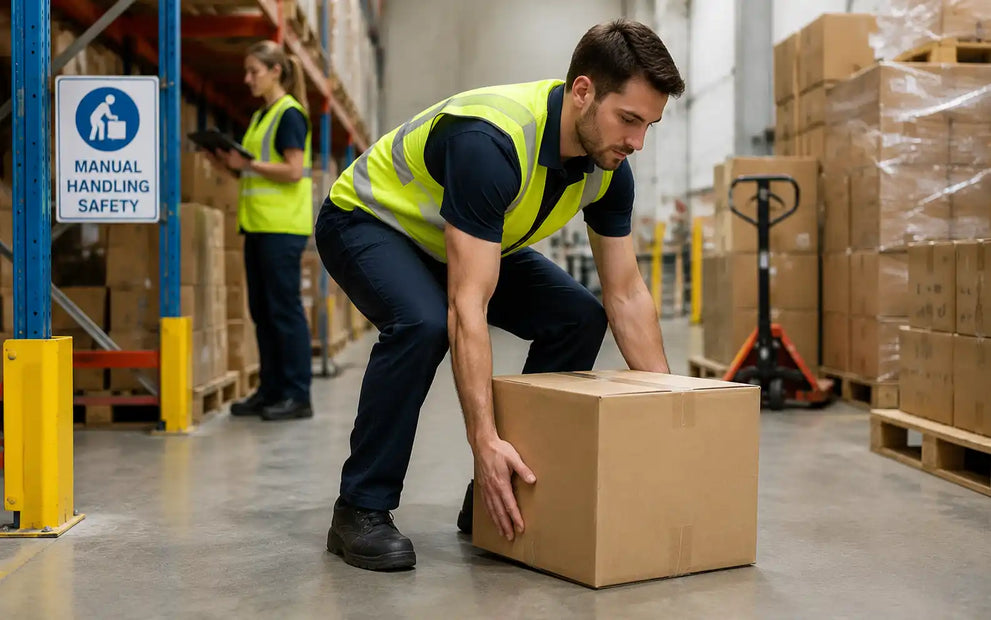
- Safe lifting postures and the importance of keeping loads close to the body
- Team lifting techniques for awkward or heavy items
- How to use mechanical aids correctly, including trolleys, hoists, and pallet jacks
- Recognising early warning signs of strain and knowing when to report discomfortWorkplace-specific hazards and control measures relevant to the role
The Human Side: Why Workers Need to Feel Heard
One thing that separates genuinely effective training from box-ticking compliance is how well it connects with workers on a personal level.
People are far more likely to apply safe manual handling principles when they understand why those principles matter for their own health — not just for their employer’s compliance record. Framing training around protecting the worker’s long-term wellbeing, rather than simply meeting legal obligations, changes the way it lands.
Encouraging workers to speak up about pain, fatigue, or tasks that feel unsafe is equally important. In many workplaces, there is still an unspoken culture of pushing through discomfort. Addressing that culture — through training, supervisory behaviour, and genuine consultation — is where lasting change happens.
A Practical Example: Aged Care
Consider a small residential aged care facility in regional New South Wales. With an ageing resident population and staffing pressures, care workers are regularly assisting residents with transfers, repositioning, and mobility support — all high-risk manual handling tasks.
 A facility that invests in structured training — including the correct use of mechanical lifts, hoist slings, and team-based transfer techniques — will see measurable differences. Staff injuries reduce. Sick days drop. And importantly, residents experience safer, more confident care.
This is not hypothetical. WHS professionals working across the sector consistently report these outcomes when training moves from generic to role-specific and when management actively models safe behaviours.
Making Training Stick: Practical Tips for Employers
Training is only as effective as the environment that supports it. Employers can strengthen the impact of manual handling training by doing a few things consistently.
Conduct regular worksite reviews to spot tasks that have changed since training was last delivered. Involve workers in identifying hazards — they often know exactly where the risks are and what would make a difference. Ensure supervisors reinforce safe practices in the day-to-day, not just during formal training sessions. And document everything: training records, risk assessments, and incident reports form the paper trail that demonstrates due diligence.
The Bottom Line
Manual handling training is not a formality. In 2026, with a more physically diverse workforce, higher physical workloads in many sectors, and a regulatory environment that expects genuine commitment to worker safety, it is one of the most practical investments an Australian business can make.
When it is done well — when it is specific, practical, regularly refreshed, and genuinely supported by leadership — it protects workers, reduces costs, and builds the kind of workplace where people actually want to show up.


