
It looks like nothing. A ceiling tile. A piece of pipe insulation. The underside of a floor. Yet the fibres hidden inside can be lethal — and for decades, Australia used asbestos-containing materials more heavily per capita than almost any other nation on earth. The consequences are still unfolding today.
Asbestos is not a distant industrial history lesson. It is present in an estimated one in three Australian homes built before 1987, in old school buildings, hospitals, factories, and public infrastructure. For tradespeople, renovators, homeowners, and safety professionals, understanding where asbestos hides, what it does to the body, and exactly how to handle it safely is not optional knowledge — it is a professional and legal obligation.
This article draws on the frameworks, standards, and guidance published by Safe Work Australia, the Australian Institute of Occupational Hygienists (AIOH), state and territory regulators, and internationally by the World Health Organization (WHO) and the International Labour Organization (ILO).
What Is Asbestos and Why Was It Used So Widely?
Asbestos is a naturally occurring group of silicate minerals made up of microscopic fibrous crystals. When those fibres are released into the air and inhaled, they lodge permanently in lung tissue, causing damage that may not become apparent for 20 to 40 years.
There are six recognised types of asbestos, but the three most commonly found in Australian buildings are chrysotile (white asbestos), amosite (brown asbestos), and crocidolite (blue asbestos). Of these, crocidolite is widely considered the most dangerous due to the needle-like sharpness of its fibres.
For most of the 20th century, asbestos was celebrated as a near-miracle material. It was heat-resistant, fireproof, chemically inert, cheap, and durable. It was mixed into cement sheets, floor tiles, roof shingles, pipe lagging, plaster compounds, brake pads, and textured paints. Australia finally banned the manufacture, use, and importation of all asbestos products on 31 December 2003. However, by that point, the material was already embedded into tens of millions of tonnes of built fabric across the country.
The Health Hazards: What Asbestos Does to the Human Body
Asbestos-related diseases are serious, progressive, and in most cases irreversible. The body cannot expel asbestos fibres once they are inhaled. Over years or decades, the fibres cause chronic inflammation and scarring, leading to one or more of the following conditions:
|
Disease |
Description |
Latency Period |
|
Mesothelioma |
Aggressive cancer of the lining of lungs, abdomen, or heart. Almost exclusively caused by asbestos exposure. |
20–50 years |
|
Asbestosis |
Chronic lung scarring causing worsening breathlessness. Non-cancerous but severely debilitating. |
10–40 years |
|
Asbestos-related lung cancer |
Malignant lung tumour, distinct from mesothelioma. Risk compounded significantly by smoking. |
15–35 years |
|
Pleural plaques / thickening |
Calcified patches on the pleural lining. A marker of exposure that may impair breathing over time. |
10–30 years |
Australia has one of the highest recorded rates of mesothelioma in the world, a direct legacy of heavy industrial and domestic use. According to reports from the Asbestos Diseases Research Institute (ADRI), hundreds of Australians are still diagnosed with mesothelioma each year — many of whom were not factory workers but tradespeople, school cleaners, and homeowners who disturbed asbestos-containing materials unknowingly.
The WHO and ILO jointly state that there is no safe level of asbestos exposure. Even brief, incidental contact with friable asbestos can carry meaningful risk.

Where Does Asbestos Hide? Common Locations in Australian Buildings
One of the most dangerous misconceptions about asbestos is that it is easy to identify. It is not. Asbestos-containing materials (ACMs) are visually indistinguishable from their non-asbestos counterparts without laboratory testing. This is exactly why Safe Work Australia requires that any material suspected of containing asbestos must be treated as if it does until proven otherwise by accredited testing.
High-Risk Areas in Pre-1987 Australian Homes
- Fibro (fibrous cement) wall sheeting and eaves
- Roofing shingles and corrugated super-six roofing sheets
- Vinyl floor tiles and the backing compound beneath them
- Textured ceiling coatings and Artex-style finishes
- Pipe lagging, hot water system insulation, and flue pipes
- Backing boards behind electrical switchboards and meter boxes
- Internal and external wall cladding, particularly in wet areas
- Mastic sealants used around windows, doors, and expansion joints
The same patterns exist in commercial and institutional buildings of the same era. Schools, hospitals, and public housing built in the 1960s and 1970s represent some of the highest-density ACM environments in Australia, and many of these buildings remain in active use today.
Internationally, countries across Southeast Asia, Africa, and parts of Eastern Europe still use asbestos in construction — meaning imported goods, secondhand machinery, and infrastructure from these regions may also carry risk for Australian businesses operating globally.
Bonded vs Friable Asbestos: Understanding the Risk Difference
Not all asbestos poses the same immediate level of risk. Australian regulations, aligned with the model Work Health and Safety (WHS) laws, distinguish between two main forms.
Bonded asbestos (non-friable) is asbestos tightly bound within a solid matrix — such as a fibro cement sheet. When intact and undisturbed, it generally does not release fibres. The risk arises when it is cut, drilled, sanded, or otherwise disturbed, which is why renovations in older homes carry such serious hazard potential.
Friable asbestos is asbestos in a crumbly, powdery, or loosely bound state — such as pipe lagging, old spray-on fireproofing, or deteriorating insulation. It can release fibres with the slightest touch or air movement, and is treated under Australian law as high-risk material requiring a specialist Class A licensed removalist.
The practical takeaway: a house with intact fibro cladding is not immediately hazardous. The same house being renovated by a tradie with an angle grinder is a very different situation entirely.
The Australian Legal and Regulatory Framework

Australia's regulatory approach to asbestos is among the most comprehensive in the world, operating across a layered system of national and state-level obligations.
Key Regulatory Bodies and Instruments
- Safe Work Australia — develops the national model WHS laws and the Code of Practice for the Management and Control of Asbestos in the Workplace
- Comcare — regulates asbestos in Commonwealth workplaces and provides national guidance
- State and territory WHS regulators (WorkSafe Victoria, SafeWork NSW, WorkSafe Queensland and others) — enforce asbestos laws within their jurisdictions
- The National Strategic Plan for Asbestos Management and Awareness — a whole-of-government framework coordinated by the Asbestos Safety and Eradication Agency (ASEA
- The Asbestos Diseases Research Institute (ADRI) — conducts research into diagnosis, treatment, and prevention
Under Australian law, the removal of more than 10 square metres of non-friable asbestos, or any amount of friable asbestos, must be carried out by a licensed asbestos removalist. Class A licensed removalists are authorised to handle friable asbestos; Class B can handle non-friable only. These licensing requirements reflect the genuine skill, equipment, and procedural knowledge required to do the job safely.
Safe Handling Protocols: A Step-by-Step Overview
When asbestos work must be carried out — whether by a licensed removalist or a qualified competent person undertaking minor work — the following framework reflects accepted industry practice across Australia and aligns with WHO and ILO guidance internationally.
Step 1 — Identify and Assess
Before any work begins in a building of suspect age, arrange for a qualified asbestos assessor or occupational hygienist to conduct an inspection. Bulk samples are sent to a NATA-accredited laboratory for analysis. An Asbestos Register is then created, documenting the type, location, condition, and risk rating of each ACM. For workplaces, maintaining this register is a legal requirement under the model WHS Regulations.
Step 2 — Control the Area
Establish a clearly defined exclusion zone before work commences. Seal off air vents, doorways, and gaps to prevent fibre migration. Display appropriate warning signage. Ensure no unauthorised personnel can enter the work area during removal.
Step 3 — Use the Right Personal Protective Equipment (PPE)
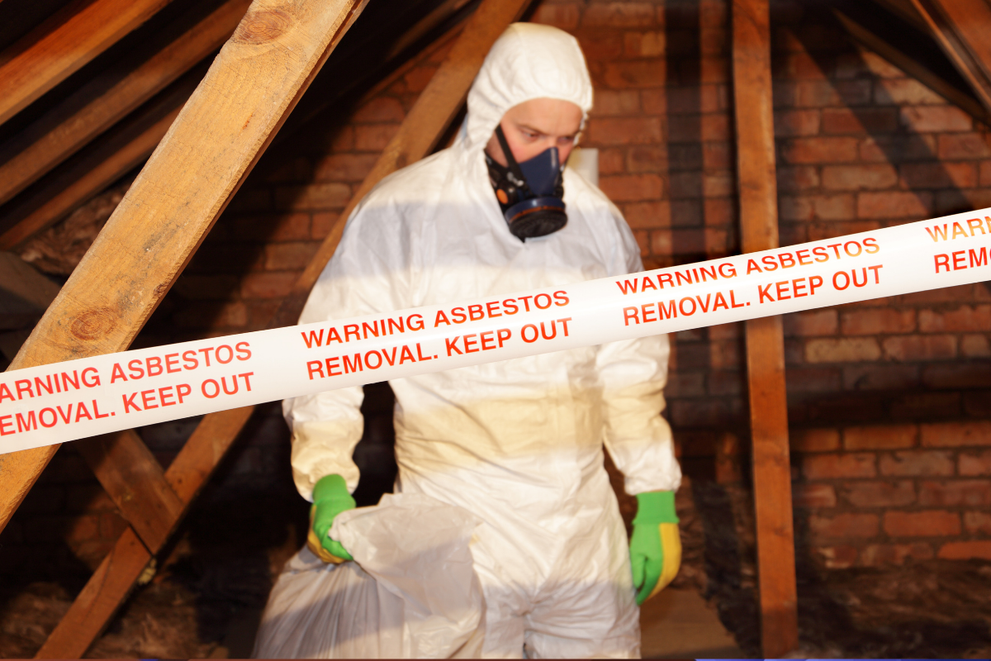
The minimum PPE standard for asbestos work in Australia includes:
- A P2 or P3 half-face respirator — correctly fitted and face-seal checked before each use
- Disposable coveralls (Tyvek-style) with hood — not reusable clothing
- Disposable non-powdered nitrile gloves
- Disposable boot covers or dedicated rubber boots
- Eye protection where there is a risk of fibre contact with eyes
A common and dangerous mistake is the use of a dust mask or surgical mask instead of a rated respirator. These provide essentially no protection against asbestos fibres, which are too fine to be captured by standard filtration.
Step 4 — Wet, Don't Dry
Where the material permits, wetting ACMs with water containing a small amount of liquid detergent significantly reduces fibre release during removal. Never dry-sweep, sand, or use compressed air near asbestos — each method dramatically increases airborne fibre concentrations.
Step 5 — Remove Carefully and Dispose Legally
Remove ACMs as intact sheets or sections wherever possible. All asbestos waste must be double-bagged in heavy-duty polyethylene bags labelled with the correct asbestos warning symbol, then transported to a licensed asbestos waste facility. Illegal dumping of asbestos waste is a serious offence in every Australian state and territory, carrying significant fines. A clearance air monitoring certificate — issued only by an independent hygienist after successful post-removal monitoring — is required before a licensed removal area can be reoccupied.
Real-World Scenarios: Lessons from the Field
Consider a common scenario: a homeowner in a 1970s fibro house decides to do a bathroom renovation. They remove the wall sheeting themselves, wearing a dust mask purchased at the hardware store. Three days later, the rest of the family moves back into the house — which now has invisible asbestos fibres distributed through its ventilation system and on every surface.
This scenario, repeated countless times across Australia each year, is exactly why regulators and industry bodies consistently emphasise one message: if in doubt, do not disturb it, and call a professional.
A more positive outcome: a school undergoing planned refurbishment commissions an asbestos management survey six months before work begins. The survey identifies ACMs in three classrooms. A licensed Class B removalist completes the work over a school holiday period, with air clearance certificates issued before students and staff return. No exposure. No disruption to education. No liability for the school. The difference between these two outcomes is simply knowledge, planning, and professional involvement.
The Global Picture: Asbestos Is Not Just an Australian Problem
While Australia has banned asbestos entirely, the WHO estimates that asbestos is still mined and used in construction across dozens of countries. Russia, Kazakhstan, China, Brazil, and India have historically been major producers and consumers. The result is a global burden of asbestos-related disease that the ILO describes as a preventable occupational health catastrophe.
For Australian businesses working in international supply chains — particularly in construction, demolition, and industrial maintenance — understanding that imported materials, plant, and equipment from some countries may still contain asbestos is an important due-diligence obligation. Guidance from the Australian Border Force confirms that asbestos has been detected in imported brake pads, gaskets, tiles, and other construction products in the past.
Final Thoughts: Competence, Caution, and a Culture of Safety
Asbestos is not a problem that can be wished away or simply regulated out of existence overnight. It is embedded in the built fabric of Australia — and much of the world — and will remain a live occupational health issue for decades to come.
What changes outcomes is not the regulation itself, but the culture around it. When tradespeople treat asbestos assessment as the first step in any renovation job. When homeowners hire licensed professionals rather than cutting corners. When employers maintain accurate asbestos registers and train their workers properly. That is when the death toll from asbestos-related disease finally begins to fall.
For any Australian seeking guidance, the starting points are clear: Safe Work Australia (safeworkaustralia.gov.au), the Asbestos Safety and Eradication Agency (asbestossafety.gov.au), and your state or territory WHS regulator. These resources are free, authoritative, and regularly updated.
Key Principle: If a building was constructed or renovated before 1987, assume asbestos is present until a NATA-accredited laboratory test proves otherwise. Never disturb suspected ACMs without professional assessment. The cost of getting it right is always less than the cost of getting it wrong.


