
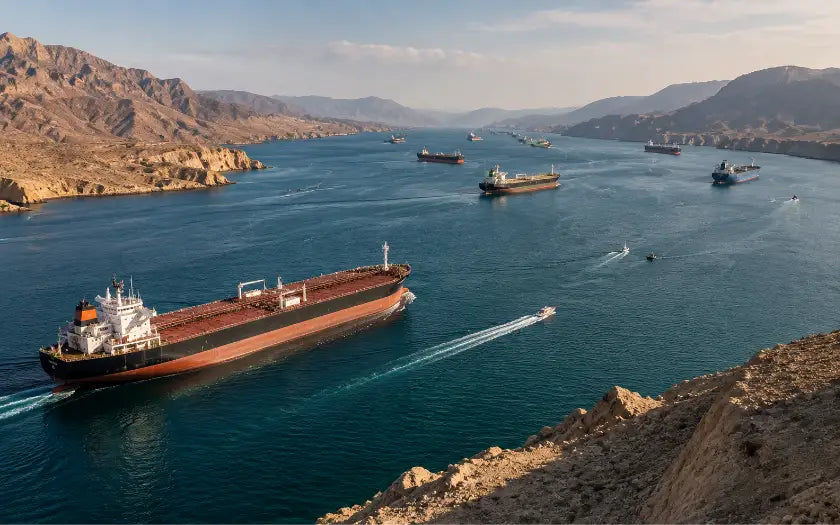
When geopolitics rattles the world's most critical shipping corridor, businesses don't just face an operational problem — they face a compliance one.
The Strait of Hormuz has been effectively closed to most commercial traffic since 28 February 2026, following US and Israeli military strikes on Iran and the subsequent retaliatory closure of the waterway by Iran's Islamic Revolutionary Guard Corps. This has sent shockwaves through energy markets, supply chains, and insurance frameworks globally — and Australian businesses are far from immune.
This isn't just a story about oil prices. It's a compliance wake-up call.
Why the Strait of Hormuz Matters More Than You Think
Prior to the crisis, roughly 25% of the world's seaborne oil trade and 20% of its liquefied natural gas passed through this narrow corridor. The disruption is so severe that the head of the International Energy Agency has described the blockade as more consequential than the oil shocks of 1973, 1979, and 2022 combined.
For Australian businesses, the exposure is layered and often misunderstood. Many assume that because Australia exports LNG and imports little crude oil directly from the Gulf, they're insulated. They're not.
Australia depends on the Strait for roughly half of its diesel imports — not because it buys Middle Eastern crude directly, but because Asian refineries in Singapore, South Korea, and Malaysia that supply Australia source 60–70% of their own crude from the Persian Gulf. When Hormuz closes, that refining pipeline tightens, and Australia feels it downstream.
Unlike the Red Sea disruptions of 2024–25, which could be partially mitigated by rerouting vessels around Africa, the Strait of Hormuz has no viable alternative. There is no bypass. Cargo trapped in the Persian Gulf simply cannot get out.
The Australian Business Reality Right Now

A freight manager at a mid-sized manufacturing company in Melbourne recently described it bluntly: their supplier in the UAE had confirmed the goods were ready. The containers were packed. Everything was set. Then the strait closed and the goods weren't going anywhere. Insurance wouldn't cover the cargo under new war-risk exclusions, their contract didn't anticipate a prolonged force majeure of this nature, and their board was asking questions they hadn't prepared answers for.
That story is playing out across Australian industries right now.
War-risk insurance premiums surged sharply, with major P&I clubs cancelling cover for Gulf and Persian Gulf transits effective 5 March 2026. Australian exporters and importers are already facing new "war risk/emergency conflict surcharges" ranging from US$2,000 for a 20-foot container to US$4,000 for refrigerated units.
Major operators including Toll, Linfox, StarTrack, and Australia Post announced increased fuel surcharges in March and April 2026. These costs are now flowing through to end customers.
The Compliance Dimensions Businesses Must Address
This is where many organisations fall short. They treat a geopolitical supply chain disruption as purely an operational issue — reroute, reorder, renegotiate. But there are genuine compliance obligations that trigger the moment a crisis of this scale hits.
1. Sanctions and Trade Controls Compliance
The conflict has shifted the sanctions landscape rapidly. Australia's autonomous sanctions framework, administered through the Department of Foreign Affairs and Trade (DFAT), operates alongside United Nations Security Council measures. Businesses must immediately review whether any rerouting decisions, alternative suppliers, or emergency procurement arrangements inadvertently involve sanctioned entities, jurisdictions, or vessels.
Iran is already one of the most heavily sanctioned countries in the world under Australian law. But in a crisis, the risks multiply. Emergency procurement decisions made under pressure — sourcing from a broker you haven't vetted, using a carrier that operates vessels with unclear ownership structures — can create sanctions exposure without anyone realising it.
Compliance action: Conduct an urgent review of every new supplier, carrier, and intermediary introduced during the disruption period. Don't let operational urgency override due diligence.
2. ASX Continuous Disclosure Obligations
For listed Australian companies, the crisis creates real disclosure risk. Under the ASX Listing Rules and the Corporations Act 2001, companies are required to disclose any information that a reasonable person would expect to have a material effect on the price or value of their securities.
A manufacturer whose key input materials are stranded in the Persian Gulf, a retailer facing significant stock shortfalls, or an energy company with materially changed cost structures — all of these scenarios likely trigger disclosure obligations. The risk isn't just reputational. Getting continuous disclosure wrong during a market-moving event can attract ASIC scrutiny and class action exposure.
Compliance action: Involve your legal and company secretarial team immediately. Prepare a clear internal assessment of materiality and get board sign-off on your disclosure approach.
3. Insurance Coverage Gaps and Reporting Obligations
Any shipment to, from, or through Iran, its waters, or the Persian Gulf will not be insured for war and strike, riot and civil commotion losses after 17 March 2026, with dates varying between insurers.
This creates a compliance obligation in itself. Many businesses carry trade credit insurance, cargo insurance, and business interruption policies that their finance teams haven't reviewed against current exclusion clauses. Finding out your claim is void after a loss event is avoidable — but only if you act now.
Compliance action: Pull every relevant policy document and get written clarification from your broker on current exclusions. Review whether your business interruption policy covers supply chain disruption events of this type.
4. Contract and Force Majeure Obligations
Supply contracts across Australian industries contain force majeure clauses — but their quality varies enormously. Some are drafted broadly enough to cover geopolitical blockades. Many are not.
The compliance issue here is twofold. First, you need to know whether you can legitimately invoke force majeure to excuse a delayed delivery or increased cost, and whether doing so requires formal written notice within a specific timeframe. Miss that notice window and you may lose the protection entirely. Second, you need to consider whether your counterparties are validly invoking force majeure against you — and whether you should be disputing it.
Compliance action: Have your legal team review every active contract for force majeure clauses, notice requirements, and applicable law. Document everything in writing from this point forward.
5. AML and Financial Crime Risk in Emergency Procurement

This one catches businesses off guard. When procurement teams are scrambling to find alternative suppliers under time pressure, the standard onboarding and due diligence processes often get bypassed. That creates anti-money laundering (AML) exposure under Australia's Anti-Money Laundering and Counter-Terrorism Financing Act 2006.
AUSTRAC expects regulated entities to maintain their customer due diligence obligations regardless of market conditions. But even non-regulated businesses face reputational and legal risk from entering commercial relationships with entities that later turn out to have links to sanctioned networks or illicit finance.
Compliance action: Treat emergency suppliers with the same due diligence rigour — or more — than standard onboarding. Speed doesn't excuse shortcuts.
6. Healthcare and Pharmaceutical Supply Chain Compliance
One sector where the Hormuz disruption carries specific compliance weight is healthcare. Substantial volumes of petrochemicals and plastics feed stocks flow through the strait, affecting the supply of packaging, pharmaceutical components, and consumer goods across multiple industries. Hospitals and healthcare providers relying on goods manufactured from these inputs face shortages that have direct patient safety implications.

For healthcare organisations operating under the National Safety and Quality Health Service (NSQHS) Standards, medication safety compliance doesn't pause during a supply crisis. Facilities managing high-risk medicines need structured protocols to handle shortages safely. The Medication Safety & High-Risk Medicines (NSQHS) course provides practical guidance on maintaining safe medication management frameworks — particularly relevant when supply volatility forces substitutions or alternative sourcing decisions.
Compliance action: Notify your clinical governance team of any medication supply disruptions. Invoke your drug shortage protocols and ensure any substitutions are reviewed and approved through appropriate channels.
A Practical Compliance Checklist
Use this across your organisation right now — not when the crisis eases, because by then the decisions that carry liability will already have been made.
- Review all active contracts for force majeure notice requirements and trigger events
- Audit all new suppliers and carriers introduced since late February 2026 against sanctions lists
- Obtain written confirmation from brokers on current insurance coverage and exclusions
- Assess and document materiality for ASX continuous disclosure purposes
- Update your AML risk assessment to reflect elevated procurement risks
- Engage your legal counsel on any liquidated damages clauses in supply agreements
- Brief your board on the compliance exposure — not just the operational one
- For healthcare entities, activate medication shortage protocols per NSQHS standards
Looking Beyond the Immediate Crisis
Even if the strait reopens, the disruption to global supply chains will be felt long after ships have been cleared to pass en masse. The compliance obligations don't end when the geopolitics settle.
Post-crisis, businesses should expect heightened regulatory scrutiny of decisions made during the disruption period. ASIC may review disclosure decisions. AUSTRAC may query emergency procurement activity. Courts may be asked to adjudicate force majeure disputes. The documentation you create — or fail to create — today will determine your legal position months from now.
The Strait of Hormuz crisis is not a once-in-a-generation event that you can simply survive and forget. It's a stress test of your governance frameworks. And the organisations that come through it with their compliance record intact will be the ones that treated it as a legal and regulatory challenge from day one — not an afterthought.
Final Thought
Supply chain crises don't create compliance obligations — they reveal whether your compliance frameworks were ever genuinely fit for purpose. If your organisation has been treating trade sanctions screening, insurance review, and force majeure management as box-ticking exercises, the Strait of Hormuz disruption has just revealed the gap.
Close it before someone else does it for you.
Strengthen Your Compliance Capability
Global disruption doesn’t just test supply chains — it tests how prepared your organisation really is.
At Australian Compliance Training, we provide practical online compliance and risk management training designed to help professionals and organisations navigate evolving global challenges with confidence.
From AML/CTF and governance to healthcare standards, cybersecurity, workplace safety, and regulatory compliance — our industry-focused courses help you strengthen decision-making, reduce risk, and build more resilient operations in an unpredictable world.
Explore our online courses today and build compliance capabilities that support long-term resilience, wherever your business operates.


