
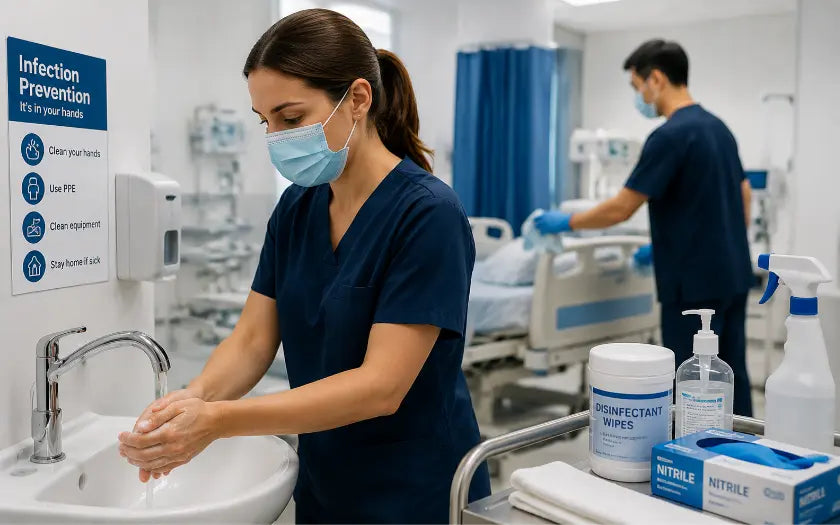
 Every year, thousands of patients across Australia and around the world acquire infections not from the conditions that brought them to hospital — but from the healthcare environment itself. These are called healthcare-associated infections (HAIs), and they remain one of the most persistent challenges facing modern clinical settings. The good news? Most of them are preventable.
Infection Prevention and Control (IPC) is the framework that makes prevention possible. It covers everything from how staff wash their hands to how entire facilities are designed to limit the spread of pathogens. Understanding IPC is not just a regulatory requirement — it is a fundamental commitment to patient safety.
What Is IPC and Why Does It Matter?
IPC stands for Infection Prevention and Control. It refers to the evidence-based practices, policies, and systems put in place to protect patients, healthcare workers, and visitors from the spread of infectious diseases within clinical environments.
In Australia, the governance of IPC falls under several key bodies. The Australian Commission on Safety and Quality in Health Care (ACSQHC) sets the national agenda, particularly through the Australian Guidelines for the Prevention and Control of Infection in Healthcare. At the state level, bodies like the NSW Health and Queensland Health issue their own directives aligned with national standards. The National Safety and Quality Health Service (NSQHS) Standards — specifically Standard 3: Preventing and Controlling Healthcare-Associated Infection — provide the accreditation framework that hospitals must meet.
Globally, the World Health Organization (WHO) publishes guidelines that form the backbone of IPC programs in over 190 countries. These guidelines are regularly updated to reflect emerging evidence and new threats, such as those posed by antimicrobial-resistant organisms and novel pathogens.
The Core Principles of IPC
Standard Precautions: The Foundation
Standard precautions are the baseline level of infection control practices applied to every patient, every time — regardless of their diagnosis or presumed infection status. They are based on the principle that all blood, body fluids, secretions, and non-intact skin may contain transmissible pathogens.
Key elements include:
-
Hand hygiene — the single most important measure in preventing cross-transmission
-
Personal protective equipment (PPE) — gloves, gowns, masks, and eye protection used appropriately based on risk assessment
-
Safe handling and disposal of sharps — to prevent needlestick injuries and associated bloodborne pathogen exposure
-
Respiratory hygiene and cough etiquette — especially critical during respiratory illness seasons or outbreaks
-
Environmental cleaning and disinfection — maintaining a clean clinical environment to reduce surface contamination
Transmission-Based Precautions
When standard precautions alone are not sufficient — such as with patients who have known or suspected highly contagious conditions — transmission-based precautions are applied. These are divided into three categories: contact, droplet, and airborne precautions. A patient with tuberculosis, for instance, would be placed in an airborne infection isolation room with negative pressure ventilation, while a patient with influenza would require droplet precautions including surgical masks for staff within close proximity.
Hand Hygiene: Small Action, Enormous Impact
If there is one intervention that has transformed healthcare safety more than any other, it is hand hygiene. The concept may seem simple, but the execution in a busy clinical setting requires sustained commitment and system-level support.
 Australia's National Hand Hygiene Initiative (NHHI), led by Hand Hygiene Australia, monitors compliance across public hospitals using a structured audit methodology aligned with the WHO's "5 Moments for Hand Hygiene." These moments identify the specific times when hand hygiene must be performed:
|
Moment |
When It Applies |
|
1 |
Before touching a patient |
|
2 |
Before a clean or aseptic procedure |
|
3 |
After body fluid exposure risk |
|
4 |
After touching a patient |
|
5 |
After touching the patient's surroundings |
According to industry reports, hospitals with consistently high hand hygiene compliance rates see measurable reductions in HAI rates. Compliance is not just about knowledge — it is about having alcohol-based hand rub dispensers within arm's reach, visible reminders, and a culture that normalises and celebrates good practice.
IPC in Practice: Real-World Scenarios
Scenario 1: The Surgical Ward
Consider a patient recovering from abdominal surgery. Their wound site represents a direct entry point for pathogens. In this context, IPC means ensuring that dressing changes are performed with aseptic non-touch technique (ANTT), that staff perform hand hygiene before and after every contact, and that used equipment is either disposed of or reprocessed according to the correct sterilisation protocol.
A seemingly minor lapse — using a non-sterile glove for a wound assessment or leaving equipment on a patient's bedside table without cleaning it — can have consequences that extend well beyond that single patient.
Scenario 2: Community Aged Care
IPC is not confined to hospitals. Aged care facilities face unique challenges because residents live in a shared environment, often have compromised immune systems, and may have limited capacity to follow hygiene instructions independently. In Australia, the Aged Care Quality and Safety Commission enforces IPC standards under the Aged Care Quality Standards, and facilities are expected to have a designated IPC lead responsible for implementing and monitoring programs.
During the COVID-19 pandemic, gaps in IPC preparedness in aged care settings had tragic consequences — both in Australia and globally. This led to significant reforms and a renewed emphasis on IPC training and accountability.
Antimicrobial Stewardship: IPC's Essential Partner
IPC and antimicrobial stewardship (AMS) are deeply intertwined. Overuse of antibiotics in clinical settings drives the emergence of antimicrobial-resistant organisms — including methicillin-resistant Staphylococcus aureus (MRSA) and carbapenem-resistant Enterobacteriaceae (CRE). When these organisms spread within a healthcare facility, standard treatments become less effective, making prevention through IPC all the more critical.
Australia's National Antimicrobial Stewardship Program, governed through ACSQHC, works alongside IPC frameworks to ensure that antibiotics are prescribed appropriately and that resistant organisms are identified and contained quickly.
Environmental Cleaning: More Than Just Tidiness
The clinical environment itself is a reservoir for pathogens. Frequently touched surfaces — bed rails, call buttons, door handles, and infusion pumps — can harbour organisms for hours or even days. Effective environmental cleaning requires:
-
Hospital-grade disinfectants appropriate to the pathogens of concern
-
Defined cleaning frequencies based on ward type and patient risk
-
Colour-coded equipment to prevent cross-contamination between zones
-
Documented audit processes to verify cleaning quality
Some Australian facilities have adopted ATP (adenosine triphosphate) bioluminescence testing to objectively verify surface cleanliness beyond what the naked eye can detect. This kind of evidence-based quality assurance is increasingly considered best practice.
Building a Culture of IPC: Leadership and Education
 Policies and procedures alone do not prevent infections. Culture does. When clinical leaders visibly model good IPC practice — performing hand hygiene in front of patients, speaking openly about near-misses, and holding teams accountable — it signals to all staff that IPC is a shared priority, not a box-ticking exercise.
Education plays an equally vital role. New staff should receive structured IPC orientation, and ongoing training should be refreshed regularly — not only in response to outbreaks but as a routine part of professional development. In many Australian health services, online learning platforms are now used to deliver and track IPC competency assessments across large, dispersed workforces.
Patients themselves are also partners in IPC. Encouraging patients to speak up if a clinician does not perform hand hygiene before touching them is no longer seen as confrontational — it is encouraged. Several Australian health services have formalised this approach through "it's OK to ask" patient engagement campaigns.
Key IPC Standards: A Quick Reference
|
Standard / Framework |
Issuing Body |
Scope |
|
NSQHS Standard 3 |
ACSQHC |
Acute healthcare facilities in Australia |
|
Australian Guidelines for IPC in Healthcare |
ACSQHC / NHMRC |
Broad clinical guidance, all settings |
|
Aged Care Quality Standards |
ACQSC |
Residential and home aged care |
|
WHO Core Components of IPC Programs |
WHO |
Global, all healthcare settings |
|
ISO 15883 (Washer-Disinfectors) |
ISO |
Medical device reprocessing |
Looking Ahead: IPC in a Changing World
The landscape of IPC is constantly shifting. Climate change is contributing to the emergence of new infectious diseases. Global travel continues to accelerate the spread of resistant organisms. And the growing complexity of healthcare — with more immunocompromised patients, more invasive procedures, and more reliance on shared equipment — means the stakes have never been higher.
In response, Australian health authorities are investing in real-time surveillance systems that can detect unusual patterns of infection early, allowing rapid response before outbreaks take hold. Digital tools, including electronic hand hygiene monitoring systems and AI-assisted environmental auditing, are beginning to supplement traditional audit methods.
IPC is not static. It requires continuous learning, honest self-assessment, and the willingness to adapt as evidence evolves. Whether you work in a large metropolitan hospital, a rural general practice, or a suburban aged care home, the principles remain the same: prevent transmission, protect people, and never become complacent.


