
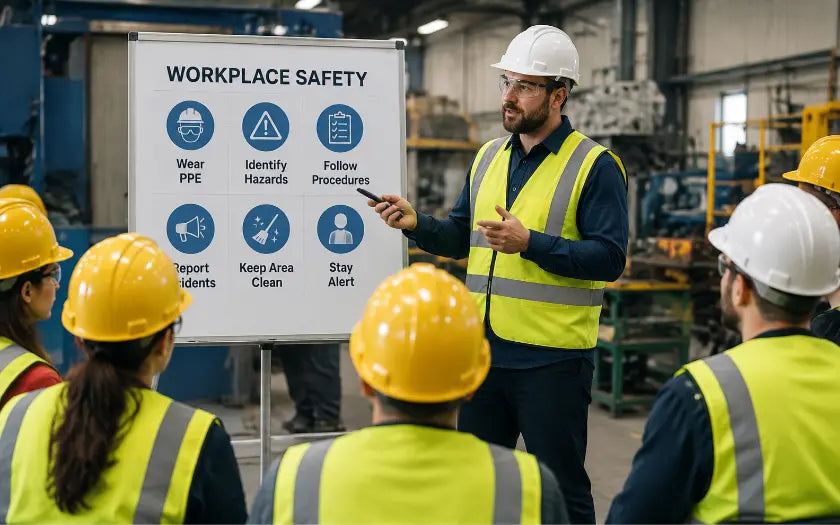
Every workplace injury carries a cost that goes far beyond the medical bill. There's the human cost — a worker who goes home with a broken wrist, a back injury that changes their quality of life, or worse. Then there's the operational cost — lost productivity, investigations, potential legal liability, and the quiet but real damage to team morale.
The frustrating truth? Most workplace injuries are preventable. And the gap between a safe workplace and a dangerous one often comes down to the quality of safety training — not just whether it exists, but whether it actually works.
This guide breaks down how organisations in Australia and around the world are rethinking safety training to get real results.
The Real Problem with Traditional Safety Training
 Walk into almost any organisation and you'll find a safety induction folder, a laminated emergency evacuation poster on the wall, and a once-a-year toolbox talk that most workers quietly dread attending.
That approach isn't safety training. It's safety theatre.
Safe Work Australia, the national body responsible for developing work health and safety policy, has consistently highlighted that incidents are rarely caused by workers who didn't know the rules existed. They're caused by workers who weren't trained in a way that stuck, by systems that didn't support safe behaviour, and by workplace cultures that quietly prioritised speed over caution.
The global picture supports this. The International Labour Organisation (ILO) notes that millions of workers suffer occupational injuries every year, and a significant portion of those incidents occur in environments where training programs exist but haven't been designed with adult learning principles in mind.
That distinction matters enormously.
Understanding How Workers Actually Learn
Before you can fix safety training, you need to understand why so much of it fails. Most traditional programs are designed around information transfer — get the rules into the worker's head and assume they'll apply them. But that's not how adults learn, especially under pressure.
Adults learn best when training is relevant to their actual work, when they can practice what they're learning in realistic conditions, and when there's a feedback loop that shows them what they got right and wrong.
A construction worker in Brisbane who sits through a two-hour PowerPoint on manual handling is unlikely to apply the correct technique when they're on-site, tired, in a hurry, and lifting an awkward load. But a worker who has physically practised the technique, received feedback from a supervisor, and seen what a back injury actually looks like in a real scenario? They're far more likely to pause and do it properly.
The shift from information-based training to behaviour-based training is probably the single biggest lever organisations can pull.
Building a Safety Training Program That Actually Works
Start With a Genuine Risk Assessment
 Before designing any training, organisations need an honest picture of where the real risks sit. This means going beyond the standard hazard register and actually walking the floor, talking to frontline workers, and reviewing incident and near-miss data.
Safe Work Australia's model Work Health and Safety (WHS) laws — adopted across most Australian states and territories — require employers to actively manage risks, not just document them. A training program built on a real risk assessment will be far more targeted and effective than one built on assumptions.
For example, a food manufacturing facility that reviews its injury data might find that most incidents happen during the afternoon shift when fatigue is higher, or during changeovers between production runs. That insight shapes not just what training is delivered, but when and to whom.
Make Training Role-Specific, Not Generic
Generic safety training has its place — inductions, emergency procedures, basic WHS awareness. But the training that actually prevents injuries needs to be specific to the tasks, environments, and hazards that individual workers encounter.
A warehouse picker and a forklift operator work in the same building but face very different risks. Training that tries to serve both equally well often ends up serving neither effectively.
Leading organisations now design role-specific training modules that reflect the actual conditions workers operate in. This means using photographs and scenarios from the actual workplace, referencing equipment by the names workers actually use, and involving supervisors in the design process — because supervisors often carry knowledge about informal work practices that formal risk assessments miss entirely.
Leverage Simulation and Hands-On Practice
There's a reason emergency services, aviation, and healthcare have embraced simulation-based training so enthusiastically. When the stakes are high and mistakes are costly, you practice in a controlled environment before the real moment arrives.
The same logic applies to workplace safety. Virtual reality (VR) safety training has grown significantly in Australian industries including mining, construction, and utilities. Companies using VR can place a worker inside a simulated confined space rescue, a chemical spill scenario, or a near-miss event — and let them experience the consequences of poor decisions without anyone getting hurt.
But simulation doesn't have to mean expensive technology. A warehouse team that runs a tabletop exercise on what to do if a racking system shows signs of structural failure is doing a form of simulation. The goal is practice under conditions that feel real enough to activate genuine decision-making, not just passive listening.
Train Supervisors as Safety Champions — Not Just Overseers
One of the most underrated elements of any safety training program is the quality of frontline supervision. Research consistently shows that the relationship between a worker and their immediate supervisor is one of the strongest predictors of safe behaviour on the job.
Supervisors who are trained to notice early warning signs — a worker who seems fatigued, a process that's been quietly modified to save time, equipment that's being used differently than intended — can intervene before an incident happens.
But too often, supervisor safety training is an afterthought. They get the same induction as everyone else, perhaps with a few extra slides about their legal responsibilities, and then they're left to figure out the rest through experience.
The most safety-conscious organisations invest specifically in supervisor capability. They teach supervisors how to have a safety conversation without it feeling like an interrogation, how to respond when workers raise concerns without dismissing them, and how to model safe behaviour visibly and consistently.
The Role of Safety Culture in Making Training Stick
 Training programs don't exist in a vacuum. They sit inside an organisational culture, and if that culture doesn't genuinely value safety — if managers are pressured to hit targets at the expense of procedures, or if workers are quietly punished for raising safety concerns — even the best training will erode.
A worker at a logistics company once shared that their team had been trained thoroughly on safe manual handling techniques. But on the floor, if you took the time to use a trolley or ask for help with a heavy item, you fell behind the picking targets that determined your bonus. Within weeks of induction, most new starters were cutting corners just to keep up with the team.
That's a culture problem, and training alone can't solve it. Leadership has to visibly and consistently prioritise safety — not just in words, but in the decisions they make when safety and productivity are in tension.
Safe Work Australia's work on psychological safety and speaking-up culture recognises this. Workers who feel they can raise a concern without fear of ridicule or retaliation are far more likely to flag a hazard before it becomes an incident.
Keeping Training Current and Refreshed
The Forgetting Curve Is Real
Research in cognitive psychology has long established that people forget a significant portion of what they've learned within days if the knowledge isn't reinforced. For safety training, this has serious practical implications.
Annual refresher training might tick a compliance box, but it does very little to maintain safe behaviour throughout the year. Short, frequent reinforcement — sometimes called microlearning — is far more effective at keeping critical safety knowledge active.
This could be as simple as a five-minute pre-shift briefing that revisits one specific hazard, a monthly team discussion of a recent near-miss, or a short digital reminder sent to workers' phones. The format matters less than the consistency.
Update Training When the Work Changes
One of the most common factors in workplace incidents is change — new equipment, a modified process, a different shift structure, a new chemical introduced to the workflow. Change disrupts familiar patterns and creates windows of elevated risk.
Effective safety training programs have a clear trigger: whenever the work changes, training is reviewed and updated before the change takes effect. This sounds obvious, but it's surprisingly easy to fall into the habit of training people on how things used to work.
In Australia, this principle is embedded in WHS consultation obligations. Employers are required to consult with workers when changes are made that may affect their health or safety. That consultation process is also a training opportunity — when workers understand why a process has changed and what the new risks are, they're more likely to follow the updated procedures.
Measuring Whether Your Safety Training Is Working
You can't improve what you don't measure, and yet many organisations treat safety training as complete once it's been delivered. Delivery is only the beginning.
Effective measurement looks at multiple layers. At the knowledge level, assessments and quizzes help confirm whether workers understood what they were taught. At the behaviour level, direct observation — structured workplace audits, supervisor observation checklists — reveals whether training is being applied on the job.
But the most meaningful metric is incident data over time. Are the specific incidents your training was designed to prevent actually decreasing? Is the near-miss reporting rate going up, which often signals a healthier safety culture rather than a more dangerous one?
Organisations that take this seriously also track leading indicators — safety conversations held, hazards reported, training completion rates, inspection findings — rather than waiting for a lagging indicator like an injury to tell them something has gone wrong.
What Australian Businesses Can Learn From Global Best Practice
Countries like Finland, Germany, and Singapore consistently rank among the world's safest work environments. What they share isn't a single magic program — it's a systemic approach where safety training is deeply integrated into how work is organised, supervised, and evaluated.
In Germany's manufacturing sector, for example, the dual vocational training system means safety is woven into trade apprenticeships from day one, not bolted on as an afterthought. Workers graduate with safety knowledge that feels like professional identity, not a box they had to tick.
In Singapore, the Workplace Safety and Health (WSH) framework places significant emphasis on competency-based standards — workers in high-risk roles must demonstrate practical competency, not just pass a written test. Australian industry is moving in a similar direction, with increasing recognition that certification should reflect real capability.
Practical Steps to Start Improving Today
If you're responsible for safety in your organisation and feeling overwhelmed, the place to start isn't a full program overhaul. It's a conversation.
 Talk to the workers who do the most hazardous tasks. Ask them what part of their job scares them, what they wish they'd been shown before they started, and what the current training gets wrong. That conversation will give you more useful information than any audit.
From there, pick the single highest-risk gap and close it — with specific, practical, hands-on training that workers actually find useful. Build from there.
The workplaces that reduce injuries most effectively aren't always the ones with the biggest training budgets. They're the ones where safety is treated as a genuine operational priority, where workers feel trusted and heard, and where training is designed for the humans who do the work — not the regulator who might one day audit the records.
That's the standard worth reaching for.
Ready to Build Your Safety Knowledge? Start With the Right Course
Understanding workplace safety at a deeper level doesn't just make you a better professional — it makes you a more valuable one. Whether you're a business owner trying to protect your team, a supervisor stepping into greater responsibility, or someone looking to formalise their safety expertise, structured learning accelerates the journey significantly.
Workplace Health and Safety Course
A dedicated Workplace Health and Safety course gives you the foundational and practical knowledge to confidently identify hazards, understand your legal obligations under Australian WHS legislation, and implement training and systems that genuinely reduce risk.
This kind of structured learning covers everything from risk assessment methodology and incident reporting to consultation obligations and safety culture — the very elements this article has outlined as critical to reducing workplace injuries.
For those working in Australian industries, a recognised WHS qualification also signals to employers that your commitment to safety is more than intent — it's demonstrated competency. In a landscape where regulators, insurers, and clients are paying closer attention to how organisations manage safety, that credential carries real weight.
If reducing workplace injuries matters to you — and after reading this, it should — a Workplace Health and Safety course is one of the most practical next steps you can take.


