
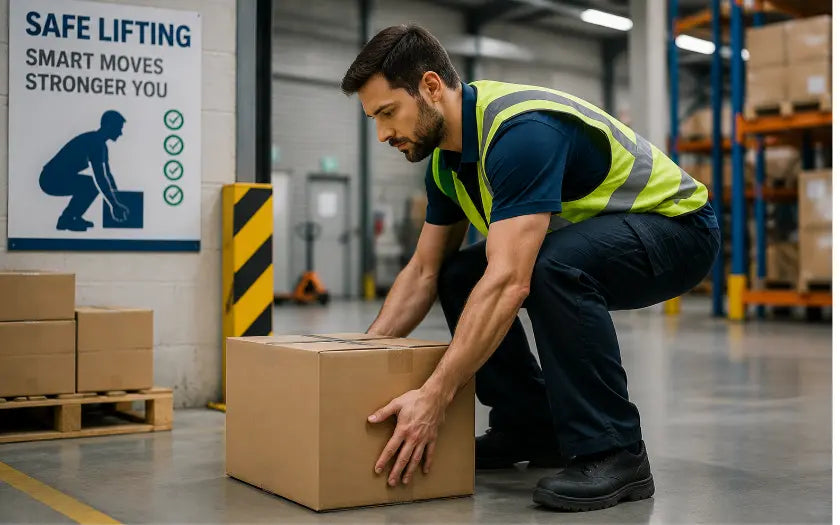
Manual handling injuries remain one of the most common causes of workplace injuries across Australia. Whether employees work in construction, healthcare, warehousing, manufacturing, retail, or office environments, tasks involving lifting, carrying, pushing, pulling, or moving objects can place significant strain on the body.
While many people associate manual handling injuries with heavy lifting, injuries can also occur from repetitive movements, awkward postures, poor workstation design, or improper techniques. These injuries often result in pain, reduced productivity, workers' compensation claims, and extended periods away from work.
The good news is that most manual handling injuries are preventable. By understanding workplace risks and implementing practical control measures, employers can create safer working environments and protect their workforce.
What Are Manual Handling Injuries?
 Manual handling refers to any activity involving lifting, lowering, pushing, pulling, carrying, moving, holding, or restraining an object, person, or animal.
According to Safe Work Australia's hazardous manual tasks guidance, poor manual handling practices can lead to musculoskeletal disorders (MSDs) — injuries affecting muscles, joints, ligaments, tendons, nerves, and spinal discs.
Common manual handling injuries include:
-
Back strains and sprains
-
Shoulder injuries
-
Neck pain
-
Muscle tears
-
Joint injuries to knees, wrists, and elbows
-
Repetitive strain injuries (RSIs)
These injuries can develop suddenly from a single overexertion event or gradually over months of cumulative exposure.
Why Manual Handling Injuries Occur
 Most manual handling injuries are not accidents — they are predictable outcomes of poorly managed work conditions. Common contributing factors include:
-
Lifting loads that are too heavy, bulky, or unstable
-
Repetitive movements without adequate rest or task rotation
-
Twisting the torso during lifting or carrying
-
Sustained awkward postures over long shifts
-
Inadequate workspace design that forces unnatural reach or bend
-
No mechanical aids where they are needed most
-
Insufficient training on hazard recognition and safe technique
Even seemingly simple tasks — stacking shelves, typing at a workstation, or assisting a patient — can cause injury when performed repeatedly without proper controls throughout the workday.
The Impact on Businesses
Manual handling injuries affect far more than the injured worker. The broader costs to an organisation can be significant and long-lasting:
-
Reduced productivity and operational disruption
-
Increased absenteeism and staff shortages
-
Higher workers' compensation premiums
-
Reduced team morale and engagement
-
Legal liability under Work Health and Safety (WHS) obligations
For most organisations, preventing injuries is far more cost-effective than managing their consequences. Prevention costs a fraction of what a single serious injury claim can cost in direct and indirect expenses.
Step 1: Identify Manual Handling Hazards
The first step in prevention is conducting a thorough workplace risk assessment to identify all manual handling hazards before they cause harm.
Employers should regularly assess tasks involving lifting, carrying, pushing, pulling, repetitive movements, and awkward postures. Use the Safe Work Australia hazard identification and risk assessment framework as your starting point, and always involve workers in the process — they often identify risks that management misses from a distance.
Employees should feel actively encouraged to report tasks they believe may contribute to injury.
Step 2: Eliminate or Reduce Risks
Once hazards are identified, work systematically through the hierarchy of controls — starting with elimination (the most effective measure) and moving toward administrative controls only when higher-order solutions are not practicable.
Practical examples include:
-
Using trolleys and hand trucks to eliminate manual carry
-
Redesigning workstations so loads are at a comfortable working height
-
Reducing the weight of individual loads by splitting into smaller units
-
Improving storage arrangements to minimise reach and lift distances
-
Automating repetitive tasks where feasible
-
Introducing team lifting protocols for heavy or awkward loads
Where possible, the safest solution is to remove the need for manual handling altogether.
Step 3: Teach Safe Lifting Techniques
Technique is an important supportive layer — but it is not a substitute for engineering and design controls. When some manual handling is unavoidable, workers should understand:
-
Assess the load before lifting: test its weight, shape, and stability
-
Keep the load close to the body's centre of gravity
-
Maintain a stable, wide-base stance with feet shoulder-width apart
-
Bend at the knees — not the back — and use leg muscles for the lift
-
Avoid sudden twisting or jerking movements mid-lift
-
Seek assistance or use equipment when a load feels too heavy or awkward
Safe technique should always be supported by the risk controls already in place, not used in their place.
Step 4: Provide Manual Handling Training
Structured training is one of the most legally expected and practically effective investments an employer can make. It builds workforce capability across hazard recognition, safe technique, and risk reporting.
Effective manual handling training covers:
-
Workplace-specific hazard identification
-
Safe lifting and carrying techniques relevant to the role
-
Risk control measures in use at the site
-
Injury prevention strategies and early symptom recognition
-
How and when to report concerns
Training should be refreshed after incidents, significant task changes, or when new equipment is introduced. Organisations that invest in regular, structured training consistently report stronger safety outcomes and better compliance with WHS obligations.
Step 5: Use Mechanical Aids Where Possible
Technology is the most reliable way to reduce physical strain on workers. The right equipment transforms high-risk manual tasks into lower-risk mechanical operations. Common aids include:
-
Forklifts and pallet jacks for heavy stock movement
-
Hoists and patient lifters in healthcare and aged care environments
-
Height-adjustable workstations to eliminate sustained awkward posture
-
Conveyor systems in manufacturing and logistics
-
Vacuum lift devices for repetitive pick-and-place tasks
Employers must ensure all workers receive adequate instruction and supervision on the safe use of any mechanical aids — equipment misuse creates its own injury risks.
Step 6: Improve Workplace Design
Poorly designed environments force workers into preventable physical risk. Good ergonomic design reduces strain and typically improves efficiency at the same time.
Employers should consider:
-
Storage heights — keep heavy items at waist level to eliminate overhead and floor-level lifting
-
Workstation layout — minimise reach distances and awkward postures
-
Access pathways — ensure adequate space for safe movement and equipment operation
-
Lighting — adequate illumination reduces misjudgement and compensatory strain
-
Available workspace — workers need enough room to use proper technique
The Comcare ergonomics guidance is a practical reference for Australian employers designing or reviewing workspaces.
Step 7: Encourage Early Reporting
Musculoskeletal injuries are often progressive. A minor ache that goes unreported can develop into a serious, long-term condition over weeks or months. Early reporting allows organisations to:
-
Investigate hazards before they cause further harm
-
Adjust work practices and implement additional controls
-
Provide early intervention physiotherapy where appropriate
-
Prevent a single incident from becoming a pattern
Building a psychologically safe reporting culture — where workers face no negative consequences for raising concerns, and where reported issues visibly result in action — is one of the most important things an employer can do.
Step 8: Monitor and Review Safety Practices
Manual handling risks evolve as workplaces change. Regular review ensures controls remain appropriate and effective over time.
Employers should review:
-
Injury reports and near-miss data at regular intervals
-
Employee feedback on hazards they encounter day to day
-
Training effectiveness through observation and outcomes
-
Whether controls remain adequate after task, equipment, or personnel changes
Following recognised Safe Work Australia safety management practices supports continuous improvement and helps ensure your safety measures keep pace with your workplace.
Manual Handling Risks Across Different Industries
 Manual handling injuries are not limited to physically demanding industries. Every workplace has its own risk profile.
Construction — Workers lift building materials, tools, and equipment in challenging, often uneven environments with limited mechanical access.
Healthcare and aged care — Patient handling and transfers create some of Australia's highest MSD injury rates per worker. Safe patient handling programs and mechanical lifters are critical in this sector.
Warehousing and logistics — High-volume stock movement under time pressure consistently drives unsafe lifting behaviour and repetitive strain.
Retail — Repetitive shelf-stocking, display movement, and inventory handling without adequate lifting equipment leads to chronic strain over time.
Manufacturing — Assembly line tasks and repetitive production movements are leading contributors to long-term MSDs across the sector.
Office environments — Poor workstation setup and repetitive keyboard and mouse use are primary drivers of RSI and neck or shoulder conditions. See Safe Work Australia's computer workstation guidance for practical advice.
Every workplace should assess its specific risks rather than applying a generic approach.
Creating a Safer Workplace Through Prevention
Preventing manual handling injuries requires more than telling workers to lift correctly. Organisations that achieve strong safety outcomes take a systems-based approach:
-
Identifying hazards systematically and regularly
-
Improving workplace design at the source
-
Deploying mechanical aids wherever they help
-
Delivering structured, role-relevant training
-
Building an open reporting culture
-
Reviewing and improving safety practices continuously
Investing in prevention protects workers, supports productivity, demonstrates compliance with WHS obligations, and reduces long-term compensation and legal costs. It is one of the highest-return safety investments an employer can make.
Improve Workplace Safety with Australian Compliance Training
If your organisation wants to reduce manual handling risks and improve workplace safety awareness, our Manual Handling Training & Certification course provides practical, nationally recognised training on safe work practices, hazard identification, risk management, and injury prevention — aligned to the current Safe Work Australia Code of Practice.
You may also benefit from:


