
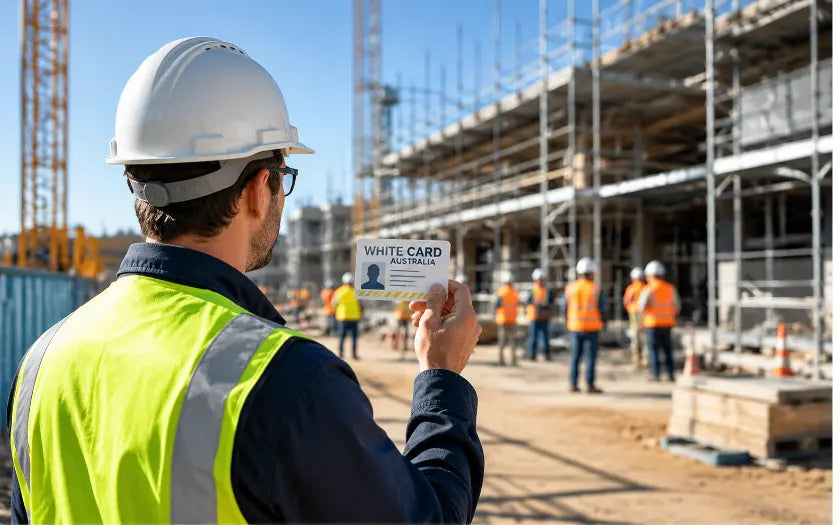
If you're stepping into the construction industry in Australia for the first time, one question comes up before almost anything else: do I need a White Card? The short answer is yes — and you can't legally set foot on a construction site without one.
Whether you're a fresh apprentice, a tradesperson switching sectors, a site manager, or even a delivery driver making regular visits to active worksites, the White Card is your entry point. This guide walks you through everything you need to know — what it is, how to get it, how much it costs, and what to do if you're coming from interstate or overseas.
What Is a White Card?
The White Card — officially known as the General Construction Induction Card — is a nationally recognised certification that confirms you've completed approved Work Health and Safety (WHS) training for the construction industry.
It's issued under the Safe Work Australia framework and is required for anyone who works on, or is likely to work on, a construction site anywhere in Australia.
The card itself doesn't expire. Once you have it, you have it for life — as long as you meet the training and documentation requirements at the time of getting it.
The White Card replaced older state-specific cards (like the Blue Card in some states) and standardised the process nationally. This means a White Card issued in Queensland is recognised in Western Australia, and vice versa. One card, one country.
Who Needs a White Card?
 This is where people sometimes get caught off guard. The White Card requirement is broader than most people assume.
You need one if you work in any of the following roles on a construction site: builders, plumbers, electricians, carpenters, concreters, labourers, painters, tilers, scaffolders, crane operators, site supervisors, and project managers. But it goes further than just trades.
Engineers, architects, and consultants who attend sites regularly are also expected to hold one. So are safety officers, surveyors, and — in many cases — delivery personnel who enter active work zones on a frequent basis.
If you're unsure whether your role requires it, the safest approach is to get one. Turning up to a site without it when it's required can result in you being turned away on the spot, which is embarrassing at best and job-threatening at worst.
What Does the White Card Training Cover?
The White Card course — formally titled CPCCWHS0001 Prepare to Work Safely in the Construction Industry — covers the foundational WHS knowledge every construction worker needs before entering a site.
The training content is nationally standardised, which means no matter which Registered Training Organisation (RTO) delivers it, the core competencies remain the same. You'll learn about your legal rights and responsibilities under Australian WHS legislation, how to identify and respond to workplace hazards, the importance of following safe work procedures, how to report incidents and near-misses, and how to locate and use safety equipment on site.
It's deliberately designed to be accessible. You don't need prior construction experience or any specific educational background to complete it.
How to Get Your White Card: Step by Step
Step 1: Choose a Registered Training Organisation (RTO)
Your White Card training must be delivered by an RTO registered with the Australian Skills Quality Authority (ASQA) or the relevant state training authority. Choosing an unregistered provider means your card won't be valid — a mistake that's more common than it should be, particularly with online providers.
Before enrolling anywhere, check the provider's RTO registration directly on the National Register.
Step 2: Complete the Training
You have two main delivery options: face-to-face or online (with a practical component). Let's break both down.
Face-to-face training is conducted in a classroom or on-site environment. It typically takes one day to complete. Many people find this format easier to absorb, especially if they're new to construction environments and benefit from seeing practical demonstrations in real time.
Online training has grown significantly in popularity and is accepted in most states and territories — but there's an important catch. Online White Card training in Australia requires a face-to-face verification component. You complete the theory online, then attend a brief in-person session where your identity is verified and your practical understanding is assessed. You cannot complete the entire process 100% online.
A young carpenter's apprentice from regional South Australia found this out the hard way when he completed an online White Card course from a provider that didn't offer local verification sessions — leaving him with a certificate he couldn't use until he travelled three hours to the nearest participating location. Always confirm the verification process before you enrol.
Step 3: Pass the Assessment
The assessment for the White Card is not designed to trip you up. It tests whether you understand the core safety concepts covered in the training — not construction expertise. Most assessments are a combination of written questions, scenario-based responses, and sometimes a short practical demonstration.
If English isn't your first language, many RTOs offer training and assessment in languages other than English or can provide interpreter support. Ask before enrolling.
Step 4: Receive Your Card
Once you've passed, your RTO will arrange for your White Card to be issued. In some states, the card is issued directly by the state construction authority. The timeline varies — some providers issue the card within a few days, while others take up to two weeks.
You'll typically receive a temporary certificate to carry on-site until your physical card arrives.
How Much Does a White Card Cost?
 Costs vary depending on the provider and delivery format. Face-to-face training generally ranges from around $50 to $150. Online training with verification tends to sit in a similar range, though some providers charge more for the convenience of flexible scheduling.
Be cautious of providers offering White Cards at unusually low prices or with suspiciously fast turnaround. Legitimate White Card training takes time to complete properly. If a provider is offering a "same-day" card for $20 with no verification component, that's a red flag.
For workers experiencing financial hardship, some state governments and industry bodies offer subsidised training. It's worth contacting your state's construction industry training fund — such as CITB in Queensland — to see what concessions may apply.
State-by-State: Is There Anything Different?
The White Card is nationally recognised, but there are some state-level nuances worth knowing.
New South Wales: Training must include a face-to-face component. SafeWork NSW publishes a list of approved providers.
Victoria: WorkSafe Victoria oversees WHS compliance on Victorian sites. The White Card is universally required.
Queensland: Workplace Health and Safety Queensland administers the framework. CITB Queensland is a commonly used provider for subsidised training.
Western Australia: WorkSafe WA has specific requirements. Check that your provider is approved for delivery in WA specifically.
South Australia, Tasmania, ACT, Northern Territory: All accept the national White Card. Confirm your provider's approval status regardless of which territory you're training in.
The key rule across all states: the card is issued, once your training is verified, and accepted everywhere. Don't let anyone tell you otherwise.
Does a White Card Expire?
No — the White Card itself does not have an expiry date. Once issued, it remains valid for life.
However, there is an important practical consideration. If you haven't worked in construction for two or more years, some employers and site managers may request that you undertake a refresher or demonstrate currency of knowledge before allowing site access. This isn't a legislative requirement in most jurisdictions but is increasingly common as a best-practice standard, particularly on larger commercial and government projects.
Keeping a record of ongoing construction-related training is always a smart move — and something that separates professionals who take safety seriously from those who see it as a one-time obligation.
What Happens If You Work Without a White Card?
Working on a construction site without a valid White Card is not just a technicality — it carries genuine legal consequences.
Under state and territory WHS legislation, both the worker and the employer (or principal contractor) can face penalties for failing to ensure induction requirements are met. Penalty amounts vary by jurisdiction but can be substantial for businesses that knowingly allow unqualified workers on site.
Beyond the legal dimension, it's a safety issue. The whole point of the White Card training is to ensure every person on a construction site has at least a baseline understanding of how to keep themselves and others safe. Construction remains one of Australia's highest-risk industries for workplace injuries and fatalities, according to Safe Work Australia's annual work health and safety statistics.
I Already Have a White Card From Another State — Do I Need a New One?
No. The White Card is nationally portable. If your card was legitimately issued by a registered provider in any Australian state or territory, it is valid everywhere else in the country.
If you've lost your card, the process for replacement depends on which state issued it and which provider originally delivered your training. Contact your original RTO first. In some states, a replacement can be issued by the state authority if your original provider is no longer operating.
Coming From Overseas? Here's What You Need to Know
If you're an international worker entering the Australian construction industry, your overseas safety certifications — regardless of country — are not recognised as equivalent to the Australian White Card.
You will need to complete the CPCCWHS0001 training through an Australian RTO. Full stop.
The good news is that the process is the same as for any Australian resident, and many RTOs in major cities are experienced at working with migrant workers and can offer multilingual support.
White Card vs. Other Construction Licences
 The White Card is your starting point — but it's not the only credential you'll need depending on your role.
If you're working as an electrician, plumber, gasfitter, rigger, scaffolder, or in any other licensed trade, you'll need the relevant occupational licence on top of your White Card. The White Card is the floor, not the ceiling.
For those moving into supervisory or management roles, additional WHS training — such as CPCCWHS2001 Apply WHS Requirements, Policies and Procedures in the Construction Industry — builds on the White Card foundation and is increasingly expected at a professional level.
Ready to Get Certified? Start Your Construction Safety Training Today
If you're preparing to enter the construction industry and want to build your safety knowledge properly from day one, the General Construction Induction (White Card) Certification at the Australian Compliance Training is designed to give you exactly that foundation — structured, Australian legislation-aligned, and built for real workplace application.
Don't wait until your first day on site. Get your White Card sorted now and start with confidence.


