
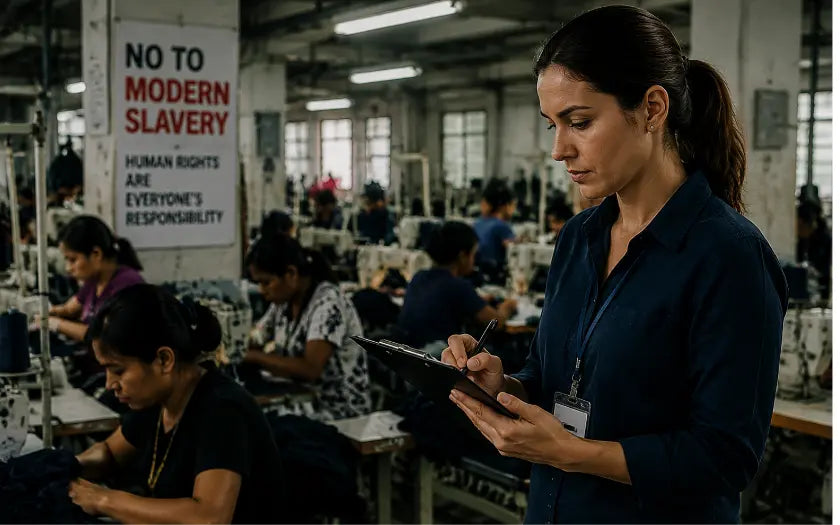
There's a moment that catches many Australian businesses off guard. A supplier audit reveals workers on a construction site in Southeast Asia are living in employer-controlled accommodation, having their passports held, and working far beyond any reasonable hour. Nobody set out to cause harm. The purchasing team was focused on cost and lead times. Nobody asked the harder questions about who was making the product and under what conditions.
That moment — and thousands like it — is exactly what Australia's Modern Slavery Act 2018 was designed to prevent. Not through punishment alone, but through transparency, accountability, and the expectation that businesses will genuinely look.
This guide walks you through what the Act requires, how compliance actually works in practice, what's changing in 2026, and what your organisation needs to do right now.
What Is Australia's Modern Slavery Act?
 The Modern Slavery Act 2018 (Cth) requires businesses to report annually about the steps they have taken to address modern slavery risks in their supply chains and operations. It applies to businesses that are based in, or operate in, Australia with an annual revenue of more than $100 million.
This threshold captures approximately 3,000 entities, including large corporations, foreign entities conducting business in Australia, and the Australian Government.
The Act defines modern slavery broadly. It covers not just trafficking and forced labour in their most extreme forms, but also debt bondage, child labour, forced marriage, and deceptive recruitment. For the purposes of the Act, modern slavery refers to conduct that would constitute an offence under Division 270 (slavery and slavery-like offences) or Division 271 (trafficking in persons) of the Commonwealth Criminal Code, and also includes child labour.
If your organisation meets the threshold, you must prepare and submit an annual Modern Slavery Statement. There's no soft option here — this is a legal requirement, not a voluntary pledge.
What's Changing in 2026 — Read This First
The regulatory environment around modern slavery in Australia is actively shifting. Australia is at a pivotal moment in strengthening its response to modern slavery. With the Australian Government commencing consultations on reforms to the federal Modern Slavery Act, the decisions made in 2026 will shape the effectiveness of Australia's anti-slavery framework for years to come.
The key proposed reforms — some already agreed to in principle by government — include:
Introducing penalties for non-compliance with statutory reporting requirements, lowering the reporting threshold from $100 million to $50 million, requiring entities to report on modern slavery incidents or risks, amending the Act to require entities to have a due diligence system in place, and proposing expanded functions for the federal Anti-Slavery Commissioner in relation to the Act.
The Australian Anti-Slavery Commissioner has recommended the introduction of a mandatory risk-based modern slavery due diligence obligation for reporting entities under the Act, and a mechanism for the Commissioner to declare that a product, service, or industry carries a high risk of modern slavery.
The critical takeaway: even if your business currently sits below the $100 million threshold, the proposed reduction to $50 million could bring you into scope sooner than you expect. And even if you're already reporting, the expectation of how well you report is rising significantly.
Companies operating in or sourcing from Australia should prepare for stricter compliance requirements that align with global frameworks like CSDDD, greater scrutiny over modern slavery statements, and possible penalties and enforcement measures.
Who Needs to Comply?
Understanding your obligations starts with two simple questions.
First: does your entity have annual consolidated revenue of $100 million or more? Second: is your entity an Australian entity, or a foreign entity that carries on business in Australia?
If the answer to both is yes, you are a reporting entity under the Commonwealth Act and must submit an annual Modern Slavery Statement.
It's also worth noting that New South Wales has its own Modern Slavery Act 2018 (NSW), which imposes additional due diligence and reporting obligations on certain NSW public sector entities — including government agencies, state-owned corporations, councils, and universities — regardless of revenue. A range of government agencies, state-owned corporations, councils and universities in NSW have additional modern slavery reporting obligations under the NSW Act.
Even if your organisation doesn't meet the reporting threshold, procurement teams, investors, and customers may still ask you to demonstrate how you manage modern slavery risk in your supply chain. Being prepared ahead of legal obligation is increasingly a commercial necessity.
Step-by-Step: How to Build Your Modern Slavery Compliance Framework
 Step 1 — Understand What You're Looking For
Before you can address modern slavery risk, your team needs to know what it actually looks like in the real world. It's not always dramatic. Warning signs can include unusually low prices from suppliers in high-risk regions, third-party labour hire arrangements that seem difficult to verify, workers who seem unable to speak freely during site visits, or unexplained high staff turnover in a supplier's workforce.
High-risk sectors identified by regulators and international bodies include agriculture, construction, textiles, electronics manufacturing, domestic work, and hospitality. High-risk geographies include parts of Southeast Asia, South Asia, and Sub-Saharan Africa, though modern slavery is not exclusively an overseas problem — it exists in Australian communities too.
Step 2 — Map Your Operations and Supply Chains
This is where the real work begins, and where most organisations underestimate the complexity involved.
Supply chain mapping means identifying not just your direct (Tier 1) suppliers, but tracing further back through Tier 2 and Tier 3 — raw material producers, component manufacturers, logistics providers, labour hire intermediaries. The further back you go, the less visibility you typically have, and the higher the risk.
Start with a proportionate approach. Prioritise the highest-risk supplier relationships, highest-risk geographies, and highest-risk product categories. Document what you find, including the gaps.
A practical tip: engage your procurement team in this process from day one. They often hold relationship history, supplier information, and buying records that a compliance team working in isolation would take months to reconstruct.
Step 3 — Conduct a Modern Slavery Risk Assessment
Once you've mapped your supply chain, assess the likelihood and severity of modern slavery risk across your supplier relationships and business activities. This is a structured process, not a gut-check exercise.
Risk assessment should consider:
-
The nature of the product or service (labour-intensive manufacturing carries different risk than professional services)
-
The geography of production and procurement
-
The structure of the supply chain (direct control vs. multiple intermediaries)
-
The vulnerability of the workforce (migrant workers, seasonal workers, youth workers)
-
Historical incidents or red flags from existing supplier audits
Document your methodology. When you're writing your Modern Slavery Statement, you'll need to explain how you identified and assessed risk — not just what you found.
Step 4 — Take Action to Address Identified Risks
Identifying risk without responding to it defeats the entire purpose of the legislation. Action can take many forms depending on what you find.
For lower-risk suppliers, it might mean including modern slavery clauses in contracts, requiring suppliers to sign a code of conduct, or asking them to complete a self-assessment questionnaire.
For higher-risk relationships, it might mean commissioning independent audits, visiting supplier facilities, engaging a specialist due diligence provider, or making a commercial decision to change suppliers if a risk cannot be adequately managed.
This is also the stage where internal policies matter. Does your organisation have a modern slavery policy? Does your procurement policy require suppliers above certain spend thresholds to provide evidence of their own compliance? Are your buyers trained to recognise warning signs during supplier visits?
Building internal capability in this area is not optional if you want your compliance to hold up to scrutiny. If you're looking to build that capability at the employee level, the Modern Slavery Act Compliance course at the Australian Compliance Training provides structured, practical training aligned to Australia's reporting obligations — ideal for procurement professionals, compliance officers, HR managers, and anyone involved in supply chain decisions.
Don't just document your intentions — document your actions.
Step 5 — Measure Effectiveness
This is the piece that separates serious compliance programs from paper exercises. The Act requires entities to describe not just what they've done, but how they measure whether it's working.
Effectiveness indicators might include: the number of suppliers that completed due diligence questionnaires, the outcomes of supplier audits, whether identified risks were remediated, training completion rates among relevant staff, or changes in supplier relationships driven by modern slavery concerns.
No measurement system is perfect, but showing thoughtful, evolving effort to understand whether your actions are making a difference signals genuine engagement with the legislation.
Step 6 — Write and Submit Your Modern Slavery Statement
Your annual Modern Slavery Statement must be approved by the principal governing body of your organisation — typically the board — and signed by a responsible member (often the CEO or a director).
The statement must cover seven mandatory criteria set out in the Act:
-
Your entity's structure, operations, and supply chains
-
The risks of modern slavery in those operations and supply chains
-
The actions taken to assess and address those risks
-
How you assess the effectiveness of those actions
-
The process of consultation with any entities you own or control
-
Any other relevant information
Submit your statement through the Modern Slavery Statements Register — the publicly searchable database where all statements are published. The Australian Government must submit by 31 December each year; other reporting entities have similar annual deadlines.
A business that fails to comply with its reporting obligations may be requested to provide an explanation to the Attorney-General or undertake remedial action, or both. If a business fails to comply with a request of the Attorney-General, the Attorney-General may publish information about the business and its failure to comply on the Modern Slavery Statements Register.
Step 7 — Build a Continuous Improvement Cycle
Modern slavery compliance is not a one-time task. Supply chains change. Geopolitical conditions shift. New suppliers come on board. Existing suppliers change their own sub-contractors without notifying you.
Review your risk assessment annually at a minimum. Update your supplier due diligence processes when significant changes occur. Refresh training for relevant staff. Track how your statement evolves year-on-year — regulators and civil society organisations are increasingly scrutinising whether statements show genuine improvement or just repetition.
What Good Looks Like vs. What Falls Short
 The Australian Anti-Slavery Commissioner's office and civil society organisations review publicly available statements and have been vocal about the gap between strong and weak reporting.
Strong statements are specific: they name geographies and supply chain tiers, they describe concrete actions taken, they identify real risks rather than stating vaguely that "modern slavery could occur in our supply chain," and they reflect genuine board-level engagement.
Weak statements repeat boilerplate language, apply cookie-cutter risk assessments without sector-specific depth, and describe policies without evidence of implementation. These are the statements that attract attention under a strengthened enforcement regime — and with civil penalties on the horizon, that attention is increasingly consequential.
A Note on Global Alignment
Australia doesn't operate in isolation. The European Union's Corporate Sustainability Due Diligence Directive (CSDDD), the UK Modern Slavery Act, and Canada's Fighting Against Forced Labour and Child Labour in Supply Chains Act all create pressure on global supply chains that Australian businesses are part of.
Companies should prepare for stricter compliance requirements in modern slavery that align with global frameworks like CSDDD, greater scrutiny over modern slavery statements, and possible penalties and enforcement measures.
If you source from or sell to organisations with global footprints, you'll increasingly be asked to demonstrate your modern slavery posture not just under Australian law, but consistent with international standards.
Start Building Your Compliance Framework Today
The businesses that will navigate this regulatory environment most confidently in 2026 and beyond are those that treat modern slavery compliance as a genuine operational commitment — not an annual documentation exercise.
That starts with training the people making procurement decisions, managing supplier relationships, and overseeing compliance obligations. The Modern Slavery Act Compliance course from the Australian Compliance Training delivers exactly that — practical, Australian-law-aligned training that helps your team understand what to look for, what to do, and how to document it properly.
Enrol your team today and build the foundation your Modern Slavery Statement actually needs.


