
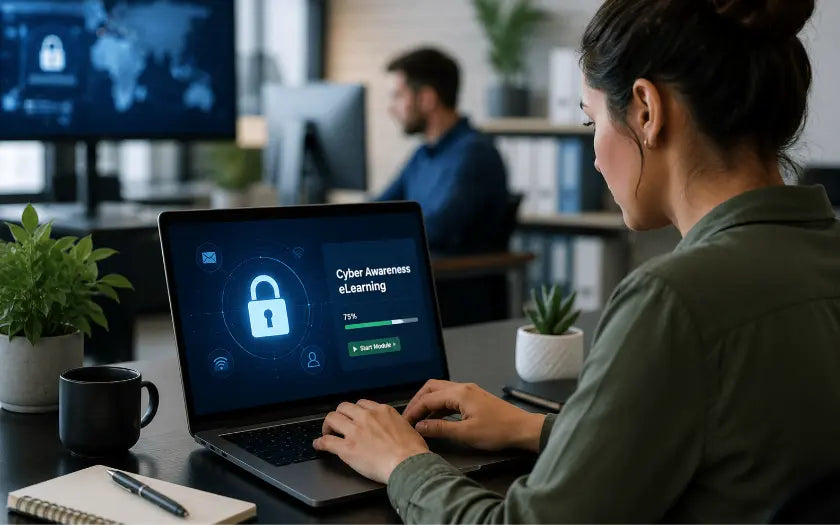
A finance manager at a mid-sized Melbourne accounting firm clicked a link in what looked like a routine email from their cloud storage provider. Within hours, client records were compromised, the firm was scrambling to notify the Office of the Australian Information Commissioner, and the reputational damage took months to repair. The technical cause? A phishing email that bypassed the spam filter. The root cause? Nobody on the team had received cybersecurity training in over two years.
This isn't a rare story. It plays out across Australian businesses every week — in healthcare clinics, construction firms, retail operations, and professional services practices. The threat isn't always sophisticated. Most of the time, it's embarrassingly simple. And that's exactly the point.
Cybersecurity is, at its core, a people problem. Technology can only do so much. Firewalls, endpoint protection, and multi-factor authentication are all valuable — but they can all be undermined in seconds by an employee who doesn't know what to look for. That's where eLearning comes in, and that's what this guide is about.
Why Cybersecurity Is Now a Compliance Issue for Australian Businesses
Australian businesses are operating within a regulatory environment that has made cybersecurity a legal and compliance obligation — not just a best practice recommendation.
The Security of Critical Infrastructure (SOCI) Act places mandatory cybersecurity obligations on entities operating in sectors like energy, health, water, and communications. The Privacy Act 1988 requires organisations to take reasonable steps to protect personal information from misuse and unauthorised access. Failing to do so — and then suffering a notifiable data breach — triggers mandatory reporting obligations under the Notifiable Data Breaches (NDB) scheme to the OAIC.
The Australian Cyber Security Centre (ACSC) publishes the Essential Eight — a prioritised set of strategies to mitigate cyber incidents. While not all of these are legislatively mandated for every business, they represent the accepted benchmark that regulators, insurers, and clients increasingly expect organisations to be working toward.
What makes this particularly pressing in 2026 is the scale of the cyber threat landscape in Australia. According to the ACSC's annual reports, cybercrime reports have grown significantly year on year, with business email compromise and phishing among the most commonly reported incidents. The financial and reputational damage spans every industry and every business size.
The uncomfortable truth is that most of those incidents involve a human decision — a click, a download, an overshared password. Training changes those decisions.
The Real Gaps That eLearning Closes
Before diving into the how, it's worth being honest about where cybersecurity awareness breaks down in most Australian workplaces.
Employees often don't know what a phishing email looks like in their specific industry context. A phishing email targeting a healthcare worker looks different from one targeting someone in financial services. Generic training that shows a badly formatted email with obvious red flags doesn't prepare someone for the sophisticated, highly targeted spear-phishing attempts that are now the norm.
Staff also tend to underestimate their personal role in data security. The belief that "I don't handle sensitive data, so it doesn't apply to me" is extraordinarily common — and dangerously incorrect. Every employee with network access is a potential entry point.
And then there's the culture problem. If cybersecurity is treated as an IT department concern that gets mentioned once during onboarding and never revisited, it never becomes part of how a team actually operates day-to-day. eLearning, done properly, changes that.
Good eLearning creates repeated, structured touchpoints that normalise security-conscious behaviour. It gives employees practical scenarios they can recognise from their own experience. And it creates a documented training record that demonstrates due diligence if an incident ever occurs and regulators come asking.
Building a Cyber-Safe Workplace: The Framework
 Step 1 — Understand Your Risk Profile Before You Train
Not every business has the same cybersecurity risk exposure. A sole-trader bookkeeper has different vulnerabilities than a 200-person healthcare provider. Before designing or selecting a training program, it's worth spending time identifying:
Where your sensitive data lives and who can access it. How your team works — on-site, hybrid, or remote. What types of external communications your staff regularly receive. Whether you operate in a regulated sector with specific cybersecurity obligations.
This risk mapping exercise doesn't need to be elaborate. It can be as simple as a conversation with your IT provider and a review of your current systems. The output is clarity about what your employees actually need to understand — and where your training should be focused.
Step 2 — Make Foundational Cybersecurity Training Universal
Every employee, regardless of seniority or technical ability, needs a foundational understanding of cybersecurity basics. This isn't about turning your team into security experts. It's about ensuring nobody is the weakest link.
Foundational training should cover how to identify phishing and social engineering attempts, what to do when something suspicious arrives, how to manage passwords and access credentials responsibly, the safe use of personal devices and home networks for work purposes, and what a data breach or suspected incident actually looks like from their perspective.
The Cybersecurity Fundamentals & Ethical Hacking course from the Australian Compliance Training is designed for exactly this purpose — giving employees a grounded, practical understanding of the cybersecurity landscape without requiring a technical background. It's CPD-accredited and built around Australian regulatory frameworks, which matters when your training records need to demonstrate relevance.
Step 3 — Layer Privacy Compliance Training Alongside Cybersecurity
Cybersecurity and privacy obligations are deeply intertwined in the Australian regulatory environment, and the training should reflect that.
An employee who understands cybersecurity hygiene but doesn't understand the Privacy Act's requirements around data handling can still cause a notifiable breach — not through a cyberattack, but through mishandling personal information. Sending client records to the wrong recipient, storing sensitive data on unsecured personal cloud storage, or simply not knowing what constitutes personal information under the Australian Privacy Principles are all live risks in every workplace.
The Privacy & AI Governance: Complying with the Privacy Act course tackles this directly — and importantly, it also addresses the growing use of AI tools in the workplace, which introduces new privacy and data handling considerations that many organisations haven't yet grappled with seriously.
In 2026, staff using AI writing assistants, customer service chatbots, or data analysis tools in their daily work need to understand what personal data those tools are processing and whether that use is consistent with their employer's privacy obligations. This is no longer a hypothetical edge case — it's a mainstream workplace reality.
Step 4 — Address Sector-Specific Obligations Directly
For Australian businesses operating in regulated sectors, generic cybersecurity training isn't enough on its own. The training needs to connect to the specific obligations of that industry.
Healthcare organisations operating under the My Health Records Act and the NSQHS Standards need staff who understand data security in a clinical context. The Infection Prevention & Control (IPC) – NSQHS course and the Medication Safety & High-Risk Medicines (NSQHS) course address adjacent compliance obligations for healthcare teams — but from a cyber-safety perspective, pairing these with privacy and data security training creates a genuinely comprehensive compliance posture.
Financial services businesses dealing with AUSTRAC obligations need staff who understand both the AML/CTF reporting framework and the cybersecurity risks associated with financial crime. The AML/CTF course from the Australian Compliance Training addresses the financial crime compliance angle, while cybersecurity training addresses the technical threat vectors that often intersect with it.
Step 5 — Build Psychosocial Safety Into the Cyber Safety Picture
This connection is less obvious, but it's genuinely important. Cybersecurity incidents don't just cause technical or financial harm — they cause stress, anxiety, and in serious cases, significant psychological distress for the employees involved. The person who clicked the phishing link. The IT coordinator who has to lead the breach response. The manager who has to notify clients.
Australian WHS obligations — including the new psychosocial hazard duties — require employers to consider these impacts. A workforce that has been trained on what to do when an incident occurs, rather than just how to prevent one, is better equipped to respond calmly and effectively. That has measurable outcomes for both incident management and employee wellbeing.
The Psychosocial Hazards & Mental Health course offers foundational understanding of these WHS obligations, which managers responsible for cyber incident response teams should consider alongside their technical training.
The eLearning Delivery Model: What Actually Works
 Not all online training is equal. The format and delivery of cybersecurity eLearning matters enormously for whether it actually changes behaviour.
Short, modular lessons that can be completed in 20–30 minutes perform better than hour-long sessions for retention and completion rates. Real-world scenarios drawn from Australian industry contexts are significantly more effective than abstract examples. Assessments that require employees to demonstrate understanding — not just click through — create genuine accountability. And structured, documented completion records are essential for demonstrating regulatory compliance.
Self-paced delivery is also a practical necessity for most Australian businesses. Staff can't always complete training together, and forcing synchronous compliance training sessions creates logistical problems that often result in training being deprioritised. The Australian Compliance Training's online course library is built on exactly this model — structured, CPD-accredited, self-paced, and designed around Australian regulatory obligations rather than adapted from overseas materials.
How to Roll Out Cyber Training Without Resistance
The most technically excellent training program in the world will fail if employees approach it as a burden. Getting buy-in matters.
Framing matters enormously. When managers communicate that cybersecurity training is about protecting the business and protecting employees — not about surveillance or distrust — reception changes immediately. People respond to understanding why something matters, not just being told to complete it.
Tying training completion to real business context helps too. If a team has recently received an unusual email, or if there's been a high-profile cyber incident in their industry in the news, that's the moment to send the training link. Relevance makes everything more engaging.
And leadership participation signals seriousness in a way nothing else does. When senior leaders complete the same training as frontline staff — and say so — it transforms compliance training from an obligation imposed from above into a shared organisational practice.
Maintaining a Cyber-Safe Culture Over Time
One-off training doesn't create a cyber-safe workplace. Culture does.
Annual refresher training is the minimum — but the most effective organisations build cybersecurity awareness into their ongoing rhythms. Regular team communications about emerging threats. Clear and simple reporting pathways when something suspicious occurs. Recognition for employees who flag issues early. These things compound over time into a genuine security culture.
What a Strong Cyber Training Record Demonstrates
When a regulatory inquiry follows a data breach, or when a cyber insurer reviews a claim, or when a major procurement client runs a supplier security assessment, one of the first things they ask about is staff training. Can you demonstrate that your employees received structured, documented cybersecurity training? Can you show when, who completed it, and what it covered?
 Australian businesses that can answer yes to those questions are in a materially stronger position — legally, commercially, and reputationally.
The Australian Compliance Training provides structured completion records for all courses, which serves exactly this function. It's not just about the learning — it's about being able to evidence the learning when it counts.
Putting It All Together: A Practical Action Plan
If you're a business owner, HR manager, or compliance lead reading this and trying to figure out where to start, here's the honest answer: start with the two or three courses most directly relevant to your biggest risks and your regulatory environment, and build from there.
For most Australian businesses, that means cybersecurity fundamentals and privacy compliance first — then layering in sector-specific and role-specific training as you go. The full course library at the Australian Compliance Training gives you a clear starting point, with courses covering WHS, privacy, AML/CTF, cybersecurity, aged care, NDIS, construction safety, and more — all in one place, all built for Australian law.
The businesses that will navigate the next wave of cyber threats and regulatory scrutiny most effectively aren't necessarily the ones with the biggest IT budgets. They're the ones whose people know what to do — and why it matters.
Frequently Asked Questions (FAQs)
Q1: Is cybersecurity eLearning sufficient on its own for Australian compliance obligations?
eLearning is a critical component but works best as part of a broader strategy that includes technical controls, clear incident response policies, and regular review of your security practices. For regulatory purposes, documented eLearning completion demonstrates that reasonable steps were taken to train staff — which is a specific requirement under the Privacy Act and a key consideration under the SOCI Act for applicable entities.
Q2: How often should Australian businesses update their cybersecurity training?
At minimum, annually. However, the threat landscape changes quickly, and businesses in high-risk sectors like financial services, healthcare, and critical infrastructure should consider refresher modules every six months. Training should also be triggered after any significant industry cyber incident, or whenever a major legislative change occurs that affects your obligations.
Q3: Do small businesses in Australia need formal cybersecurity training for staff?
Yes — and the Privacy Act's "reasonable steps" requirement applies regardless of business size. Small businesses handling personal information, health records, or financial data have real obligations. The good news is that online, self-paced training from providers like the Australian Compliance Training is cost-effective and accessible without needing an in-house IT or compliance team.
Q4: What is the ACSC Essential Eight, and does training cover it?
The Essential Eight is a set of baseline cybersecurity strategies published by the Australian Cyber Security Centre, designed to help organisations mitigate the most common cyber threats. Good cybersecurity eLearning aligns with these principles by addressing the human behaviour aspects — things like application control awareness, multi-factor authentication habits, and safe patching practices — that complement the technical controls.
Q5: What should Australian businesses look for when choosing a cybersecurity eLearning provider?
Look for training that is built specifically around Australian legislation and regulatory frameworks, CPD-accredited, structured around real workplace scenarios rather than abstract theory, and capable of generating documented completion records. The Australian Compliance Training meets all of these criteria, with training designed for Australian employers and employees across multiple industries.
Q6: How does cybersecurity training connect to Privacy Act compliance in Australia?
The connection is direct. A data breach caused by poor cybersecurity practices — a phishing click, an unsecured device, an accidental disclosure — triggers Privacy Act obligations if personal information is involved. Training staff on both cybersecurity hygiene and the Australian Privacy Principles is how organisations demonstrate that reasonable protective steps were taken, which is a legal requirement, not just a best practice.
Q7: Can cybersecurity eLearning be completed remotely or by hybrid workers?
Absolutely — and this is one of its core advantages. Self-paced online training is ideal for distributed teams, remote workers, and organisations with multiple locations. All staff can complete training on their own schedule, with completion automatically recorded and accessible to the employer for compliance documentation purposes.
Q8: What happens if an Australian business suffers a breach and has no training records?
The absence of documented staff training is a significant aggravating factor in any regulatory review following a data breach. It undermines the organisation's ability to argue that reasonable steps were taken to protect personal information. Beyond the regulatory dimension, it creates exposure in civil claims and can affect cyber insurance coverage. Documented training through a structured provider is one of the most straightforward risk management steps a business can take.


