
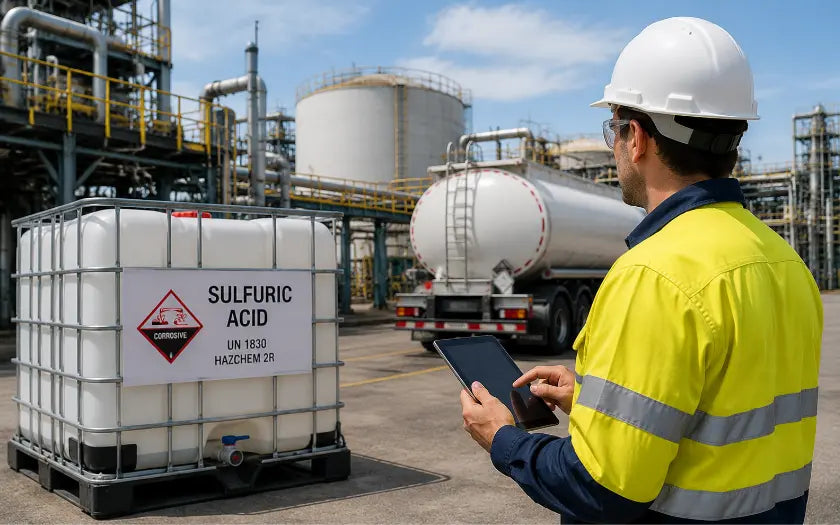
There is a quiet crisis running through the veins of Australian industry right now — and most people outside mining, fertiliser, and manufacturing circles haven't heard much about it yet.
Sulfuric acid. The world's most consumed industrial chemical. The invisible backbone of copper extraction, phosphate fertiliser production, nickel refining, battery manufacturing, and water treatment. And in 2026, it has become one of the most strategically contested commodities on the planet.
What's happening globally is not a minor supply hiccup. It is a compound shock — multiple disruptions hitting simultaneously — and Australian industries are directly in the firing line.
What Triggered the 2026 Sulfuric Acid Supply Crisis?
 To understand where Australia stands, you need to understand what converged to create this situation.
Two independent events have collided: the effective closure of the Strait of Hormuz to commercial shipping since late February 2026, and China's export prohibition on sulfuric acid effective from May 1, 2026. Together, they have removed a substantial portion of available global supply at a moment when the market had almost no buffer.
China, with approximately 4.6 million tonnes of sulfuric acid exports in 2025, is projected to cut exports to around 1.2 million tonnes in 2026 — a sharp decline driven by domestic priorities, specifically the need to stabilise fertiliser supply amid rising demand.
Russia's sulfur export ban, first imposed in November 2025, has been extended through to June 2026 following drone strikes targeting the Astrakhan facility, which produces nearly 60% of Russia's sulfur. Turkey added to the pressure with its own sulfur export ban effective from April 2026.
This is what analysts are calling a "triple supply shock" — and its effects are cascading through industries that depend on acid as a core processing input. For a deeper breakdown of the geopolitical triggers, GEM Mining Consulting's analysis on Mining.com.au offers a clear market-level view of where the pressure points sit.
Sulfur prices have risen by over 70% this year, climbing from approximately $525 to around $910 per ton, causing acid costs to account for 65–70% of production costs in the most exposed operations.
Why Australia Is Particularly Exposed
Australia's vulnerability is structural, not accidental.
Availability of sulfuric acid is crucial to Queensland industry in particular, underpinning existing fertiliser production and minerals processing. Without a readily available and cost-effective source of sulfuric acid, some existing mining-related projects are unlikely to remain commercially viable, and a range of new critical minerals and battery-related manufacturing projects may not be feasible.
The Queensland Government's own Sulphuric Acid Supply Study — a foundational document for anyone working in the state's minerals sector — maps this dependency in granular detail across fertiliser, copper, cobalt, lithium, nickel, and rare earth processing. It is worth reading in full by any industry or policy professional assessing their exposure.
The fertiliser sector is the most immediate pressure point. Annual MAP (monoammonium phosphate) and DAP (diammonium phosphate) imports have typically totalled around 750,000 tonnes and 200,000 tonnes respectively, supplementing local production at western Queensland's Phosphate Hill, which has capacity to make 970,000 tonnes if gas is available. Until recently, China and Saudi Arabia were primary sources for Australia's blended ammonium phosphate needs.
Both of those sources have now been severely disrupted.
The CEO of peak industry body Fertilizer Australia, Stephen Annells, warned that the phosphate supply situation "will potentially be a bigger concern than our urea problem," particularly given that MAP and DAP are critical to next year's pre-season nutrient management. Fertilizer Australia is the peak body coordinating industry response and is a key resource for producers navigating the current environment.
For Australian farmers preparing for the next growing season, that warning deserves to be taken seriously.
The Industries Most at Risk in Australia
 Mining and Copper Processing
Australia's mining sector uses sulfuric acid extensively for heap leach operations — particularly in copper and nickel extraction. Hydrometallurgical copper extraction requires approximately 2.5 tonnes of sulfuric acid per tonne of copper produced. Unlike sulfide concentrates that can be processed through alternative smelting methods, oxide deposits require acid leaching for economically viable extraction.
This means that when acid supply tightens, the response isn't just a cost increase — it's a production shutdown. Binary outcomes, not gradual adjustments.
Mount Isa in Queensland provides a real illustration of this exposure. The Queensland Government's supply study identified that the largest consumer of sulfuric acid in the North West Queensland region is Incitec Pivot Limited, consuming approximately 1.16 million tonnes per annum at its Phosphate Hill operation, sourcing around 850,000 tonnes from its Mount Isa Acid Plant using Glencore's metallurgical waste gases and imported sulfur as feedstocks.
With Glencore having announced the winding down of copper mining at Mount Isa, that captive acid source faces genuine long-term pressure — even before the current global shock is factored in. The Minerals Council of Australia has been actively engaging government on the downstream risks of losing integrated smelting capacity, and their policy positions are worth tracking for any business operating in this space.
Agriculture and Fertiliser Manufacturing
Australian farmers are already feeling the squeeze through fertiliser prices, and the worst may not have passed yet.
Fertilizer costs are projected to rise by 15–20% in the initial two quarters of 2026, driven directly by the sulfuric acid shortage affecting phosphate fertiliser production globally. A worsening global sulfuric acid shortage threatens to restrict production of MAP and DAP products well into 2026–27, even if hostilities in and around Iran cease soon.
The Australian Bureau of Agricultural and Resource Economics and Sciences (ABARES) regularly publishes commodity and input cost outlooks that are directly relevant to farmers and agribusiness operators trying to plan ahead in this environment.
For a nation that exports agricultural commodities worth hundreds of billions of dollars annually, higher input costs and lower yields represent a significant economic risk — not just a farm-gate problem.
Critical Minerals and Battery Manufacturing
Australia's critical minerals strategy — central to its economic future — depends heavily on acid-intensive processing. Nickel, cobalt, lithium, and rare earth processing all require sulfuric acid at various stages. A lack of available sulfuric acid has a strong likelihood to reduce economic activity and employment opportunities in Queensland's mineral provinces and severely hamper efforts to develop new and essential critical minerals, value-added fertilisers, and battery electrolyte manufacturing projects.
The Australian Critical Minerals Strategy published by the Department of Industry, Science and Resources sets out Australia's ambitions in this space. What it now urgently needs to account for is the chemical input security that makes those ambitions achievable — sulfuric acid availability being chief among them.
How Australian Industries Can Respond
 1. Diversify Sourcing — Immediately
The first and most urgent step is reducing single-source dependency. The broad rule is simple: regions with captive smelter acid or sulphur-burning plants can absorb the shock better than regions that rely on spot merchant cargoes. Australia has historically leaned on imports from South Korea and China — both of which are now constrained.
Australian procurement teams need to be actively building relationships with alternative suppliers — Japan, select Middle Eastern sources where logistics allow, and domestic smelter-linked acid producers. For companies navigating complex international procurement under force majeure conditions, the Akin Gump legal analysis on the sulfuric acid crisis and supply contracts is one of the clearest published guides to understanding contract rights and obligations in the current environment.
This isn't speculative planning. It needs to happen now.
2. Invest in Domestic Production Capacity
Australia produces sulfuric acid domestically at eight plants, most co-located with smelting operations that generate sulfur dioxide as a processing byproduct. Expanding this capacity — or at minimum protecting existing production from closure — is a national economic priority, not just a commercial one.
The medium-term answer, according to industry analysts, is more local production and better contract coverage: sulfur-burning plants, captive acid from copper and zinc smelters, and larger storage facilities.
Australia has the industrial base to move toward this model. The policy will needs to catch up. The Department of Industry, Science and Resources and state development agencies are the appropriate channels for industry to be pressing this case formally and urgently.
3. Adopt Alternative Processing Technologies
For mining operators specifically, the global crisis has accelerated interest in processing alternatives that reduce acid dependency.
The SART process (Sulfidization-Acidification-Recycle-Thickening) allows the recycling of acid in mining operations, decreasing the need for fresh acid by 10–15%. Additionally, Glycine Leaching is a commercially available alternative for processing copper oxide, replacing sulfuric acid with glycine. For nickel production, the Pyrometallurgical Shift (RKEF) method completely eliminates acid use, although it requires higher energy consumption.
None of these are silver bullets — they come with capital costs, operational changes, and trade-offs. The CSIRO's Mineral Resources division has been active in developing and evaluating alternative hydrometallurgical processes relevant to Australian conditions, and represents a credible domestic research partner for operations exploring process change.
4. Lock In Long-Term Supply Contracts
Spot market dependence is a vulnerability that companies can, to some degree, manage themselves. Contract renegotiation has become common as suppliers seek to capture scarcity premiums while buyers attempt to secure supply continuity.
Australian companies that haven't locked in multi-year supply agreements are exposed. Those negotiating now face elevated prices — but the cost of certainty is lower than the cost of a production shutdown. Legal teams also need to review force majeure clauses, which are being actively tested across global supply chains right now.
Wood Mackenzie, whose April 2026 outlook specifically identified sulfuric acid availability as a primary operative constraint on copper production, provides ongoing market intelligence that procurement and strategy teams should be drawing on when building contract positions.
5. Build Strategic Stockpiles
Sulfuric acid storage carries genuine safety and infrastructure challenges — it is a highly corrosive substance requiring purpose-built facilities and compliance with Safe Work Australia's hazardous chemicals storage frameworks. But the lesson from 2026 is that just-in-time supply chains for critical industrial chemicals carry unacceptable systemic risk.
Australian companies and, arguably, state and federal governments should be exploring strategic reserve models for chemicals that underpin critical industries. Queensland's government study flagged this thinking as necessary for the state's mineral province competitiveness. The time to act on that thinking has arrived.
The Government's Role
This crisis has a policy dimension that individual companies cannot solve on their own.
The federal government's Critical Minerals Strategy and associated investment vehicles need to explicitly account for the chemical inputs that critical mineral processing depends on. There's limited strategic value in securing world-class lithium or nickel deposits if the acid required to process them is unavailable or unaffordable.
At the state level, Queensland has demonstrated awareness of this issue through its supply study. Translating that awareness into infrastructure investment, planning decisions, and industry coordination is the next concrete step. Resources Queensland and equivalent bodies in Western Australia are the natural homes for this policy work.
Australia also has a role to play diplomatically — actively building trade relationships with countries that can provide reliable sulfur or acid supply, and reducing the geographic concentration that made this crisis so acute. The Department of Foreign Affairs and Trade (DFAT) has a clear role in supporting industry through the diversification of critical chemical trade relationships.
What the Global Picture Tells Us
Internationally, the nations weathering this crisis best share one characteristic: they have some form of domestic production or captive smelter acid that insulated them from spot market volatility. India, for example, is better placed than Chile due to already importing large volumes of sulfuric acid from Japan and South Korea while also adding domestic sulfur-burning capacity.
Australia needs to build toward a similar resilience profile — not through isolationism, but through genuine supply diversity backed by domestic production capability.
Supply chain resilience has emerged as a critical competitive differentiator, with companies investing heavily in vertical integration and alternative sourcing capabilities. These structural changes represent permanent shifts in industrial organisation rather than temporary crisis responses.
That final point matters. This isn't a crisis that resolves and then everything returns to how it was. The 2026 sulfuric acid shock is permanently reshaping industrial supply chains. Australian industries that treat it as a temporary disruption to wait out will find themselves structurally disadvantaged against competitors who used this moment to fundamentally rethink their inputs strategy.
The International Copper Study Group and Fastmarkets are among the global bodies publishing the most current and detailed data on acid market dynamics — both are worth monitoring on an ongoing basis for any business with meaningful exposure to this market.
Preparing for Industrial Change and Supply Chain Uncertainty
Australia’s sulfuric acid crisis highlights a broader reality facing modern industries: businesses must be prepared to adapt quickly to global disruptions, regulatory shifts, and evolving operational risks.
From mining and manufacturing to agriculture and critical minerals processing, organisations that invest in strategic planning, operational resilience, and workforce adaptability will be better positioned to navigate future supply chain challenges.
Professionals looking to strengthen their understanding of organisational resilience, transformation, and business adaptation can explore:
Digital Transformation & Change Management Training Course .
This course helps professionals understand:
-
change management strategies
-
operational transition planning
-
organisational resilience
-
workplace transformation
-
leadership during industry disruption
Explore more industry-focused workplace and compliance training at:
Australian Compliance Institute


