
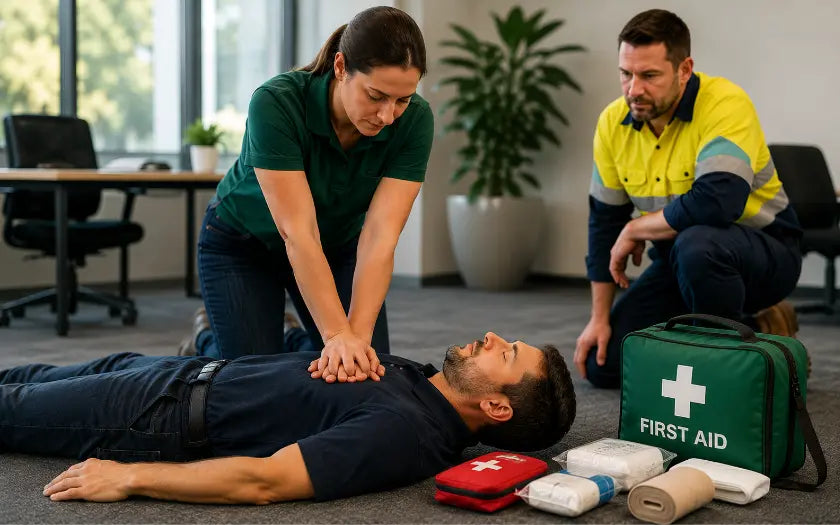
A warehouse supervisor in Brisbane once told me about the morning a forklift operator sliced his hand open on a metal edge. The injury wasn't catastrophic, but the response was a mess. Nobody could find the first aid kit key, the trained first aider had moved sites the week before, and the closest working phone was two buildings away. The cut healed fine. The near-miss in the response, though, stuck with the whole team for months.
That story isn't unusual. It's also exactly the kind of scenario that Work Health and Safety (WHS) laws across Australia are designed to prevent. First aid preparedness isn't a box-ticking exercise for an audit folder — it's the difference between a manageable incident and one that spirals because help wasn't ready when it mattered.
This article walks through what WHS first aid obligations actually require, how to build a system that works in real conditions, and where most businesses quietly fall short.
Why First Aid Sits at the Heart of WHS Compliance
 Every business operating under Australia's model WHS laws has a duty to provide adequate first aid arrangements. This isn't a vague suggestion — it's a specific legal duty placed on the "person conducting a business or undertaking" (PCBU), spelled out in the WHS Regulations and supported by the Model Code of Practice: First Aid in the Workplace published by Safe Work Australia.
The Code makes clear that compliance isn't about owning a first aid kit and calling it done. It covers four interconnected pillars:
-
First aid equipment and kits suited to the actual risks present
-
Trained first aiders in sufficient numbers
-
Accessible facilities and signage
-
Procedures that workers actually know and can follow under pressure
Each state and territory regulator — SafeWork NSW, WorkSafe Victoria, WorkSafe Tasmania, SafeWork SA, and others — applies this model Code with local variations, so it's worth checking your specific jurisdiction's guidance alongside the national framework.
Start With a Genuine Risk Assessment
Here's where many businesses go wrong from day one: they buy a generic first aid kit off a shelf and assume that satisfies the law. It doesn't.
SafeWork NSW is explicit that a PCBU must consider the nature of the work, the hazards present, the size and spread of the workforce, and the number of people on site when deciding what first aid provisions are needed. A quiet accounting office and a busy commercial kitchen have wildly different risk profiles, and their first aid setups should reflect that.
Questions worth asking during a risk assessment
A practical risk assessment doesn't need to be complicated. It needs to be honest. Walk the site and ask:
-
What injuries have actually happened here before, even minor ones?
-
Are there hazards like hot surfaces, chemicals, height work, or heavy machinery?
-
How spread out is the workforce, and how far is help from each area?
-
Are there shift workers, remote workers, or lone workers who might not have immediate access to a first aider?
Safe Work Australia's Code includes a sample risk assessment template that many businesses adapt rather than build from scratch, which is a sensible starting point if you're not sure where to begin.
First Aid Kits: More Than a Box With a Cross on It
Once the risk profile is understood, the kit contents should follow logically. A low-risk office environment — think a marketing agency or a call centre — typically needs supplies for minor cuts, headaches, and the occasional sprained ankle. A high-risk environment, such as a construction site or manufacturing floor, needs considerably more: burn dressings, eye wash, thermal blankets for shock, and heavy-duty bandaging.
Industry guidance commonly references Australian Standard AS 2675 as a benchmark for compliant kit contents, though the specific items should always be matched back to your own risk assessment rather than copied wholesale from a generic checklist.
A few practical habits make a real difference here:
-
Assign one person per location to check and restock the kit on a set schedule, not "whenever someone notices it's empty."
-
Keep a simple log of what's used and when, so restocking isn't guesswork.
-
Place kits where the highest-risk activities actually happen, not just near the front reception desk where it's convenient for visitors to see.
Visibility matters too. AS 1319 sets the standard for safety signage, including the white cross on a green background that should mark every first aid kit and station. Kits shouldn't be locked away unless there's a genuine security risk — and if they are, every shift needs a clearly identified key holder.
How Many First Aiders Do You Actually Need?
 This is one of the most commonly misunderstood parts of WHS first aid duties. There's no single national number that applies to every workplace — the ratio depends on risk classification (low or high risk) and headcount, and state guidance such as the NSW Code of Practice provides indicative tables to help PCBUs work this out.
What's consistent across jurisdictions is the underlying principle: a trained first aider should be reasonably close to every worker, every shift, with minimal delay. Some factors that should push a business toward having more first aiders than the bare minimum include:
-
Multiple shifts, including night or weekend work when staffing is thinner
-
Seasonal spikes in workforce numbers
-
Large numbers of visitors or members of the public on site
-
Unique hazards specific to the industry, like amusement rides or fitness equipment
If it's genuinely impractical to have a trained first aider physically on site — a small remote office, for example — the regulator expects a documented arrangement, such as a nearby medical practice or a neighbouring business with trained staff, plus a clear ability to contact emergency services quickly. This arrangement needs to be communicated to workers, not just written into a policy document nobody reads.
A real-world example
A regional logistics company with a dozen scattered depots once relied on a single first aid officer based at head office, three hours from the furthest site. After a worker at a remote depot suffered a chemical splash to the eye and waited almost forty minutes for trained help, the company restructured entirely — training at least one first aider at every depot and running annual refreshers. The cost of training was small compared to the liability and harm that single incident exposed.
Qualifications, Refreshers, and Keeping Skills Current
A first aider isn't just someone who's keen to help. WHS guidance requires that first aiders hold a nationally recognised qualification issued by a Registered Training Organisation, covering the nationally endorsed first aid units of competency.
Crucially, this isn't a one-and-done certificate. Industry standard practice, reflected in guidance from regulators like SafeWork NSW, is that CPR skills should be refreshed annually, while the broader first aid qualification should be renewed roughly every three years. Skills like CPR are perishable — confidence and muscle memory fade quickly without practice, and a first aider who hasn't revisited their training in years may hesitate exactly when speed matters most.
This is also where general workforce awareness training adds real value, separate from formal first aider certification. Not every employee needs to be a qualified first aider, but every employee benefits from understanding what to do in the first sixty seconds of an emergency — who to call, where the kit is, and how to support the trained first aider rather than get in the way. A structured course like the Workplace First Aid Awareness for Employees program from Australian Compliance Training is built around exactly this gap — giving the broader workforce practical awareness so the whole team responds calmly and correctly, rather than leaving everything to one person who happens to be nearby.
Defibrillators: A Growing Expectation, Not Just a Nice-to-Have
Automated External Defibrillators (AEDs) have moved from "optional extra" to genuine best practice in many Australian workplaces, particularly where there's risk of electrocution, where ambulance response times are likely to be longer, or where large numbers of the public pass through.
SafeWork SA notes that AEDs are designed to be used by trained and untrained people alike, with step-by-step audible instructions and built-in checks that guide the user through the process. South Australia has gone further than most jurisdictions, with legislation now mandating AEDs in certain buildings, facilities, and vehicles. Other states are watching this space closely, and it's reasonable to expect similar requirements to spread over time.
If your workplace fits the risk profile — public-facing premises, physically demanding work, or simply a location far from emergency services — installing an AED and making sure staff know it exists is a relatively low-cost step with outsized potential impact.
Building Procedures People Will Actually Follow
 Equipment and trained people are only half the picture. The other half is procedure — and procedures only work if people know them without having to dig through a policy manual mid-emergency.
Effective first aid procedures typically cover:
-
Who to contact first, internally and externally (000 for emergencies, plus an internal first aider or supervisor)
-
Where the nearest first aid kit and AED are located, clearly signed and known
-
How incidents get recorded and reported afterward, both for WHS compliance and for spotting patterns over time
-
What happens during shift changes or when the usual first aider is away
The best procedures are tested, not just written. Running a short, low-pressure simulation — even a five-minute walkthrough during a team meeting — exposes gaps far more reliably than a document review ever will. The Brisbane warehouse story at the start of this article is a perfect case: the policy existed on paper, but nobody had actually tested whether the key was findable or the trained first aider was still on site.
Consultation Isn't Optional
WHS law also places a duty on PCBUs to consult workers when determining first aid needs, and to review those arrangements regularly rather than setting them once and forgetting them. Workers on the floor often know things management doesn't — which corner of the site is genuinely hard to reach, which task causes the most near-misses, or which shift feels under-resourced when something goes wrong.
A short, recurring conversation with staff — even informally — tends to surface practical issues that a desk-based risk assessment alone would miss.
Common Gaps Worth Checking Today
A few quick checks tend to reveal where most businesses are exposed, even ones that believe they're compliant:
-
Is the first aid kit actually stocked for your specific hazards, or is it a generic off-the-shelf box?
-
Does every shift, including nights and weekends, have a trained first aider reasonably accessible?
-
Are CPR refreshers happening annually, and full qualifications renewed within three years?
-
Do general staff — not just designated first aiders — have basic awareness of what to do in the first few minutes?
If any of those raise doubt, it's worth treating that as a genuine signal rather than a minor administrative gap.
Bringing It All Together
Meeting WHS first aid responsibilities isn't about satisfying an inspector once a year. It's about building a system — risk-assessed equipment, sufficiently trained people, accessible facilities, and procedures that are tested rather than assumed — that holds up on an ordinary Tuesday afternoon when something unexpected happens.
The businesses that get this right tend to share one trait: they treat first aid awareness as something the whole workforce shares responsibility for, not just the one or two people wearing a "First Aider" lanyard. Building that wider awareness across your team is one of the most cost-effective safety investments available, and it's exactly what the Workplace First Aid Awareness for Employees course from Australian Compliance Training is designed to deliver — practical, workplace-relevant awareness training that helps every employee respond with confidence, not just the designated first aider.
If your last review of first aid arrangements was more than twelve months ago, now is a reasonable time to revisit it.


