
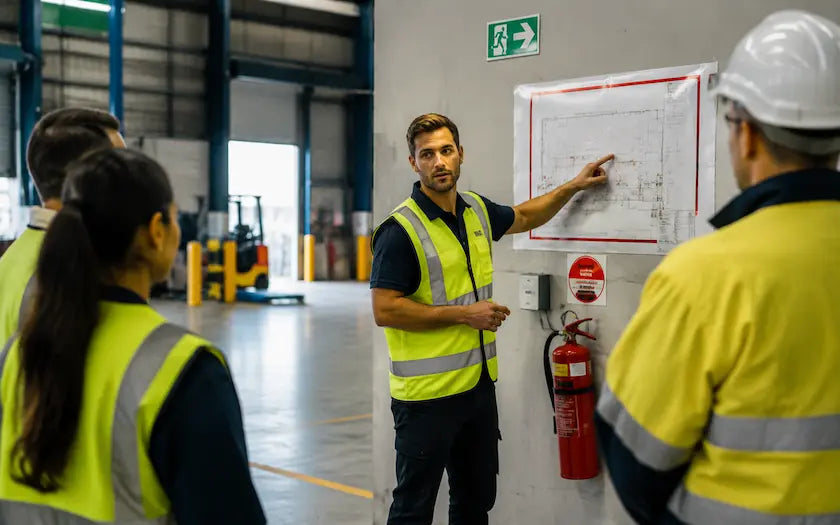
A maintenance worker finishes his shift at a busy Melbourne warehouse and heads to the locker room. Seconds later, a forklift battery sparks and ignites nearby packaging material. Within two minutes, smoke fills three aisles. The alarm sounds.
Half the workers know exactly where to go. The other half — mostly casuals who started that week — freeze. They have never been walked through the evacuation route. They have never met a warden. They didn't even know there was an assembly point.
That scenario isn't hypothetical. Versions of it play out across Australia every year. The difference between a near-miss and a tragedy often comes down to one thing: whether people were properly trained before the emergency happened.
Why Fire Safety Training Is Non-Negotiable in Australian Workplaces
Australia has made real progress on workplace safety over the past decade. According to Safe Work Australia's Key Work Health and Safety Statistics 2025, the worker fatality rate dropped 24% between 2014 and 2024. That's encouraging — but it doesn't mean the risk has disappeared. Fire-related incidents remain one of the most unpredictable and fastmoving hazards any workplace can face.
What makes fire especially dangerous is the speed at which conditions change. A small ignition can become a life-threatening situation in under three minutes. In that window, workers need to act — not think, not search for instructions, not wait for someone else to take the lead. They need to already know what to do.
That knowledge only comes from structured, consistent training.
The Legal Framework: What Australian Law Actually Requires
Under Regulation 43 of the Work Health and Safety (WHS) Regulations, every Person Conducting a Business or Undertaking (PCBU) in Australia is legally required to prepare and maintain a workplace emergency plan. This isn't optional — it's the law across all states and territories that have adopted the model WHS framework.
The emergency plan must cover how workers will be alerted, how they'll evacuate safely, how emergency services will be contacted, and how people with mobility or sensory impairments will be assisted. Critically, it must also include how often training and practice drills will be conducted.
AS 3745:2010 — Planning for Emergencies in Facilities is the Australian Standard that underpins evacuation planning requirements. It covers everything from the design of evacuation diagrams and assembly point placement to how emergency control organisations should be structured and trained. As of 2026, this standard remains current, incorporating amendments made in 2014 and 2018.
What Changed in 2025
The regulatory landscape shifted slightly with the NSW WHS Regulation 2025, which came into effect on 22 August 2025. Businesses in NSW that store, handle, or install more than 25 tonnes of lithium-ion batteries are now required to lodge their emergency plans directly with Fire and Rescue NSW. This reflects growing recognition that new technology creates new fire risks — and that emergency planning must keep pace.
More broadly, Safe Work Australia also extended incident notification duties in 2025 to cover violent workplace incidents and work-related attempted suicides. While this doesn't directly affect evacuation procedures, it underscores a broader cultural shift: Australian workplaces are being held to higher accountability standards, and emergency preparedness is firmly within that scope.
What a Compliant Emergency Plan Actually Looks Like
Many businesses assume that posting an evacuation map near the exit is enough. It isn't. A compliant emergency plan under Australian WHS laws needs to be far more comprehensive.
It must include clearly documented evacuation routes and procedures, specific arrangements for workers with disabilities or mobility limitations, a site map showing fire equipment locations and exit points, communication protocols between emergency coordinators and all staff, procedures for alerting neighbouring businesses where relevant, a process for notifying the relevant WHS regulator after a serious incident, and scheduled testing with documented outcomes.
The plan also needs to be accessible — not locked in a manager's filing cabinet, but visible and familiar to every person on site, including short-term contractors and visitors.
The Role of Emergency Wardens
Fire wardens are the backbone of any evacuation response. Their job is to direct workers, confirm all areas are cleared, account for everyone at the assembly point, and liaise with emergency services. Under AS 3745, every facility should have a trained Emergency Control Organisation (ECO) with a Chief Warden and floor or area wardens assigned to each section of the building.
The problem is that many organisations appoint wardens but don't invest in training them properly. A warden who has only read a pamphlet is not a trained warden. The role needs to be practised, understood, and reviewed regularly — especially when the layout of the building changes or staff turnover is high.
The Training Gap: Where Most Workplaces Fall Short
Here's the uncomfortable truth: a lot of Australian workplaces have a plan on paper but a gap in practice. Emergency procedures get documented during an audit, filed away, and rarely revisited until something goes wrong.
Industry experience consistently shows that emergency preparedness in many medium and large businesses goes no further than a basic evacuation notice. That's a significant shortcoming — and under WHS Regulations, it's also a legal breach.
Effective fire safety training needs to go beyond reading a notice. Workers should understand how to recognise fire hazards, know the location of fire extinguishers and how to use them, understand when it's safe to attempt to fight a small fire and when evacuation is the only option, know their designated evacuation route and assembly point, and understand their role if they're a warden or first aid officer.
Training should also be practical. Sitting through a 20-minute online video once a year and clicking "I understand" doesn't prepare anyone for the real thing. Drills, walkthroughs, and scenario-based exercises make a tangible difference to how people respond under pressure.
How Evacuation Drills Work (and Why They Matter More Than You Think)
A well-run evacuation drill does several things simultaneously. It tests whether the alarm system can be heard in all parts of the building. It reveals whether evacuation routes become congested or confusing under real conditions. It shows how long it actually takes to evacuate — and that number often surprises people. And it identifies anyone who needs individual assistance that isn't currently accounted for in the plan.
AS 3745 requires evacuation exercises to be conducted at least once a year. Best practice, however, is to vary the scenarios over a multi-year cycle — a standard fire drill one year, a partial evacuation the next, then a scenario involving a key warden being unavailable. This builds adaptability rather than just familiarity with a single script.
After every drill, results need to be documented. What worked, what didn't, who was confused, how long it took. That debrief process is where genuine improvement happens. It's also evidence of due diligence if a regulator ever asks.
Fire Safety Beyond Australia: A Global Perspective
Australia's regulatory approach is aligned with international best practice, but it's worth understanding how fire safety training fits into the broader global picture.
In the United Kingdom, the Regulatory Reform (Fire Safety) Order 2005 places similar obligations on employers to conduct risk assessments, train staff, and maintain emergency evacuation procedures. In the United States, OSHA's fire safety standards under 29 CFR 1910 require workplaces to establish fire prevention plans and train workers accordingly. The International Labour Organization also recognises fire safety training as a core component of occupational health and safety frameworks globally.
What's consistent across all these systems is the emphasis on training as a continuous process, not a one-time event. The training gap identified in Australian workplaces isn't unique — it's a challenge faced in every industrialised country.
Practical Tips for Building a Stronger Fire Safety Culture

The best fire safety outcomes don't happen because a regulator forced a business to tick boxes. They happen because an organisation genuinely builds safety into how it operates day to day.
That means including fire safety procedures in new staff inductions — not just mentioning the exits, but walking people through the plan. It means refresher training for long-term employees who may have forgotten what they learned years ago. It means making it easy for workers to raise concerns about blocked exits, faulty equipment, or outdated signage without fear of being ignored.
It also means looking at the physical environment with fresh eyes periodically. Fire exit doors that are propped open or blocked by stock. Extinguishers with expired inspection tags. Evacuation diagrams that still show the old floor layout before the renovation. These aren't small things — they're the kind of oversights that matter enormously in an actual emergency.
|
Training Element |
Frequency Recommended |
|
New staff fire safety induction |
On commencement |
|
Full evacuation drill |
At least annually (AS 3745) |
|
Warden-specific training |
Annually or when wardens change |
|
Emergency plan review |
After every drill, incident, or workplace change |
|
Refresher training for all staff |
Every 1–2 years |
Personal Emergency Evacuation Plans (PEEPs)

One area that often gets overlooked is the provision for workers and visitors who may need individual assistance during an evacuation. A person who uses a wheelchair, has a hearing impairment, or has a condition affecting their mobility cannot simply be told to "follow the green signs."
Under AS 3745, facilities are required to identify anyone who may need assistance and prepare individual Personal Emergency Evacuation Plans. These detail exactly who will assist that person, how, and by which route. It's a simple step that's often skipped — and in a real evacuation, it can be the difference between a safe outcome and a preventable tragedy.
The Cost of Getting It Wrong
Failing to meet fire safety and evacuation training requirements under Australian WHS laws carries real consequences. Workplace Health and Safety regulators across Australia have the power to issue improvement notices, prohibition notices, and significant financial penalties against both businesses and individual officers.
Beyond the regulatory penalties, there's the human cost. Every preventable injury or death carries lasting impacts on families, colleagues, and communities. There's also the reputational and operational fallout — businesses that experience serious incidents face insurance scrutiny, increased premiums, loss of workforce confidence, and in some cases, criminal liability for those in leadership positions.
The business case for proper fire safety training isn't hard to make. The cost of good training is small compared to the consequences of not having it.
Take Action: Workplace Fire Safety Training That Meets Australian Standards
If your organisation is ready to build a genuinely compliant and effective fire safety culture, the place to start is structured, professionally developed training.
Fire Safety and Emergency Evacuation Training – Australian Compliance Training provides practical, WHS-aligned online training covering everything from fire hazard identification and extinguisher use through to evacuation procedures and emergency response roles.
And for a deeper dive into your legal obligations, the course Workplace Fire Safety Requirements Under Australian WHS Laws offers a comprehensive walkthrough of what your organisation must have in place — from the structure of your emergency plan to the documentation requirements for training and drills.
Ready to bring your fire safety compliance up to standard? Enrol today at Australian Compliance Training and ensure your team is genuinely prepared — not just on paper.


