
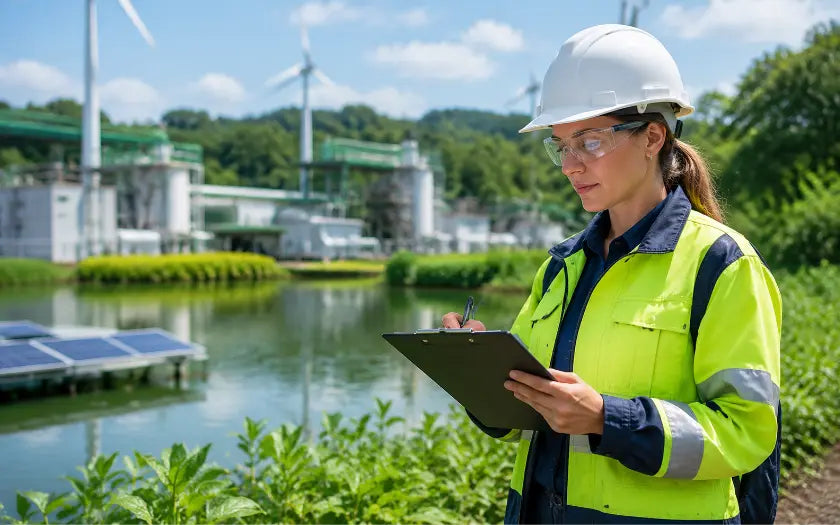
Why This Training Can No Longer Be an Afterthought
There was a time when environmental compliance training meant handing a new employee a laminated sheet of recycling instructions and calling it done. Those days are firmly behind us.
 Today, organisations across Australia and around the world are operating in an era of tightening environmental legislation, growing community expectations, and very real financial consequences for non-compliance. Whether you manage a construction site in Western Australia, a logistics firm in Victoria, or a manufacturing plant in Queensland — the pressure to get environmental and sustainability training right has never been higher.
This guide walks you through what modern compliance training actually looks like, what Australian frameworks demand, and how organisations globally are raising the bar.
The Regulatory Landscape: Australia and Beyond
What Australian Organisations Are Accountable For
Australia's environmental compliance obligations are layered across federal, state, and territory levels. At the federal level, the Environment Protection and Biodiversity Conservation Act 1999 (EPBC Act) sets the baseline for protecting matters of national environmental significance. On top of that, every state and territory has its own environmental protection legislation — from the Environment Protection Act 2017 in Victoria to the Environmental Planning and Assessment Act 1979 in New South Wales.
Organisations operating in Australia must also align with standards published by the Australian Institute of Environmental Health, guidance from the Clean Energy Regulator, and — for listed companies — sustainability reporting expectations that are rapidly evolving under frameworks like the Australian Accounting Standards Board's climate disclosure rules.
For businesses with international operations or supply chains, global frameworks come into play too. The ISO 14001 Environmental Management System standard, used widely across Europe, Asia, and North America, is increasingly recognised by Australian organisations as a credible benchmark for environmental performance.
The Global Push Toward Mandatory Reporting
Globally, regulators are moving from voluntary environmental disclosures to mandatory ones. The European Union's Corporate Sustainability Reporting Directive (CSRD), the United States Securities and Exchange Commission's climate disclosure rules, and similar emerging policies in the UK and Singapore are reshaping what "compliance" means for multinational organisations.
Australian companies with overseas investors or customers are finding they need to meet these international expectations too — not just local ones. That makes sustainability training a cross-border priority, not just a domestic checkbox.
What Environmental Compliance Training Actually Covers
 Effective training goes well beyond telling staff not to pour chemicals down the drain. Here's what a comprehensive programme typically includes:
Core regulatory knowledge — Staff need to understand which laws apply to their role and industry. A project manager on a coastal development needs a working knowledge of EPBC Act referral processes. A warehouse supervisor needs to understand spill response obligations under their state EPA guidelines.
Waste management and resource use — Practical training on waste classification, recycling streams, hazardous materials handling, and energy efficiency in day-to-day operations.
Carbon and emissions awareness — Particularly relevant post-2023, as Australian organisations face growing expectations around Scope 1, 2, and 3 emissions reporting under the National Greenhouse and Energy Reporting (NGER) scheme.
Incident response and reporting — What to do when an environmental incident occurs, how to document it, who to notify, and how to prevent recurrence.
Sustainability governance — For senior staff and board members, training on how sustainability risk integrates into corporate governance, decision-making, and stakeholder communication.
Real-World Scenario: A Construction Company Gets It Right
Consider a mid-size civil construction company operating across New South Wales and Queensland. After receiving a penalty notice from a state EPA for sediment runoff from one of their sites — an issue their site team genuinely didn't realise was non-compliant — the leadership team decided to overhaul their environmental training approach.
Rather than running a generic online module, they brought in a registered environmental auditor to help design role-specific training. Site supervisors completed hands-on sessions covering erosion and sediment control plans. Project managers received training on how to read and implement site-specific environmental management plans (EMPs). Even procurement staff completed a short module on environmentally preferable purchasing.
Twelve months later, that company had zero EPA notices — and found that their clients (including several government agencies) were actively rewarding their improved environmental credentials in tender evaluations.
This kind of outcome isn't rare. It's what happens when training is treated as operational practice, not just a HR obligation.
Designing Training That Actually Works
Move Away from One-Size-Fits-All
The most common failure in environmental compliance training is generic content that doesn't connect to what people actually do at work. A retail employee and a chemical plant operator have vastly different environmental responsibilities. Treating them to the same 45-minute slideshow helps no one.
Role-based training — tailored to what each person does, the risks they face, and the regulations that apply to their work — is far more effective and far more defensible if your organisation is ever audited.
Blended Learning Works Best
Industry experience consistently shows that blended approaches outperform purely digital or purely face-to-face delivery. Online modules are great for foundational knowledge and policy awareness. But practical components — site walkthroughs, scenario-based discussions, or even simulation exercises — build the judgment that regulations actually require.
In Australia, training providers registered under relevant vocational education frameworks (such as units within the Qualifications Framework) can deliver nationally recognised environmental compliance credentials that carry real weight with regulators and clients.
Make It Regular, Not Just Induction-Based
A surprisingly common gap: organisations train new staff on environmental obligations at induction and then never revisit it. Legislation changes. New risks emerge. Operations evolve. Best-practice organisations schedule annual refreshers, trigger-based retraining (e.g., after a near-miss or a regulatory update), and ongoing microlearning — short, targeted content that keeps environmental awareness alive in day-to-day culture.
A Snapshot: Training Depth by Organisational Role
|
Role |
Training Focus |
Recommended Frequency |
|
Site/Operations Staff |
Spill response, waste handling, permit conditions |
Annually + site inductions |
|
Project Managers |
EMPs, regulatory referrals, incident reporting |
Annually |
|
Senior Leadership |
ESG governance, disclosure obligations, climate risk |
Bi-annually |
|
Procurement Teams |
Sustainable procurement, supplier screening |
Annually |
|
HSE Officers |
Full regulatory competency, audit readiness |
Continuous development |
Common Compliance Gaps — and How to Close Them
Even well-intentioned organisations leave gaps. Some of the most frequently cited issues in EPA audits and environmental incident investigations include:
-
Staff not knowing that certain activities (like vegetation clearing or soil disturbance) trigger regulatory approval requirements
-
Inadequate records of training completion — leaving organisations unable to demonstrate due diligence
-
Sustainability policies that exist on paper but haven't been translated into practical site-level procedures
Closing these gaps usually comes down to three things: making training specific, making it documented, and making it part of how the business actually operates — not a separate HR process.
The Business Case Is Clear
 Beyond avoiding fines and regulatory action, organisations with strong environmental training programmes consistently report tangible business benefits. Insurance premiums can reduce when demonstrable risk management is in place. Government and corporate tender processes increasingly award points for environmental management credentials. Staff retention improves in organisations that can genuinely demonstrate their commitment to sustainability — especially among younger workers.
According to industry reports from the sustainability sector, organisations that embed environmental compliance into their operational culture — rather than treating it as a compliance burden — consistently outperform their peers on environmental performance metrics over the long term.
Looking Ahead: The Next Frontier for Sustainability Training
Sustainability training is evolving fast. Emerging topics that forward-thinking organisations are already incorporating include nature-positive business practices (aligned with the Global Biodiversity Framework adopted in 2022), circular economy principles, and water stewardship — particularly relevant in Australia's variable climate.
Artificial intelligence tools are also beginning to reshape how environmental compliance is monitored and how training gaps are identified in real time. Organisations that invest now in building genuine environmental capability across their workforce will be better positioned as these tools become standard.
Final Thought
Environmental and sustainability compliance training is no longer a peripheral HR activity. In 2025 and beyond, it is a core operational and strategic function — one that protects your organisation, your people, and the environments in which you operate.
The organisations doing this well aren't just avoiding penalties. They're building genuine competitive advantage, earning community trust, and contributing to a more sustainable economy. That's a return on investment worth pursuing.
For Australian organisations, a good starting point is reviewing your obligations under your relevant state EPA and the federal EPBC Act, then mapping those obligations to your workforce roles before designing training. From there, the path to genuine compliance capability becomes much clearer.


