
It started with a simple email. A finance officer at a mid-sized Melbourne firm received what looked like an urgent message from the company's CEO — a request to transfer funds to a new supplier account before end of business. The email had the right branding, the right tone, even a familiar sign-off. She processed the payment without question.
Three hours later, she realised the CEO had been overseas without internet access all day.
That story is not an isolated incident. It is playing out — with variations — across businesses throughout Australia every single week. And it is exactly why cyber security awareness training is no longer just a good idea. It is a business-critical investment.
The Australian Threat Landscape Has Never Been More Serious
 The numbers tell a stark story. According to the ASD's Annual Cyber Threat Report 2024–25, the Australian Signals Directorate responded to over 1,200 cyber security incidents in the past financial year, an increase of 11% from the previous year, with over 1,700 notifications of potentially malicious cyber activity issued — up 83%.
More troubling is why these incidents keep happening. Most risks trace back to the basics — misconfigurations, improper deployments, incorrect user settings, and poor identity hygiene. Human error is often the starting point.
This is the uncomfortable truth for Australian employers: the most sophisticated firewall in the world cannot protect an organisation from an employee who clicks the wrong link. Your people are simultaneously your greatest asset and your most significant vulnerability.
Click-through rates on phishing emails have jumped 140%, showing how effective these scams have become. At the same time, a survey of 2,000 Australian employees found that 41% reported receiving no cyber security training from their employers — a gap that attackers are very deliberately exploiting.
Why Human Error Remains the Biggest Risk
There is a common misconception in Australian workplaces that cyber attacks are primarily a technology problem. They are not. They are a human problem with a technology component.
Human error is attributed to nearly two-thirds of reported phishing incidents in Australia, and 95% of reported data breaches worldwide begin with a phishing attempt. The Sydney hedge fund that lost $8.7 million through a fake Zoom invitation did not fail because of a software flaw. It failed because a person made a trust-based decision without the knowledge to question it.
This is not about blaming employees. Most people who fall for phishing attacks are intelligent, capable professionals. The problem is that they have never been taught what a sophisticated modern attack actually looks like. Cybercriminals have evolved. The training most employees receive — if they receive any — often hasn't.
In 2025, phishing attacks are no longer clumsy scams. Cybercriminals now use AI-driven tools to craft near-perfect emails and set up fake login pages that mirror legitimate platforms. A poorly worded email with a suspicious attachment is easy to spot. A perfectly composed message from what appears to be your CFO, requesting an urgent action within a time-pressured scenario, is an entirely different challenge.
What Australian Regulations Now Require
The regulatory environment in Australia has tightened considerably, and organisations that are not keeping pace are exposing themselves to serious consequences beyond the cyber incident itself.
Australia's Information Security Manual (ISM) now requires that cyber security awareness training be undertaken annually by all personnel. This is not simply best practice — it is a formal control within the framework that government entities and many regulated industries are expected to follow.
In May 2025, the Australian Government introduced a mandatory ransomware reporting regime for businesses with annual turnovers of $3 million or more. Under this regime, affected businesses now have a legal obligation to report ransomware incidents.
The Notifiable Data Breaches (NDB) scheme under the Privacy Act continues to require that businesses notify the Office of the Australian Information Commissioner and affected individuals when a data breach is likely to cause serious harm. Failure to comply can result in substantial financial penalties — and reputational damage that is far harder to quantify.
For most Australian businesses, the Essential Eight framework from the Australian Signals Directorate provides a practical starting point. While it does not mandate specific training programs, its underlying principle is clear: people, processes, and technology must work together. Training is the bridge between the other two.
The Real Cost of Ignoring Cyber Security Training
Let's talk money, because that is often where leadership attention turns when budget conversations happen.
Australian businesses are facing a cyber attack every six minutes, and cybercriminals stole over $152.6 million from Australian businesses through Business Email Compromise alone. These are not rounding errors. They are existential-level financial events for small and medium businesses.
One in three Australian firms has already faced multiple ransomware incidents — and the costs go well beyond the ransom demand itself. Factor in system downtime, recovery costs, legal exposure, regulatory penalties, reputational damage, and customer attrition, and even a single successful attack can reshape an organisation's financial future.
The cost of training is a fraction of the cost of a breach. That calculation should not need a spreadsheet.
What Effective Cyber Security Training Actually Looks Like
 Not all training is created equal. A twenty-minute slideshow completed once a year at onboarding is not effective cyber security training. It is a compliance checkbox. Real awareness training changes behaviour — and that requires a fundamentally different approach.
Ongoing, Not Once-Off
One-off workshops don't work. Employees forget, and attackers evolve. Real-time coaching and simulations are necessary to keep employees alert to new tactics. The most effective programs treat cyber security as a continuous conversation, not an annual event. Short, regular touchpoints — monthly or quarterly microlearning sessions — embed knowledge far more effectively than a single annual session.
Relevant and Role-Based
A warehouse manager and a senior accountant face very different cyber risks. Generic training that tries to cover everything ends up addressing nothing well. The best programs tailor content to specific roles and responsibilities. The ISM guidance explicitly acknowledges this, noting that training content should be tailored to the needs of specific groups of personnel, including general users and different classes of high-risk users.
Simulation-Based Learning
Knowing about phishing theoretically is different from being tested on it in practice. Simulated phishing campaigns — where employees receive controlled fake phishing emails in their actual working environment — are one of the most effective tools available. In one client organisation, improved staff training on phishing scenarios led to a measurable reduction in click rates on suspicious emails, proving that human behaviour remains central to defence.
Psychological Safety, Not Fear
Effective training should never humiliate employees who fail a test. The goal is to build confident, security-aware people — not to catch them out and shame them. Organisations that create a culture where employees feel comfortable reporting suspicious activity without fear of blame will always be better protected than those that punish mistakes.
Key Topics That Every Australian Employee Should Understand
When considering what your awareness program should cover, the following areas represent the core curriculum for any Australian workplace in 2025.
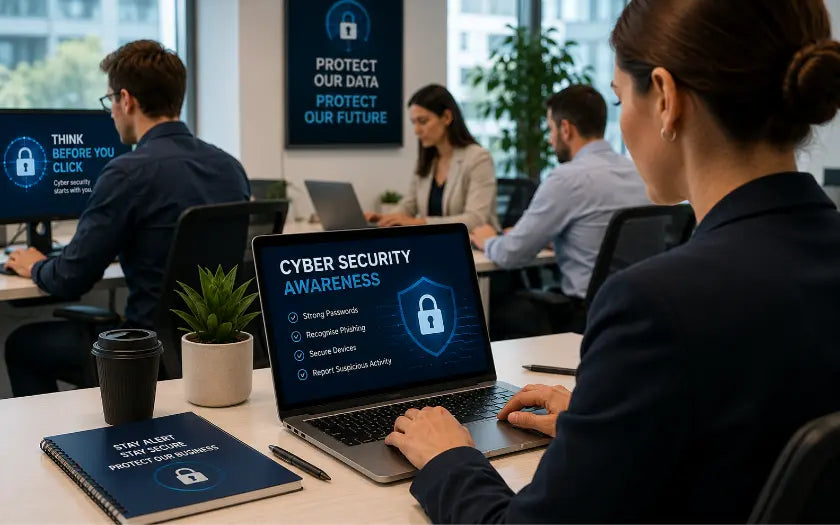
Recognising phishing and business email compromise. Business email compromise sees cybercriminals impersonate company executives to request transfers or sensitive data. Employees need to know how to verify unusual requests through a secondary channel — a phone call, not a reply email.
Password hygiene and multi-factor authentication. Despite concerns about password security, 56% of Australian employees still use username and password combinations for work accounts, and only 55% reported workplace-wide use of MFA in their organisations. Teaching employees the value of strong, unique passwords and showing them how to use MFA correctly is foundational.
Safe use of devices and remote working. A real Australian incident involved an employee logging into a personal Google account on a work device and inadvertently syncing work credentials to their personal account. When that personal device was later compromised, attackers extracted the work credentials directly from the browser. This kind of scenario — entirely preventable with proper guidance — illustrates why device hygiene education matters deeply.
Reporting and incident response. After recognising they had engaged with a phishing attempt, only 15% of Australian employees began using MFA, and only 18% informed a colleague or employer. Training employees on how to report suspicious activity quickly is as important as teaching them to recognise it.
Building a Cyber Security Culture, Not Just Completing Training
 This is the part that most training programs miss. Compliance with a training requirement is a floor, not a ceiling.
The broader workforce plays a key part in maintaining cyber security, and organisations should provide ongoing cyber security awareness training to all personnel to help them best understand their cyber security responsibilities.
But responsibility alone is not enough. What you are really building toward is a workplace culture where security-conscious behaviour happens naturally — where employees feel personally invested in protecting the organisation, not just technically compliant with a policy.
Organisations that prioritised workforce awareness and education saw measurable benefits. Cyber security teams that collaborate with finance, HR, and IT operations have much better visibility over risk and can respond faster.
Leadership matters enormously here. When senior leaders actively participate in training — when they discuss cyber threats openly in team meetings, when they model good behaviour by using MFA and reporting suspicious emails — the entire organisation follows their lead. Security culture flows downward.
Take the First Step: Phishing Prevention and Email Security Training
If you are looking to begin — or significantly upgrade — your organisation's cyber security awareness program, the most practical and immediate place to start is with email security. It is the most common attack vector and, when addressed properly, offers one of the clearest returns on training investment.
The Phishing Prevention and Email Security Training course from Australian Compliance Training is built specifically for Australian workplaces. It covers how to identify phishing attempts — including AI-generated and BEC-style attacks — how to respond correctly when a threat is spotted, and how to build lasting habits that protect both the individual and the organisation.
This is not a generic, one-size-fits-all module. It is contextualised for the Australian threat landscape, relevant to how Australian businesses actually operate, and designed to produce real behavioural change — not just a completed checkbox.
Ready to protect your team? Enrol your employees today in the Phishing Prevention and Email Security Training course and take the most important step your business can take toward a security-aware culture.
Additional Resources Worth Knowing
For Australian organisations wanting to go deeper, these authoritative resources provide valuable guidance:
-
ASD's ACSC Cyber Security Resources — Australia's primary source for threat reports, frameworks, and practical advice
-
OAIC Notifiable Data Breaches Scheme — Understanding your legal obligations when a breach occurs
-
Essential Eight Maturity Model — The ASD's recommended baseline for Australian businesses
-
Stay Smart Online — Practical advice for employees and individuals


