
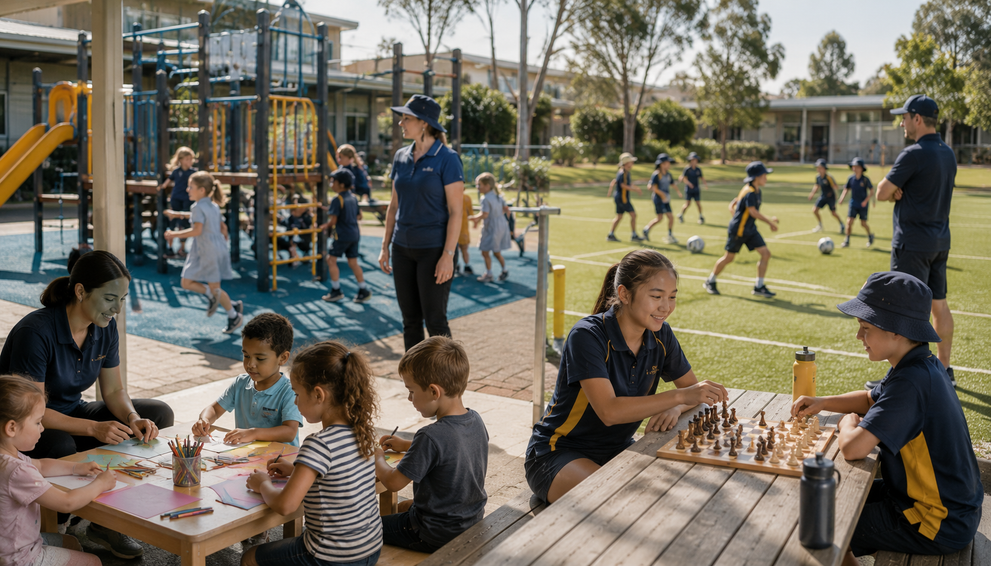
Walk into any school, sports club, church group, or after-school program in Australia today, and you'll notice something that wasn't nearly as visible a decade ago — working with children checks, visible codes of conduct, and staff who've actually been trained on what to do if a child discloses something troubling.
That shift didn't happen by accident. It's the direct result of one of the most significant reform processes in Australian history: the Royal Commission into Institutional Responses to Child Sexual Abuse, which handed down its final report in 2017 after uncovering decades of institutional failure.
Out of that Royal Commission came the Child Safe Standards — and today, they're not optional extras. They're a compliance reality for thousands of organisations across the country, from childcare centres to community sporting clubs to religious institutions.
If your organisation works with, or comes into contact with, children and young people, this article walks you through what the standards actually require, how they differ across states, and what practical steps you need to take to stay compliant.
What Are the Child Safe Standards, Really?

At their core, the Child Safe Standards are a set of principles designed to make organisational abuse harder to commit, easier to detect, and simpler for children to speak up about.
Following the Royal Commission's recommendations, the Australian Government asked the Australian Human Rights Commission to develop a nationally consistent framework. The result was the National Principles for Child Safe Organisations, formally endorsed by the Commonwealth and every state and territory government in February 2019.
These ten principles cover everything from leadership and governance through to staff training and complaint handling. They require that child safety and wellbeing is embedded in organisational leadership, governance and culture, and that children and young people are informed about their rights, participate in decisions affecting them, and are taken seriously. Australian Human Rights Commission
Other principles address family and community involvement, equity for children with diverse needs, staff suitability and screening, child-focused complaint processes, and ongoing staff training. Organisations are also expected to regularly review and improve their implementation of the principles, and to document their policies and procedures clearly. Australian Human Rights Commission
Think of the ten principles less as a checklist and more as a culture shift — they're asking organisations to genuinely reorganise the way they think about children, not just tick a box once a year.
Why This Matters Beyond Compliance
A youth soccer club I came across during research for this piece had, for years, run "informal" carpooling arrangements between parents and coaches with zero documentation. Nobody meant any harm by it — it was just how things had always worked. But under a genuinely child safe framework, that kind of informal, undocumented contact is exactly the sort of practice that gets flagged and redesigned, not because anyone assumes wrongdoing, but because clear boundaries protect both children and the adults working with them.
That's really the philosophy behind the standards: reducing opportunity, increasing transparency, and making it normal for kids to speak up.
The Legal Landscape: A Patchwork Across States
Here's where things get genuinely complicated for organisations operating in more than one jurisdiction — Australia doesn't have a single, uniform Child Safe Standards law. Instead, each state and territory has been implementing its own legislative version of the National Principles, at its own pace.
Victoria and New South Wales were early movers, with legislated Child Safe Standards and Reportable Conduct Schemes that have been operating for several years.
Queensland has taken a more recent path. In 2024, Queensland passed the Child Safe Organisations Act 2024, which brings the 10 Child Safe Standards and a Reportable Conduct Scheme into effect through 2025 and 2026. The Child Safe Standards are being rolled out through the Child Safe Organisations System from 1 October 2025, with different sectors reaching their compliance deadlines at different times. Early childhood education and care providers in Queensland face requirements that come into effect from 1 January 2026, embedded alongside a Universal Principle ensuring cultural safety for Aboriginal and Torres Strait Islander children. The Reportable Conduct Scheme in Queensland is set to commence from 1 July 2026, rolling out in a phased approach. Safe Space Legal + 3
The ACT amended its Human Rights Commission Act, and since 1 August 2024, it has been mandatory for all organisations working with children and young people in the territory to implement the ten Child Safe Standards, with a Reportable Conduct Scheme administered by the ACT Ombudsman. Safe Space Legal
Western Australia and the Northern Territory are further behind. Both have endorsed the National Principles but have not yet implemented territory- or state-specific legislation mandating them. A Western Australian Auditor General's report found the state still has meaningful work to do, noting that of the 409 recommendations made by the Royal Commission, 310 apply to WA state government agencies, and the government has committed to progressing recommendations through to at least June 2026. Safe Space LegalAudit
South Australia currently sits somewhere in between, having no Reportable Conduct Scheme in operation at present. Safe Space Legal
If this feels like a moving target — that's because it is. National, coordinated child protection reform of this scale takes years to fully bed down, and Australia is still very much in that process.
What This Means Practically
If your organisation operates across state lines — say, a national youth charity with branches in Victoria, Queensland, and WA — you can't apply a single, one-size-fits-all policy and assume it covers you everywhere. You need to map your obligations state by state, and build in flexibility for jurisdictions still catching up to the more mature schemes.
The Ten Principles, Broken Down
Rather than treating this as abstract legal language, it helps to translate each principle into what it actually looks like on the ground.
Leadership, governance and culture. This means having a written child safety and wellbeing policy, a code of conduct, and a risk management framework — and ensuring your board or leadership team can articulate why child safety matters, not just point to a document.
Children's participation and empowerment. Kids should know their rights and have genuine input into decisions that affect them — this might mean student representative councils, youth advisory panels, or simply asking children directly what would make them feel safer.
Family and community engagement. Parents and carers should be informed about your child safety policies from day one, not left to discover them only if something goes wrong.
Diversity and equity. Standards apply equally to children with disability, First Nations children, LGBTQIA+ young people, and children from culturally and linguistically diverse backgrounds — a generic policy that doesn't account for these differences will fall short.
Suitable, supported staff and volunteers. This is where Working With Children Checks, reference checks, structured induction, and ongoing supervision come in.
Child-focused complaint handling. Complaints processes need to be simple enough for a ten-year-old to understand and use, not buried in dense legal language only adults can navigate.
Staff training and education. Everyone — paid staff, volunteers, even short-term contractors — needs training in recognising and responding to harm, not just a one-off induction session years ago.
Environmental safety. This covers physical spaces (supervision ratios, safe pick-up/drop-off procedures) as well as online environments, including social media use and communication platforms.
Continuous improvement. Policies should be living documents, reviewed regularly against real incidents and feedback, not filed away and forgotten.
Documentation. Everything above needs to be written down, accessible, and demonstrable — verbal assurances aren't enough if a regulator or auditor comes knocking.
Common Compliance Gaps Organisations Overlook
Having looked at how various organisations approach this, a few recurring gaps show up again and again:
-
Volunteer-heavy organisations often screen paid staff rigorously but treat volunteers, especially short-term or one-off helpers (like a parent supervising a school excursion), far more loosely.
-
Digital communication policies frequently lag behind. A coach texting a player directly, without a parent copied in or a documented reason, is a classic example of a boundary that seemed harmless a few years ago but now sits squarely outside good practice.
If either of these sound familiar in your organisation, they're worth auditing sooner rather than later.
Global Context: Australia Isn't Alone
While Australia's framework is distinctive in how it emerged directly from a Royal Commission, it isn't operating in isolation. Comparable child safeguarding frameworks exist internationally — the UK's Keeping Children Safe in Education guidance, Canada's Screening in Faith initiatives, and various UNICEF child protection frameworks all share the same underlying DNA: reduce opportunity for harm, empower children to speak, and hold organisations accountable through documentation and oversight.
The United Nations Convention on the Rights of the Child, which Australia ratified in 1990, underpins much of this thinking globally. Article 3 of the Convention establishes that all adults should do what is best for children, and that decisions affecting children should be made with their wellbeing front of mind. That single principle threads through nearly every modern child safeguarding framework worldwide, Australia's included. Fcac
Building a Compliance Roadmap: Practical Steps

If you're starting from scratch, or auditing an existing framework, here's a realistic sequence:
-
Identify which state or territory legislation applies to your organisation (and every location you operate in).
-
Conduct a gap analysis against the ten National Principles using the self-assessment tools provided by the National Office for Child Safety.
-
Update or draft your child safety and wellbeing policy, code of conduct, and complaint-handling procedures.
-
Review recruitment and screening processes for both staff and volunteers.
-
Roll out structured training across your entire workforce — not just customer-facing staff.
-
Set a review cycle, ideally annual, to keep policies current as legislation continues to evolve.
That fifth step — training — is where a lot of organisations genuinely struggle. It's one thing to have a policy sitting in a folder; it's another to have every staff member and volunteer actually understand what to do when a child discloses harm, or how to recognise early warning signs of grooming behaviour.
This is exactly the gap that structured, purpose-built training closes. The Child Safe Standards Compliance Training course from Australian Compliance Training is designed to walk staff and volunteers through the National Principles in plain, practical language — covering recognition of harm, appropriate response, and reporting obligations, mapped against the specific requirements your organisation needs to meet. If your team hasn't been through structured training on this yet, it's a genuinely sensible next step, and one that demonstrates real, documented compliance if you're ever asked to prove it.
Where This Is Heading
Reportable Conduct Schemes are expanding, oversight bodies are strengthening, and jurisdictions still catching up — WA, the NT, South Australia — are under increasing pressure to legislate. According to industry reports, regulators across most states are moving toward more active audit and enforcement postures rather than a purely self-assessment model, which means organisations that treat this as a "set and forget" exercise are likely to find themselves exposed.
Staying ahead of that curve isn't just good compliance practice. It's the difference between a child feeling genuinely safe in your care, and a policy document sitting unread in a drawer.


