
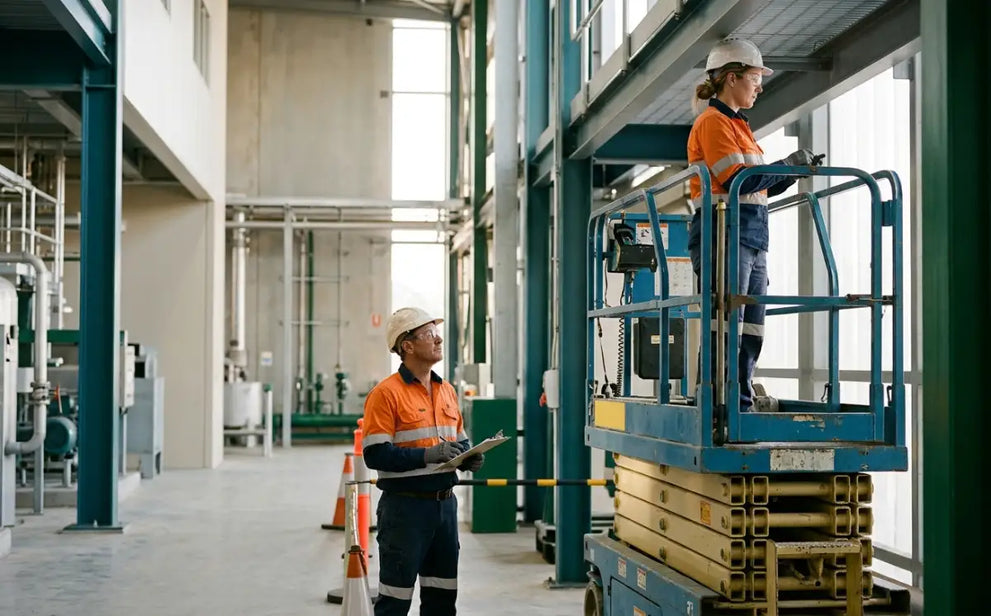
Working at heights is not limited to construction sites or jobs performed several metres above the ground. A maintenance worker accessing a roof, an employee using a ladder or a contractor working near an unprotected edge may all face fall hazards that require appropriate safety controls.
The working at heights requirements in Australia focus on identifying fall risks, preventing falls where reasonably practicable, and ensuring workers have suitable equipment, training and supervision.
Importantly, there is no universal two-metre exemption from fall-risk management duties. The height of the work matters, but so do the conditions, the task and the potential consequences of a fall.
For Australian employers, understanding these requirements means knowing when specific legal obligations apply, which fall protection measures are suitable and how state or territory rules may differ.
What Are the Legal Requirements for Working at Heights in Australia?
Australian workplace health and safety laws require employers and other relevant duty holders to manage risks associated with falls from height.
Under the model Work Health and Safety (WHS) framework, a person conducting a business or undertaking (PCBU) must ensure health and safety so far as is reasonably practicable. The model WHS Regulations also contain specific requirements for managing fall risks.
These obligations are not restricted to construction. They can apply to maintenance, warehousing, cleaning, agriculture and other activities where workers could fall from one level to another.
Safe Work Australia's working at heights guidance explains the importance of identifying hazards, selecting suitable controls and managing risks throughout the work.
Although most Australian jurisdictions have adopted laws based on the model WHS framework, the applicable legislation and specific requirements must be checked in each state or territory.
Employer and PCBU Responsibilities
Employers and PCBUs must take reasonably practicable steps to protect workers and other people who may be affected by work activities.
For working at heights, this generally involves:
-
Identifying potential fall hazards before work begins.
-
Eliminating fall risks where reasonably practicable.
-
Implementing suitable fall prevention or protection measures.
-
Providing safe access, appropriate equipment and maintained work systems.
-
Consulting workers about relevant safety risks and controls.
-
Providing necessary information, instruction, training and supervision.
-
Reviewing controls when workplace conditions or activities change.
The measures required depend on the nature of the work and applicable legislation. A documented procedure alone is not enough if the actual work remains inadequately controlled.
What Do Workers and Supervisors Need to Do?
Workers must take reasonable care for their own health and safety and avoid adversely affecting others. They must also follow reasonable safety instructions and cooperate with applicable workplace safety procedures.
Supervisors play an important role in checking work arrangements, communicating hazards and ensuring agreed controls are followed.
However, a supervisor's legal responsibilities depend on their position and circumstances, including their authority and the duties applying to their role.
At What Height Do Working at Heights Requirements Apply?
One of the most common questions is whether Australian law requires fall protection only when someone works more than two metres above the ground.
The answer is no.
Under the model WHS framework, the duty to manage fall risks is not limited to work above two metres. A fall from a ladder, loading platform or low roof can still create a significant safety risk.
The two-metre threshold is relevant to particular construction-work requirements, but it should not be treated as a general exemption from fall protection duties.
Does the Two-Metre Rule Apply Everywhere?
Under the model WHS Regulations, construction work involving a risk of a person falling more than two metres is classified as high-risk construction work.
This classification has important implications for safe work method statements (SWMS).
However, it does not mean work below two metres is automatically safe or exempt from other WHS requirements.

Consider two examples:
Example 1: Warehouse maintenance
An employee works on a low platform beside an unprotected edge. Even if the potential fall is less than two metres, the employer must assess and manage the risk.
Example 2: Commercial roof maintenance
A contractor works near an exposed roof edge with a potential fall exceeding two metres. Depending on the work and jurisdiction, specific high-risk construction work and fall-control requirements may apply.
Employers should assess the work activity, surface conditions, potential fall distance and available protective measures rather than relying on height alone.
When Is a SWMS Required for Working at Heights?
A safe work method statement is required for high-risk construction work under applicable WHS legislation.
Under the model WHS framework, this includes construction work involving a risk of falling more than two metres.
A SWMS identifies the high-risk construction activities, associated hazards, control measures and how those measures will be implemented, monitored and reviewed.
Not every activity performed at height automatically requires a SWMS. The requirement depends on whether the work meets a relevant high-risk construction work category and the legislation that applies.
A SWMS should reflect the actual work and be implemented, monitored and reviewed throughout the activity.
What Fall Prevention and Protection Measures Are Required?
Australian working at heights safety requirements prioritise preventing falls rather than relying solely on equipment that reduces the consequences after a fall occurs.
The appropriate controls depend on the task, the workplace and the relevant legal requirements.
The Model Code of Practice: Managing the Risk of Falls at Workplaces provides practical guidance on identifying fall hazards and selecting suitable control measures.
The legal status of a code of practice depends on its adoption in the relevant jurisdiction. It provides guidance on meeting duties but should not be confused with the legislation itself.
Applying the Hierarchy of Controls to Fall Risks
The hierarchy of controls helps employers select measures that provide effective protection.
Where reasonably practicable, the first consideration should be whether work at height can be eliminated.
If elevated work remains necessary, employers should consider appropriate higher-order controls before relying on personal fall protection equipment.
|
Control approach |
Practical workplace example |
|
Eliminate the risk |
Complete maintenance from ground level using suitable equipment |
|
Provide a safe working surface |
Use a properly designed work platform or scaffold |
|
Prevent access to fall hazards |
Install suitable guardrails or edge protection |
|
Use work positioning systems |
Use an appropriate system to support a worker in a controlled position |
|
Use fall-arrest systems |
Use a properly designed system to arrest a fall where required and suitable |

The table illustrates common approaches rather than a complete legal control-selection sequence. Specific requirements and priorities must be checked against applicable regulations.
For example, a maintenance team replacing overhead equipment might use an appropriate elevated work platform instead of requiring employees to work from ladders.
Before selecting controls, employers should understand the hazards involved through an appropriate workplace risk assessment.
When Are Fall-Arrest Systems and Rescue Procedures Needed?
Fall-arrest systems are designed to stop a person after a fall has begun. They do not prevent the initial fall.
Where these systems are used, employers must consider equipment suitability, anchorage, clearance, inspection, worker competency and emergency arrangements.
A worker suspended in a harness may need prompt assistance. Rescue arrangements should therefore be planned before work begins, rather than relying solely on emergency services arriving after an incident.
Applicable WHS regulations may impose specific emergency and rescue requirements for fall-arrest systems.
Employers should also ensure that equipment is used and maintained according to applicable requirements and manufacturer instructions.
What Training and Competency Are Required for Working at Heights?
Working at heights training requirements depend on the hazards, equipment and activities involved.
Under Australian WHS and OHS frameworks, employers must provide appropriate information, instruction, training and supervision to enable work to be carried out safely.
For elevated work, this may involve understanding fall hazards, using access equipment, following safe work procedures, recognising unsafe conditions and responding to emergencies.
Training should match the worker's actual responsibilities. General WHS awareness is useful, but it does not automatically demonstrate competency in operating specialised equipment or using fall-arrest systems.

Is a Working at Heights Ticket or Licence Mandatory?
Australia does not have one universal working-at-heights licence that applies to every task involving an elevated work position.
However, particular activities and equipment may require specific qualifications, licences or demonstrated competency.
For example, certain scaffolding activities and the operation of particular elevating work platforms may require a high-risk work licence.
Employers must distinguish between general safety awareness, nationally recognised training, task-specific competency and legally required licensing.
For broader workplace safety knowledge, organisations can consider ACT's Workplace Health and Safety Certified Training alongside practical instruction, site-specific training and supervision.
General WHS training should not be treated as a substitute for specialist working-at-heights competency or a required high-risk work licence.
Workplace Health and Safety (WHS) Certified Training
Build your understanding of workplace health and safety responsibilities. Explore practical WHS principles to support safer work practices.
Do Working at Heights Requirements Differ Between Australian States?
Although Australia has a broadly consistent approach to managing workplace fall risks, working at heights regulations are not identical across every jurisdiction.
Most states and territories have adopted WHS laws based on the national model framework, while Victoria operates under a separate occupational health and safety framework.
Some jurisdictions also prescribe specific fall-risk controls for particular construction activities.
|
Jurisdiction |
Important consideration |
|
New South Wales and other model-WHS jurisdictions |
General fall-risk duties and applicable high-risk construction work requirements |
|
Queensland |
Specific construction fall-control provisions, including distinctions based on the type of construction work |
|
Victoria |
Separate OHS legislation and prevention-of-falls requirements |
|
Western Australia |
WA-specific regulations, including provisions for fall risks in general industry and construction |
In Queensland, employers should check the applicable construction provisions through WorkSafe Queensland.
Victorian employers should consult WorkSafe Victoria for requirements under the Occupational Health and Safety Regulations 2017.
Western Australian employers should refer to WorkSafe WA’s guidance on managing the risk of falls. Regulation 79 of the Work Health and Safety (General) Regulations 2022 took effect for high-risk construction work in general industry on 1 October 2026.
These differences matter when organisations operate across multiple states or engage contractors from other jurisdictions.
A procedure suitable for one workplace should not automatically be assumed to meet every applicable local requirement.
Working at Heights Compliance Checklist for Employers
Before elevated work begins, employers should confirm that the task has been planned and the relevant risks are adequately controlled.
The following checklist provides a practical starting point.
-
Identify fall hazards. Check edges, openings, fragile surfaces, access routes and surrounding conditions.
-
Consider eliminating elevated work. Determine whether the task can be completed safely from ground level.
-
Select suitable controls. Prioritise effective fall prevention measures in accordance with applicable requirements.
-
Check SWMS obligations. Determine whether the activity qualifies as high-risk construction work.
-
Inspect equipment and access systems. Confirm that equipment is suitable, maintained and safe to use.
-
Confirm worker competency. Provide appropriate instruction, training, supervision and any required licensing.
-
Prepare emergency arrangements. Establish suitable rescue procedures where the work and equipment require them.
-
Review changing conditions. Reassess controls when weather, access, equipment or work methods change.

This checklist is not a replacement for a site-specific risk assessment or any documentation required by law.
The checklist should be used alongside the workplace's existing hazard identification, risk assessment and control-review processes.
Final Thoughts
Working at heights requirements in Australia are about managing the actual risk of falling, not simply determining whether a task exceeds a particular height.
Employers need to identify hazards, apply suitable prevention measures, understand when SWMS and licensing requirements apply, and ensure workers receive appropriate training and supervision.
Because legislation and specific fall-control requirements can differ between jurisdictions, checking the relevant state or territory regulator is an essential part of planning elevated work.
The most effective approach is to assess each task before it begins, use controls suited to the conditions and review those arrangements whenever the work changes.


