
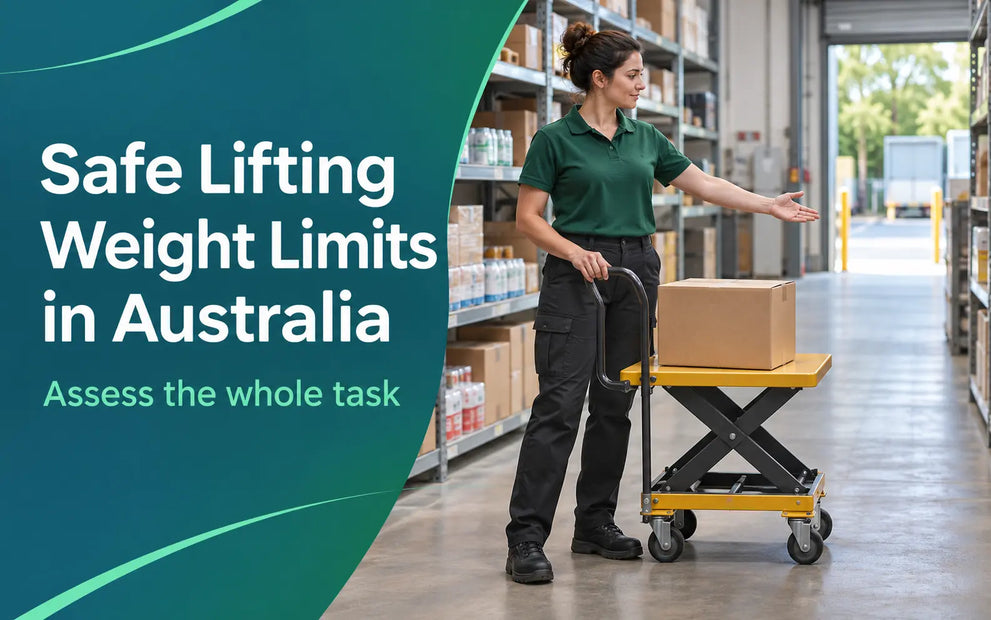
A carton weighs 20 kg, but its label cannot tell you whether lifting is safe. Australia has no universal kilogram limit making every workplace lift safe. Employers must manage the risks of the whole task.
This matters whenever deliveries, staffing or storage arrangements change. A lighter carton handled repeatedly can create significant risks. Weight, force, posture, repetition and working conditions all affect the controls needed.
This guide explains Australian lifting requirements, common weight figures and practical assessment steps. It also shows how supervisors can record controls and workers can report concerns.

Is There a Legal Lifting Weight Limit in Australia?
Neither a 20 kg lifting limit nor a 25 kg lifting limit applies universally. A workplace must consider how the load is handled and by whom. Being below a familiar number does not establish that the task is safe.
What Employers Must Assess and Control
Employers must identify hazardous manual tasks and manage associated musculoskeletal disorder risks. These disorders affect muscles, joints and related tissues. They can develop suddenly or through repeated exposure.
Start by asking whether the manual handling can be eliminated. Where elimination is not reasonably practicable, minimise risks using suitable controls. Consider task design before relying on instructions about lifting technique.
Observe the work as employees actually perform it. Include busy periods, awkward deliveries and the final items on a pallet. Ask workers where they experience difficulty and involve health and safety representatives where applicable.
How National Guidance and Local Requirements Differ
National model guidance explains risk management, but applicable requirements depend on jurisdiction. Check the legislation and adopted guidance covering your workplace. Do not assume one national code automatically has identical legal effect everywhere.
Victoria uses its own occupational health and safety framework. Its requirements include eliminating relevant risks, or reducing them where elimination is not reasonably practicable. WorkSafe Victoria's lifting guidance explains these duties and practical controls.
What Happens When Lifting Risks Are Ignored?
Uncontrolled tasks can expose workers to strains and other musculoskeletal injuries. Repeated discomfort may indicate problems with layout, workload or equipment. Ignoring those signals leaves the underlying task unchanged.
Employers can also fail their applicable duties by leaving hazardous tasks uncontrolled. A carton label or completed course does not demonstrate that risks were managed. Review the task and controls when concerns arise.
What Do the 16 kg, 20 kg and 25 kg Figures Mean?
People encounter different numbers in inductions, packaging instructions and workplace procedures. Those numbers need context before they influence a lifting decision. They are not interchangeable with a universal legal lifting limit in Australia.
Historical Recommendations Are Not Universal Safe Limits
Older Australian guidance discussed 4.5 kg for seated handling and 16–20 kg for standing work. It also discussed additional precautions for heavier loads, including loads above 55 kg.
These figures appear in clause 4.23 of the archived 1990 national code. The document also considered frequency, load position, carrying distance and load characteristics. Its checklist expressly avoided prescribing absolute weight limits.
Read the archived manual handling code as historical context, not current lifting permission. It does not establish that every worker can safely lift 16 kg. Nor should its figures be presented as current national legal thresholds.
Workplace Procedures Still Need Task-Specific Controls
A workplace might require equipment or assistance above an internal threshold. Follow the applicable procedure and report circumstances it does not adequately address. The threshold does not prove that every lighter load is safe.
For example, an internal 20 kg trigger cannot resolve repeated reaching over a counter. The employer still needs to address that exposure. Ask what the procedure controls and what risks remain.
| Type of guidance | What it means | What it does not establish |
|---|---|---|
| Current requirements | Manage hazardous manual task risks under applicable local requirements. | A universal safe lifting weight. |
| Historical recommendations | Explain figures appearing in older Australian guidance. | Current legal permission to lift those weights. |
| Workplace procedures | Specify controls for assessed tasks and working conditions. | Safety for every task below an internal threshold. |
The current hazardous manual tasks model code supports assessing all relevant risks. Its assessment guidance states that no weight suits every worker and circumstance.

Team Training
Corporate Compliance Training
Explore compliance training options for your team. Support workplace learning across your organisation.
How to Assess a Lifting Task and Choose Controls
A useful manual handling risk assessment connects observations with changes to the work. Writing “heavy lifting” on a form gives little direction. Describe where the force, repetition or awkward posture occurs.
Look Beyond the Weight on the Carton
Consider the complete handling sequence, including picking up, carrying and putting down. Check normal work and foreseeable variations. Use these questions to start the discussion:
- Is the weight known, and could the contents shift?
- Where does handling begin and finish?
- Must workers reach, twist, bend or handle items above shoulder height?
- Are handles suitable, and can workers maintain a secure grip?
- How often does handling occur, and for how long?
- What carrying distance, steps or obstacles are involved?
- Could heat, restricted space, slippery surfaces or time pressure affect the task?
- Do the task and controls accommodate the workers involved?
Do not convert these questions into an unsupported numerical pass score. Several manageable features cannot cancel one serious uncontrolled hazard. An unknown weight or unstable load needs clarification before handling proceeds.
Prioritise Task Redesign and Suitable Equipment
Consider whether goods can arrive directly at their point of use. Change packaging, storage positions or work surfaces where these create avoidable exposure. Select handling aids suited to the load, route and available space.
Adding a trolley also requires planning for loading, unloading, pushing and storage. Check its condition and suitability before relying on it. Equipment should address the task without introducing other uncontrolled risks.
Team lifting needs assessment and coordination. Uneven load sharing or a lost grip can suddenly affect another worker. Regular team handling should prompt consideration of more effective controls.
Avoid assigning a two-person lift weight limit through simple arithmetic. Two workers do not automatically provide twice one worker's handling capacity. Plan responsibilities, communication and space whenever team handling is used.

Record the Control and Check It Works
The examples below illustrate possible decisions, not completed workplace assessments. Responsible roles are suggestions and should match actual authority. Each workplace must select and verify controls for its circumstances.
| Task | Risk factors | Suitable control | Responsible role | Review trigger |
|---|---|---|---|---|
| Warehouse carton picking | Repeated bending and reaching across pallets | Trial an adjustable picking arrangement and suitable handling aid. | Warehouse supervisor | Different carton sizes or worker feedback |
| Retail stock replenishment | High storage and restricted access | Reposition frequent stock and improve access. | Store manager | Layout or delivery changes |
| Kitchen ingredient handling | Bulky containers and extended carrying | Trial smaller handled containers and suitable trolley access. | Kitchen manager | Menu, container or workflow changes |
These illustrative controls reflect SafeWork NSW's hierarchy and review guidance. Trial controls with workers, maintain equipment and review effectiveness when conditions change.
Record what changed, who will implement it and how effectiveness will be checked. Observe the revised task rather than assuming purchase means implementation. Ask whether workers can access the equipment during actual operating conditions.
Report Concerns and Support Controls With Training
If a task seems unsafe, pause and raise the concern through workplace procedures. Describe the load, location, frequency and specific difficulty. Request assessment and suitable controls before continuing with an unsafe method.
Supervisors should explain the agreed method and arrange any necessary instruction. Workers need to understand equipment use, reporting and changed procedures. General awareness training supports this work but cannot replace task-specific controls.
ACT's workplace health and safety training covers hazard identification, risk assessment and manual handling procedures. Use it alongside workplace instruction, supervision and effective controls.
Workplace Safety
Manual Handling Training & Certification
Build awareness of manual handling hazards in everyday workplace tasks. Explore training to support safer approaches to lifting, carrying, pushing and pulling.
Employers organising broader learning can review ACT's team training options. Course assignment and completion tracking still need to sit alongside workplace risk management.
Lifting Task Readiness Checklist
Before work starts, confirm the following:
- The task and load characteristics are understood.
- Workers have contributed to identifying practical difficulties.
- Elimination and changes to work design have been considered.
- Necessary controls and suitable equipment are available and maintained.
- Workers understand the agreed procedure and any equipment instructions.
- Someone owns implementation, follow-up and review.
-
Workers know how to report problems or changed conditions.

Conclusion
Assess the whole task and implement the controls it needs before the next lift. A familiar kilogram figure cannot replace that decision. Review the method when loads, work arrangements or worker feedback reveal new concerns.


