
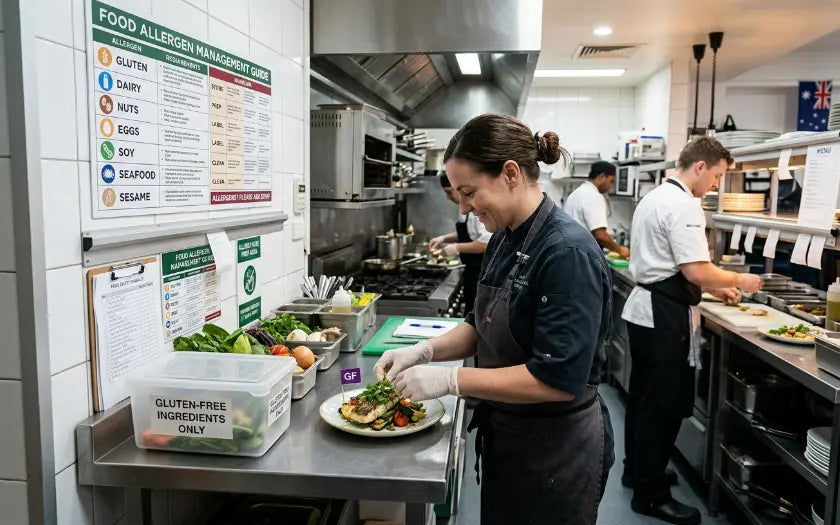
Food allergy management is a critical food safety responsibility for Australian hospitality businesses.
Restaurants, cafés, hotels, pubs, catering businesses, takeaway outlets and other food service providers serve customers with a wide range of dietary needs every day. For someone with a food allergy, however, receiving incorrect information or being served food containing an allergen can have consequences far more serious than simply having an unpleasant dining experience.
Food allergies can cause reactions ranging from mild symptoms to anaphylaxis, a severe and potentially life-threatening allergic reaction.
For hospitality businesses, effective food allergen management therefore requires much more than putting allergen symbols on a menu. Staff need to understand allergens, ingredient information needs to be accurate, communication between front-of-house and kitchen teams needs to work, and procedures should be in place to reduce the risk of unintended allergen exposure.
This guide explains food allergen management in Australian hospitality, including common food allergens, Australian allergen declaration requirements, cross-contact risks, staff responsibilities and practical best practices that hospitality businesses can implement.
What Is a Food Allergy?
 A food allergy occurs when a person's immune system reacts to an allergen contained in food.
The reaction can range from relatively mild symptoms to severe and potentially life-threatening reactions.
Food allergy should not be confused with food intolerance.
Although both may involve adverse reactions to food, they are different conditions. Food allergy involves an immune-system response, whereas food intolerance does not necessarily involve the immune system in the same way.
According to Healthdirect Australia’s food allergy guidance, allergic reactions can range from mild to severe and can affect areas including the skin, gut, breathing and cardiovascular system.
For hospitality workers, the distinction matters because a customer who says they have an allergy should be taken seriously.
Staff should never assume that a small amount of an allergen is safe for a particular customer or attempt to determine the severity of someone's allergy themselves.
Why Food Allergen Management Matters in Hospitality
Hospitality businesses operate in complex environments.
Ingredients arrive from multiple suppliers. Recipes may change. Different meals are prepared in the same kitchen. Utensils, equipment and preparation surfaces may be shared. Front-of-house staff need to communicate customer requirements accurately to kitchen teams.
These factors can create opportunities for mistakes.
For a customer with a food allergy, an error could result in exposure to an allergen.
Food Standards Australia New Zealand (FSANZ) states that food allergies can be life-threatening and that avoiding the relevant food allergen is the way people with food allergies manage their condition.
This makes accurate information particularly important when customers eat away from home.
Effective allergen management can help hospitality businesses:
-
Provide customers with accurate allergen information
-
Reduce avoidable food safety risks
-
Improve communication between kitchen and service teams
-
Strengthen ingredient and recipe management
-
Reduce the risk of allergen cross-contact
-
Build staff confidence when responding to allergy enquiries
-
Support compliance with applicable food information requirements
-
Build customer trust
Food allergen management should therefore be integrated into everyday food safety practices.
Food Allergens That Australian Hospitality Workers Should Know
Australian food businesses need to understand the substances covered by allergen declaration requirements under the Australia New Zealand Food Standards Code.
Current FSANZ requirements include prescribed declarations for foods and ingredients such as:
-
Wheat
-
Fish
-
Crustaceans
-
Molluscs
-
Egg
-
Milk
-
Lupin
-
Peanut
-
Soy, soya or soybean
-
Sesame
-
Almond
-
Brazil nut
-
Cashew
-
Hazelnut
-
Macadamia
-
Pecan
-
Pistachio
-
Pine nut
-
Walnut
-
Barley, oats and rye where the relevant gluten declaration requirements apply
-
Added sulphites at the prescribed concentration
FSANZ provides detailed information about exactly when and how these substances must be declared.
Hospitality workers do not need to diagnose allergies, but they do need to understand that ingredients that appear routine in a commercial kitchen may create serious risks for customers with allergies.
Understanding Australia's Food Allergen Declaration Requirements
 Food businesses in Australia operate under the Australia New Zealand Food Standards Code.
The Code contains requirements concerning the declaration of specified allergens.
One of the significant developments in allergen information has been Plain English Allergen Labelling (PEAL).
From 25 February 2024, new allergen declaration requirements came into effect requiring specified allergens to be declared using required names and, for relevant packaged foods, in a standardised format designed to make allergen information easier to identify.
For packaged food requiring an ingredient statement, allergen declarations generally need to appear using the prescribed format, including bold declarations and a separate bold allergen summary statement beginning with “Contains”.
For hospitality businesses, another particularly important point concerns food that does not need to bear a label.
FSANZ explains that for food such as that supplied by a café or takeaway, required allergen declarations must either be displayed in connection with the food or provided to the purchaser on request using the required names.
Hospitality businesses should understand the requirements that apply to the particular food they sell rather than assuming packaged-food labelling rules and restaurant requirements operate identically.
For detailed regulatory guidance, businesses can consult FSANZ allergen labelling guidance for food businesses.
The 2026 Position on Plain English Allergen Labelling
Australian hospitality businesses should also be aware of the end of the PEAL transition arrangements.
Food packaged and labelled before 25 February 2024 that complied with the previous allergen declaration rules was permitted to continue being sold until 25 February 2026.
That transition date has now passed.
Businesses handling packaged ingredients should therefore ensure their allergen-information systems and staff knowledge reflect the current requirements rather than relying on older allergen labelling formats.
This is particularly relevant when businesses review:
-
Supplier information
-
Ingredient labels
-
Product specifications
-
Recipe documentation
-
Allergen matrices
-
Menu information
-
Staff training materials
Keeping allergen information current should be treated as an ongoing process.
The Responsibility of Food Service Businesses
Hospitality workers are often the link between customers and the information they need to make safe food choices.
FSANZ's guidance for the food service industry states that when customers disclose a food allergy, food service businesses have a responsibility to help them make appropriate menu choices by providing information about allergens that may be present directly or indirectly in menu items.
FSANZ recommends that food service businesses:
-
Implement effective food allergen management
-
Train staff in allergen risks, management and communication
-
Maintain clear, current and accurate information about the allergen status of food
These principles highlight an important reality:
Food allergen safety depends on systems, not guesswork.
If a customer asks whether a dish contains an allergen, employees should have a reliable way of obtaining accurate information.
Never Guess About Allergens
Imagine a customer asks:
“Does this sauce contain peanuts?”
A staff member is not certain but remembers that the sauce probably does not contain peanuts.
Saying “I don't think so” can create unnecessary risk.
The appropriate approach is to verify the information using reliable sources available within the business.
Depending on the workplace, that may mean checking:
-
The ingredient label
-
Supplier specifications
-
Recipe documentation
-
An allergen matrix
-
Product information
-
A manager
-
The chef or another authorised person
If the information cannot be confirmed, staff should be transparent about that uncertainty rather than making an unsupported assurance.
Accurate communication is one of the most important controls in allergen management.
What Is Allergen Cross-Contact?
A meal may not intentionally contain an allergen as an ingredient but could potentially come into contact with an allergen during storage, preparation, cooking or service.
This is commonly described as allergen cross-contact.
For example, cross-contact may occur when:
-
The same knife is used for different ingredients without appropriate cleaning
-
Preparation surfaces are not adequately cleaned between tasks
-
Allergenic and non-allergenic ingredients are stored incorrectly
-
The same utensils are used across multiple dishes
-
Ingredients spill into nearby containers
-
Food is prepared using shared equipment
-
Staff handle allergenic ingredients and then other food without appropriate controls
-
Garnishes or toppings are added incorrectly
-
Prepared meals are mixed up during service
Cross-contact is different from microbial cross-contamination, although both require effective food safety controls.
The key issue with allergen cross-contact is the unintended transfer of an allergenic substance into another food.
Why “Just Remove the Allergen” May Not Be Safe
Suppose a meal is accidentally prepared with a nut-containing garnish.
Removing the visible nuts before serving the meal does not necessarily remove allergen residues that may already have contacted the food.
Similarly, removing cheese from a finished meal does not necessarily mean that the meal is suitable for someone with a milk allergy.
Hospitality workers should not attempt improvised solutions unless those solutions comply with the business's established allergen-management procedures.
Where a mistake has occurred, preparing a fresh meal using appropriate procedures may be necessary.
The safest response depends on the circumstances and the business's controls.
Allergen Management Starts Before the Customer Orders
 Good allergen management begins well before a customer walks into a restaurant.
It starts with understanding what ingredients enter the business.
Hospitality businesses should have systems for reviewing allergen information from suppliers.
This can include:
-
Product labels
-
Ingredient lists
-
Product specification sheets
-
Supplier allergen information
-
Recipe documentation
-
Changes in product formulation
One common risk is assuming that a product always contains the same ingredients.
Suppliers may change formulations, brands may change, and substitute ingredients may be purchased when usual products are unavailable.
This means allergen information should be reviewed whenever ingredients or suppliers change.
Create and Maintain an Allergen Matrix
An allergen matrix can be a useful operational tool for hospitality businesses.
It typically lists menu items alongside relevant allergens so staff can quickly identify which dishes contain particular ingredients.
For example, the matrix might identify whether each menu item contains:
-
Milk
-
Egg
-
Wheat
-
Peanut
-
Tree nuts
-
Sesame
-
Soy
-
Fish
-
Crustaceans
-
Molluscs
-
Lupin
However, an allergen matrix is only useful if it is accurate.
Whenever a recipe, ingredient, supplier or product changes, the matrix should be reviewed.
An outdated allergen matrix can create false confidence and potentially lead to incorrect information being given to customers.
Managing Allergens During Food Storage
Good allergen management also requires attention to storage practices.
Businesses should consider how allergenic ingredients are stored and handled to reduce unintended transfer.
Practical controls may include:
-
Keeping ingredients in appropriate containers
-
Clearly identifying ingredients
-
Maintaining original labels where appropriate
-
Preventing open containers from spilling into other foods
-
Following appropriate storage procedures
-
Keeping allergen information accessible to staff
-
Checking labels when stock changes
The exact controls required will depend on the kitchen, ingredients, menu and food-handling processes.
Managing Allergens During Food Preparation
Food preparation is one of the most important stages for controlling allergen risks.
Businesses should consider whether their preparation processes could transfer allergens between foods.
Depending on the operation, controls may include:
Clean Preparation Areas
Preparation surfaces and equipment should be appropriately cleaned before preparing food for customers with declared allergies.
Clean Utensils
Knives, spoons, chopping boards, tongs and other utensils can transfer allergenic material if they are not appropriately managed.
Hand Hygiene
Food handlers should follow proper hand hygiene procedures, particularly after handling allergenic ingredients.
Recipe Control
Staff should follow approved recipes rather than adding or substituting ingredients without considering allergen implications.
Ingredient Verification
Labels and specifications should be checked where required instead of relying solely on memory.
Clear Communication
Kitchen staff should know when an order involves a customer who has disclosed a food allergy.
Front-of-House Staff Play a Critical Role
Food allergen management is not only the kitchen's responsibility.
Wait staff, counter staff, bar staff and other customer-facing employees can play an important role because they are often the first people to receive information about a customer's allergy.
Front-of-house staff should understand how to:
-
Listen carefully to allergy enquiries
-
Record information accurately
-
Communicate it clearly to the kitchen
-
Avoid making assumptions
-
Access reliable allergen information
-
Escalate questions when uncertain
-
Communicate the kitchen's response accurately to the customer
The message should not change as it travels between the customer, waiter and kitchen.
A breakdown anywhere in that communication chain can create risk.
Communication Between Front and Back of House
Consider this scenario:
A customer tells a waiter that they have a sesame allergy.
The waiter writes “allergy” on the order but does not specify which allergen.
The kitchen assumes the customer has a nut allergy.
Even if everyone involved intended to do the right thing, the communication process failed.
Hospitality businesses should therefore establish clear procedures for allergy-related orders.
Depending on the business, that may involve:
-
Asking the customer to clearly identify their allergy.
-
Recording the specific allergen accurately.
-
Communicating it to the kitchen using an established process.
-
Confirming that kitchen staff received the information.
-
Following appropriate preparation controls.
-
Identifying the completed meal correctly.
-
Delivering it to the correct customer.
Consistency is essential.
Avoid Overpromising
 Hospitality businesses should communicate honestly about what they can and cannot safely provide.
Employees should avoid absolute claims unless the business can support them.
Statements such as:
“This is completely allergen-free.”
can be problematic if the kitchen handles the allergen or cannot guarantee that cross-contact will not occur.
Clear communication about ingredients, preparation processes and limitations allows customers to make informed decisions.
When staff are uncertain, they should escalate the question rather than guess.
What About “May Contain” Statements?
Precautionary allergen statements such as “may contain” are commonly found on packaged foods.
They generally indicate the possibility of unintended allergen presence rather than an allergen intentionally included as an ingredient.
Hospitality businesses should not automatically interpret a precautionary statement as meaning a product is safe or unsafe for every person with an allergy.
Staff should provide accurate information from labels or approved business documentation and allow the customer to make decisions based on their own medical advice and risk management.
Employees should not provide medical advice about whether a customer can safely consume a particular allergen.
Understanding Anaphylaxis
One reason allergen management is so important is the possibility of anaphylaxis.
Healthdirect describes anaphylaxis as a severe, life-threatening allergic reaction that can develop quickly and requires emergency treatment.
Possible signs can include:
-
Difficult or noisy breathing
-
Swelling or tightness in the throat
-
Swollen tongue
-
Wheezing or persistent coughing
-
Difficulty talking
-
Dizziness
-
Collapse
Anaphylaxis is a medical emergency.
Healthdirect advises that where anaphylaxis is suspected, an adrenaline autoinjector should be used if available, followed by calling Triple Zero (000) for an ambulance and following the person's ASCIA Action Plan where available.
Hospitality businesses should ensure relevant staff understand their workplace emergency procedures.
For further Australian health information, see Healthdirect's guidance on anaphylaxis.
Food Allergen Management and Food Safety Training
Policies and procedures are important, but they depend on people understanding how to apply them.
FSANZ specifically recommends training all food service staff in food allergen risks, management and communication.
Training should be relevant to employees' actual responsibilities.
Kitchen workers may need particular knowledge of ingredients, recipes, cleaning and cross-contact controls.
Front-of-house employees may need particular knowledge of customer communication, order recording and escalation procedures.
Managers and supervisors should understand the overall allergen-management system and ensure staff follow established procedures.
Effective training can help employees understand:
-
What food allergies are
-
Why allergen management matters
-
Important allergens
-
Allergen declaration requirements
-
Ingredient awareness
-
Cross-contact risks
-
Safe food-handling practices
-
Customer communication
-
Escalation procedures
-
Emergency awareness
Training should reinforce one essential rule:
If you do not know, do not guess.
Food Safety Supervisor and Food Handler Requirements
Australian hospitality businesses should also understand broader food safety management requirements.
Under Standard 3.2.2A, certain food service, catering and retail businesses handling unpackaged, potentially hazardous ready-to-eat food must implement prescribed food safety management tools.
Depending on the category of business, these can include:
-
A food safety supervisor
-
Food handler training
-
Substantiation of critical food safety controls.
These broader requirements should be considered alongside allergen-specific management practices.
Businesses can review the official requirements through FSANZ's Standard 3.2.2A food safety management guidance.
Common Food Allergen Management Mistakes
Even experienced hospitality teams can make mistakes when allergen procedures are unclear.
Guessing Ingredient Information
Staff should never rely on assumptions when answering allergy questions.
Verify the information.
Relying on Memory
Recipes and ingredients can change.
Use current documentation rather than expecting staff to remember every ingredient.
Poor Communication
A customer's allergy information needs to reach everyone responsible for preparing and serving the meal.
Ignoring Cross-Contact
A dish may not intentionally contain an allergen but could still be exposed during preparation.
Using Outdated Allergen Matrices
An allergen matrix should be updated when recipes, ingredients or suppliers change.
Assuming Small Amounts Are Safe
Hospitality staff should never decide how much of an allergen a customer can tolerate.
Removing the Visible Ingredient
Simply taking an allergenic ingredient off an already-prepared meal may not remove allergen residues.
Inadequate Staff Training
Written procedures are much less effective when employees do not understand why they matter or how to apply them.
Best Practices for Australian Hospitality Businesses
A strong food allergen management program should be practical enough to work during everyday service.
1. Know Your Ingredients
Maintain accurate information about ingredients and supplier products.
2. Maintain Current Recipes
Ensure recipes reflect what is actually being prepared.
3. Keep Allergen Information Updated
Review allergen matrices and related documentation whenever ingredients or suppliers change.
4. Establish Clear Allergy Order Procedures
Employees should know exactly what to do when a customer declares an allergy.
5. Control Cross-Contact
Review preparation areas, utensils, equipment, storage and workflow.
6. Train Front-of-House Staff
Customer-facing employees need confidence in receiving and communicating allergy information.
7. Train Kitchen Staff
Food handlers should understand ingredients, cross-contact and appropriate preparation controls.
8. Encourage Staff to Escalate Uncertainty
Employees should never feel pressured to provide an answer they cannot verify.
9. Review Incidents and Near Misses
An allergen mistake or near miss should trigger a review of what went wrong and whether controls need improvement.
10. Review Procedures Regularly
Menus, suppliers, employees and operations change.
Allergen management should change with them.
Food Allergen Management Checklist
Hospitality businesses can use the following questions as a practical starting point:
-
Do staff understand what a food allergy is?
-
Do we know which allergens are present in our ingredients?
-
Are our recipes documented and current?
-
Do we maintain accurate allergen information?
-
Do we update information when suppliers or ingredients change?
-
Can staff answer allergy questions using reliable information?
-
Do employees know never to guess?
-
Do we have a clear process for allergy-related orders?
-
Is communication between front and back of house reliable?
-
Do we have controls for allergen cross-contact?
-
Are staff trained in food allergen management?
-
Do employees know how to escalate uncertain questions?
-
Are relevant employees familiar with emergency procedures?
-
Do managers review allergen incidents and near misses?
-
Are our procedures reviewed regularly?
If several answers are “no”, the business may need to strengthen its allergen-management framework.
Why Food Allergen Training Matters for Hospitality Businesses
Food allergen management depends on the decisions employees make every day.
A procedure can explain what should happen, but employees need enough knowledge to recognise when that procedure applies.
Training can help hospitality staff understand why allergen enquiries need to be treated seriously, how cross-contact can occur, why ingredient information needs to be verified and how effective communication can reduce risk.
For managers, training can also help create greater consistency across shifts and teams.
Food allergen training should not be viewed solely as a compliance exercise.
It is an important part of building a workplace where employees understand the consequences of food-handling decisions and customers can receive more reliable information.
Build Stronger Food Allergen Awareness in Your Hospitality Team
Food allergen management requires more than knowing which dishes contain nuts, milk or gluten.
Hospitality employees need practical awareness of allergens, cross-contact, ingredient information, customer communication and workplace procedures.
Australian Compliance Training's Food Allergen Management for Hospitality Businesses course is designed to help hospitality workers and businesses strengthen their understanding of food allergen risks and responsible food-handling practices.
The course can help learners develop practical awareness of:
-
Food allergies and allergen risks
-
Common allergens in hospitality environments
-
Allergen information and communication
-
Cross-contact risks
-
Ingredient and menu awareness
-
Customer allergy enquiries
-
Workplace allergen-management practices
-
Building safer food service environments
Strengthen Food Allergen Safety — Enrol Today
Enrol in Food Allergen Management for Hospitality Businesses
Online | Self-Paced | Digital Certificate
No formal prerequisites.
Upon successful completion and final assessment, learners receive a Digital Certificate from Australian Compliance Training.
Build practical allergen awareness across your hospitality team and strengthen your approach to safer food service.
Final Thoughts
Managing food allergens in Australian hospitality requires attention at every stage of food service — from purchasing ingredients and maintaining recipes to preparing meals and communicating with customers.
Food allergies can be life-threatening, which makes accurate allergen information and effective workplace procedures particularly important.
Australian hospitality businesses should understand the allergen declaration requirements that apply to their operations, maintain accurate ingredient information, address cross-contact risks and ensure staff know how to respond when customers disclose allergies.
FSANZ's guidance for food service businesses emphasises effective allergen management, staff training and clear, accurate and current allergen information.
Ultimately, effective allergen management is not the responsibility of one chef, one manager or one waiter.
It requires a coordinated approach across the business.
When employees understand the risks, know where to find accurate information and communicate effectively, hospitality businesses are better positioned to protect customers and deliver safer, more professional food service.


