
Walk onto almost any Australian worksite, and you'll notice something common to the well-run ones: nobody's surprised when something could go wrong. That's not luck. It's the result of consistent hazard identification and risk assessment practices baked into daily operations.
For business owners, supervisors, and safety officers, understanding these requirements isn't optional box-ticking. It's the legal backbone of how Work Health and Safety (WHS) laws operate across Australia, and getting it wrong can mean injuries, fines, or worse.
This article breaks down what the law actually requires, how hazard identification and risk assessment work in practice, and why so many businesses still get tripped up despite having "a safety policy" sitting in a drawer somewhere.
What WHS Laws Actually Say About Hazards and Risks
Australia's model Work Health and Safety Act, adopted with variations across most states and territories, places a primary duty of care on persons conducting a business or undertaking (PCBUs). This duty requires them to eliminate risks to health and safety so far as is reasonably practicable, and where elimination isn't possible, to minimise those risks.
Safe Work Australia, the national body responsible for WHS policy, frames this through what's known as the hierarchy of control. The logic is simple: get rid of the hazard if you can, and if you can't, work your way down through substitution, isolation, engineering controls, administrative controls, and finally personal protective equipment as a last resort.
What's important here is that the law doesn't just expect employers to react when something goes wrong. It expects proactive identification of hazards before an incident happens. That distinction, reactive versus proactive, is where many businesses fall short.
Hazard Identification: The First and Most Overlooked Step
A hazard is anything with the potential to cause harm, whether that's physical injury, illness, or psychological harm. It could be a wet floor, faulty wiring, repetitive manual handling, or a toxic workplace culture contributing to mental health strain.
Hazard identification is the process of systematically finding these issues before they cause harm. According to Safe Work Australia's Code of Practice on hazard identification, this isn't a one-off exercise.
It needs to happen:
-
During the planning and design stage of any new task, process, or workplace
-
On an ongoing basis as conditions, equipment, or staff change
Common Methods Used in Australian Workplaces
Most businesses rely on a mix of approaches rather than a single method. Workplace inspections remain one of the most practical tools, where supervisors physically walk through work areas looking for hazards in real time.
Consultation with workers is equally critical, and arguably underused. The people performing the task daily often spot risks that a manager doing a quarterly walkthrough would miss entirely. A warehouse picker, for instance, might know that a particular shelf height causes repeated awkward reaching that nobody upstairs has ever clocked.
Incident and near-miss reporting also plays a huge role. A near miss, an event that almost caused harm but didn't, is often treated as a footnote. In reality, it's one of the most valuable pieces of data a business can collect, because it shows you exactly where the system nearly failed.
Other common methods include reviewing safety data sheets for chemicals, analysing injury and illness records, and using checklists tailored to specific industries like construction, manufacturing, or healthcare.
A Quick Scenario
A regional bakery in New South Wales had operated for years without a documented hazard register. Staff occasionally mentioned that the proving room got slippery from condensation, but it was treated as "just one of those things." After a part-time worker slipped and fractured her wrist, the WHS regulator's investigation found there had been no formal hazard identification process at all, despite repeated informal complaints. The business was issued a notice and required to implement a documented system. The slip itself wasn't the failure. The failure was not having a structured way to capture and act on what staff already knew.
This kind of scenario plays out constantly across small and medium businesses, not because owners don't care, but because hazard identification often isn't treated as a formal, recurring process.
Risk Assessment: Turning Hazards Into Action
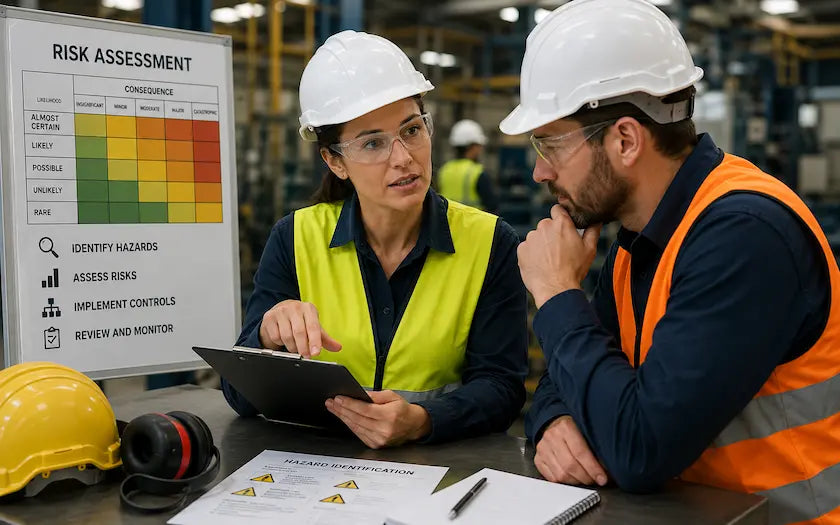
Once a hazard is identified, the next legal requirement is assessing the risk it poses. Risk assessment looks at two things: the likelihood of the hazard causing harm, and the severity of that harm if it occurs.
Safe Work Australia's guidance describes this as a structured evaluation, not a gut-feeling guess. A common approach used across industries, including in UK and US occupational safety frameworks, is a risk matrix that scores likelihood against consequence to produce an overall risk rating, such as low, medium, high, or extreme.
Why Risk Assessment Isn't Just Paperwork
It's tempting to view a risk assessment as a form that gets filled out and filed away. But under WHS laws, the assessment has to genuinely inform what controls are put in place. A risk assessment that concludes "high risk" but results in no change to procedures isn't meeting the spirit, or arguably the letter, of the law.
This is also where the hierarchy of control comes back into play. If a risk assessment for a construction site identifies fall hazards from height, the appropriate response isn't simply "wear a harness." The law expects businesses to first consider whether the work at height can be eliminated or substituted, before relying on administrative controls or PPE.
Industries With Heightened Obligations
Certain sectors carry additional or more specific WHS obligations because of the nature of the risks involved.
-
Construction sites must address risks like falls, plant and equipment hazards, and electrical work, often requiring a Safe Work Method Statement for high-risk construction work.
-
Healthcare and aged care settings need ongoing risk assessment around manual handling, exposure to infectious diseases, and increasingly, workplace violence and aggression.
Mining, agriculture, and manufacturing each carry their own regulatory layers, often with industry-specific codes of practice issued by state regulators like SafeWork NSW, WorkSafe Victoria, or WorkSafe Queensland.
Documentation: What Regulators Actually Expect to See
A frequent misconception is that WHS law mandates a specific paperwork format. It doesn't. What it does require is that businesses can demonstrate, if asked, that they've taken a systematic and genuine approach to identifying hazards and assessing risk.
In practice, this usually means maintaining a hazard register, risk assessment records for specific tasks (especially high-risk ones), and evidence of consultation with workers, such as meeting minutes or toolbox talk records.
Regulators like Safe Work Australia and state-based bodies have repeatedly emphasised that documentation should reflect real practice, not exist purely for audit purposes. A risk assessment dated three years ago for a process that's since changed completely tells an inspector very little about current safety standards.
The Role of Worker Consultation
WHS laws across Australia place a strong emphasis on consultation, not as a courtesy, but as a legal requirement. Section 47 of the model WHS Act requires PCBUs to consult with workers who are, or are likely to be, directly affected by a health and safety matter.
This matters enormously for hazard identification specifically. Workers on the floor often have the clearest view of emerging risks, equipment wear, or process shortcuts that have crept in over time. A genuinely consultative approach, through health and safety representatives, regular toolbox talks, or simple open-door feedback channels, tends to surface hazards far earlier than top-down inspections alone.
Psychosocial Hazards: A Growing Area of Focus
One of the more significant shifts in Australian WHS regulation in recent years has been the formal recognition of psychosocial hazards. These include things like excessive job demands, poor workplace relationships, bullying, harassment, and exposure to traumatic events.
Safe Work Australia's model Code of Practice on managing psychosocial hazards at work, along with state-level regulations such as those introduced in Victoria and NSW, now explicitly require businesses to identify and assess these risks with the same rigour traditionally applied to physical hazards.
This is a meaningful change. For years, psychosocial risk was treated as a soft HR issue rather than a WHS compliance matter. That framing has shifted decisively, and businesses that haven't updated their risk assessment processes to include psychosocial factors are increasingly exposed to regulatory action.
Common Mistakes Businesses Make
A few patterns show up repeatedly across WHS enforcement notices and case studies.
Treating risk assessment as a one-time event rather than an ongoing process is probably the most common. Workplaces change, new equipment gets introduced, staff turnover brings in less experienced workers, and yet the risk assessment sometimes sits untouched for years.
Another frequent issue is generic, copy-paste risk assessments that don't reflect the actual task or site conditions. A template downloaded from the internet and lightly edited rarely captures the specific layout, equipment, or workforce of an individual business.
Failing to close the loop is another quiet failure point. Hazards get identified, sometimes even formally documented, but the corrective action never actually gets implemented or followed up on.
Practical Tips for Getting This Right
Based on how well-run businesses across various Australian industries approach this, a few practices consistently stand out.
Building hazard identification into routine operations, rather than treating it as an annual event, makes an enormous difference. This might mean a five-minute pre-shift check, a monthly walkthrough, or simply encouraging staff to flag concerns without friction.
Training matters just as much as process. Staff who understand what a hazard actually looks like, and who feel safe reporting one, become an active part of the safety system rather than passive recipients of it. This is where structured learning, like a course such as Workplace First Aid Awareness for Employees, adds real value, not just for emergency response skills, but because it builds a broader culture of risk awareness among staff who might otherwise never think about WHS obligations day to day. If your team hasn't had this kind of training recently, it's worth exploring as a genuinely practical next step.
Reviewing risk assessments after any incident, near miss, or significant operational change keeps documentation honest and current, rather than a historical artefact nobody revisits.
How This Compares Internationally
While this article focuses on Australian WHS law, the underlying principles align closely with occupational safety frameworks elsewhere. The UK's Health and Safety Executive requires employers to conduct suitable and sufficient risk assessments under the Management of Health and Safety at Work Regulations. In the United States, OSHA's general duty clause similarly obligates employers to provide a workplace free from recognised hazards.
The consistent thread across all these frameworks, Australian, British, or American, is that hazard identification and risk assessment aren't passive compliance exercises. They're meant to be living processes that genuinely reduce harm.
Where to Go for Reliable Guidance
For businesses wanting to get their hazard identification and risk assessment processes right, Safe Work Australia's official guidance materials remain the most authoritative starting point, alongside state regulator resources from bodies like SafeWork NSW and WorkSafe Victoria.
For those looking to build practical, structured skills around this area, the Workplace Hazard Identification and Risk Assessment course from Australian Compliance Training offers a focused, accessible way to understand these obligations in real terms rather than just theory. It's a genuinely useful resource for supervisors, safety officers, or business owners who want confidence that their processes actually hold up to scrutiny.
Final Thoughts
WHS laws don't expect perfection. They expect businesses to take genuine, ongoing steps to find hazards before they cause harm, and to assess and control the risks those hazards present. The businesses that get this right tend to share a common trait: they treat safety as something built into daily operations, not something performed for an auditor once a year.
If your current approach to hazard identification feels more like paperwork than practice, that's usually the clearest sign it's time for a proper review.


