
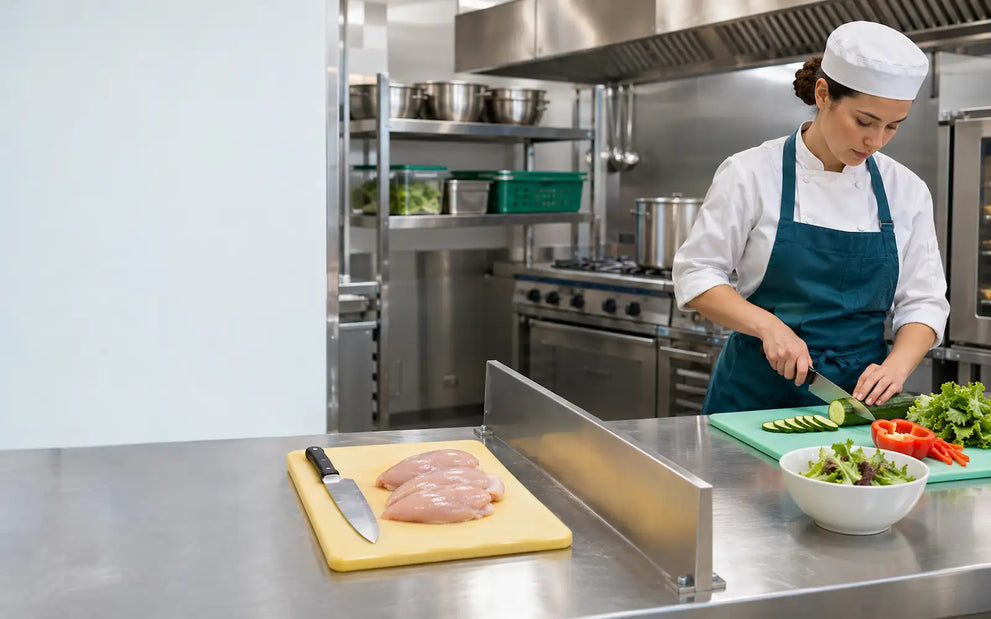
Cross-contamination is a realistic and preventable risk in every commercial kitchen. Imagine a chef finishing a tray of raw chicken breasts, then reaching for a serving spoon to plate a garden salad without washing their hands or changing gloves. At that moment, harmful bacteria such as Salmonella can transfer directly to food that will not be cooked again before it reaches a customer. This is cross-contamination: the unintended transfer of harmful microorganisms, allergens or other contaminants from one food, surface or person to another.
For food businesses, consistent prevention matters because contaminated food can make customers seriously ill, trigger regulatory action and damage a business's reputation in ways that take years to repair. The main contamination pathways are well understood and controllable. This article sets out practical, evidence-based controls covering separation, storage, hygiene, cleaning and sanitising, allergen management and staff training, with reference to applicable Australian food safety requirements.
How Do You Prevent Cross-Contamination?
Prevent cross-contamination by separating raw and ready-to-eat food, washing hands between tasks, cleaning and sanitising equipment, storing food in covered containers, and controlling allergen transfer. Apply these controls during preparation, storage, service and delivery, and check that staff follow them throughout each shift.
Microbial cross-contamination involves the transfer of harmful microorganisms. Allergen cross-contact involves the unintended transfer of allergenic material. Both need controls, but sanitising for microorganisms does not by itself remove allergens.
1. Separate Raw and Ready-to-Eat Foods
Raw meat, poultry and seafood can carry harmful microorganisms including Salmonella, Campylobacter and E. coli. These can transfer directly to ready-to-eat food through contact, or indirectly through contaminated hands, boards, knives and other equipment.
Ready-to-eat food is of particular concern because it is ordinarily consumed without further cooking. If harmful microorganisms are introduced at the preparation stage, there is no subsequent heat treatment to destroy them before the food reaches the customer.
Where your layout allows, designate separate preparation areas for raw and ready-to-eat foods. Dedicated colour-coded chopping boards and utensils for different food types are a practical way to reduce indirect transfer. When equipment must be shared, as often happens in smaller kitchens, clean and sanitise it between raw and ready-to-eat preparation. Colour coding supports separation, but does not replace cleaning or staff training.

Indirect contamination can be harder to spot than direct contact. A cutting board used for raw chicken and then only wiped with a cloth can spread bacteria to every item subsequently prepared on it. Where separate areas are unavailable, schedule ready-to-eat preparation before raw-food tasks where feasible. Whenever switching from raw food to ready-to-eat food, wash hands and clean and sanitise shared equipment and surfaces first.
2. Store Food Safely to Prevent Contamination
How food is stored has a direct bearing on contamination risk. The foundational rule is straightforward: raw foods must be stored separately from, or physically below, ready-to-eat foods. Storing raw meat, poultry or seafood above ready-to-eat food creates a drip risk, where raw juices can contaminate food that will be eaten without further cooking.
Under Standard 3.2.2, food must be stored so it remains safe and suitable. FSANZ storage guidance recommends covered food-safe containers and storing raw foods separately from, or below, ready-to-eat foods.

Potentially hazardous food generally needs to be kept at 5°C or colder, or 60°C or hotter. An alternative is permitted only where the business can demonstrate that it keeps food safe. See the FSANZ temperature control requirements.
In practice this means using food-safe, covered containers to prevent leakage between foods; placing raw meat, poultry and seafood on the lowest refrigerator shelves; and keeping raw and ready-to-eat foods in clearly separated sections of cool-rooms and cold storage. Label preparation dates, rotate stock and follow use-by dates and manufacturer storage instructions. Keep cleaning chemicals away from food and food packaging. Temperature control limits bacterial growth but does not prevent physical contamination from drip or direct contact; correct separation and containment remain essential even when temperatures are well managed.
3. Maintain Proper Handwashing and Personal Hygiene
Hands are one of the most common contamination pathways in a food business. The FSANZ health and hygiene guidance explains that food handlers must wash their hands whenever they are likely to contaminate food. This specifically includes immediately before working with ready-to-eat food after handling raw food, after using the toilet, after handling waste, and after coughing, sneezing or touching hair.
FSANZ recommends a process that involves wetting hands under warm running water, applying soap and thoroughly scrubbing fingers, palms, wrists, backs of hands and under fingernails for at least 15 seconds, rinsing under running water and drying thoroughly with a single-use paper towel. Hand-washing facilities must be used for this purpose; preparation sinks and dishwashing sinks are not appropriate substitutes.
Gloves can be a useful supplementary measure, but they do not replace handwashing. Contaminated gloves transfer microorganisms just as contaminated bare hands do. Gloves must be changed at the same times that handwashing would otherwise be required, and hands should be washed before putting on a fresh pair.
Standard 3.2.2 also requires that a food handler who is ill with a condition transmissible through food; such as gastroenteritis, vomiting or diarrhoea; must not handle food or work in a way likely to cause contamination. Food businesses have corresponding duties to enforce these requirements. A clear procedure for illness reporting and exclusion, communicated to all staff before they encounter the situation, is part of a well-managed kitchen.
4. Clean and Sanitise Food Contact Surfaces and Equipment Correctly
Cleaning and sanitising are two distinct steps, and both are necessary. Cleaning removes visible food debris, grease and dirt using detergent and physical action. Sanitising destroys microorganisms on a surface to a safe level. As the FSANZ cleaning and sanitising guidance confirms, effective cleaning must occur before sanitising; sanitisers may not work properly on surfaces that still carry visible contamination.

The correct sequence for most food contact surfaces is:
- Pre-clean by scraping or wiping away food scraps and residues.
- Wash with hot water and appropriate detergent.
- Rinse to remove detergent residues where required.
- Apply the sanitiser according to the manufacturer's instructions, at the specified dilution and contact time.
- Follow any required final-rinse instructions, then allow to air dry and protect from recontamination.
Always follow the product instructions for the sanitiser being used; dilution rates, contact times and suitable surfaces vary between products. Using a sanitiser at the wrong concentration or insufficient contact time can render it ineffective.
Cleaning cloths are a frequently overlooked contamination source. A cloth used to wipe a raw meat preparation area and then used on a salad bench without laundering, sanitising or replacing will spread microorganisms rather than remove them. Equipment with hard-to-reach parts, such as slicers or mincers, requires disassembly for thorough cleaning; gaps, joints and threads can harbour food residue and bacteria if cleaning is restricted to accessible surfaces only. Clear cleaning schedules and regular verification that procedures are actually being followed support consistent outcomes.
5. Prevent Allergen Cross-Contact
Allergen cross-contact is distinct from microbial cross-contamination, though both require active management. Cross-contact occurs when a food allergen is unintentionally transferred to a food that should not contain it. Do not rely on cooking to make food containing an unintended allergen safe. Ordinary cooking does not reliably eliminate allergen risk.

Australian declaration requirements distinguish wheat from other gluten-containing cereals, and crustaceans from molluscs. They also cover egg, milk, fish, peanut, soy, sesame, lupin and specified individual tree nuts. Added sulphites require declaration at concentrations of 10 mg/kg or more. Check the precise names, conditions and exemptions in the FSANZ allergen labelling guidance, rather than relying on a simplified allergen list.
Allergen cross-contact most commonly occurs through shared utensils, equipment, hands and work surfaces. Wiping a surface with a damp cloth after preparing a peanut dish, then using that surface for a meal described as nut-free, does not make it safe for an allergic customer. Cleaning must remove allergenic residues. Sanitising targets microorganisms and is not a substitute for allergen removal. The ASCIA food allergy guidance explains why cooking and liquid sanitiser cannot be relied on to remove allergens.
Practical controls include verifying ingredients against allergen declarations whenever suppliers or formulations change; using dedicated equipment and utensils for allergen-sensitive preparations where practicable; ensuring staff can accurately communicate allergen content to customers; and having a clear process for handling allergen-specific requests. Check NSW Food Authority guidance on allergen rules and your own jurisdiction’s requirements for disclosure. If staff cannot verify ingredients or control cross-contact, explain that limitation to the customer. Do not promise an allergen-free meal without adequate controls.
6. Protect Food During Preparation, Display and Delivery
Contamination does not only occur in the kitchen. During display, serving, packing and delivery, food needs equivalent protection. Displayed food must be protected from customers, pests and environmental sources through covers, sneeze guards or physical barriers where appropriate. Clean serving utensils must be provided and replaced regularly, and self-serve arrangements should minimise the risk of customer contamination.
Utensils must not be shared across food types without cleaning and sanitising in between; including where allergen risks are present. During packing and delivery, raw and ready-to-eat foods must remain separated, with raw proteins kept in sealed, leak-proof packaging. Where potentially hazardous food is being transported, appropriate temperature-controlled arrangements are needed, and time outside temperature control should be minimised. Vehicles and containers used for food delivery should be clean and free from materials that could contaminate food.
7. Train Staff and Verify Food Safety Procedures
Controls are only as effective as the people implementing them. Under Standard 3.2.2, food businesses must ensure that food handlers have skills and knowledge in food safety and hygiene matters commensurate with their work activities. This is a baseline legal requirement applicable to all food businesses in Australia.
For businesses covered by Standard 3.2.2A, the food handler training requirement can be met through a food safety training course or adequate skills and knowledge for the relevant activity. A course certificate is not the only permitted route. The additional management tools are explained below.
Whether or not Standard 3.2.2A applies, training alone is not sufficient. Procedures must be practically implemented and regularly verified. Supervision and observation allow managers to confirm that controls are being applied, not just that staff have completed a module. Corrective action must follow when procedures are not being followed, and refresher training is appropriate when menus, suppliers or processes change.

Daily Cross-Contamination Checklist
Use this operational checklist at the start of service and when tasks change. It supports supervision and does not replace any required food safety records.
- Storage: Raw food is contained and separated from ready-to-eat food. Packaging is intact.
- Preparation: Boards, knives and benches are suitable for the next task and clean and sanitary where required.
- Hands and gloves: Staff wash hands between contamination-prone tasks and replace contaminated gloves.
- Cleaning: Sanitiser is used at the labelled concentration and contact time. Dirty cloths are removed from use.
- Allergens: Ingredient information is current, requests are communicated clearly, and equipment is appropriately cleaned or dedicated.
- Service and delivery: Food is protected, utensils are suitable, and raw-food leakage cannot reach ready-to-eat meals.
- Supervision: Identified failures are corrected and staff understand what must change.
What Should You Do If Cross-Contamination Happens?
Stop using the affected food or equipment and tell the supervisor. Keep suspect food separate and clearly identified so it cannot be served while the risk is assessed. Do not assume that wiping a surface or reheating a dish will resolve every hazard.
Clean affected equipment, sanitise where required, and restore safe hand hygiene and preparation arrangements before restarting. If food cannot be shown to be safe, discard it. Record what happened and the corrective action under your business procedures. If affected food has already been supplied, seek advice promptly from the relevant food authority about the necessary response.
What Australian Food Safety Standards Require
The Australia New Zealand Food Standards Code sets the national framework for food safety. Chapter 3 of the Code, which applies in Australia only, contains the food safety standards most directly relevant to food businesses.
Standard 3.2.2 applies to all food businesses and food handlers in Australia. It sets legally enforceable requirements for food handling at each stage of the handling process; including receipt, storage, processing, display, packaging and transport; as well as for the health and hygiene of food handlers, and for the cleaning and sanitising of food contact surfaces and equipment.
Standard 3.2.2A applies to category one and category two food service, catering and retail businesses that handle unpackaged, potentially hazardous, ready-to-eat food. Category one businesses need all three tools: a food safety supervisor, food handler training or adequate skills and knowledge, and evidence of critical food safety controls. Category two businesses need the first two tools. Evidence can involve records or another demonstration accepted under the standard. Not every food business falls within its scope, and applicable categories and tools depend on the nature of food handling activities.
State, territory and local government food authorities are primarily responsible for enforcing these standards. Requirements can vary between jurisdictions. Consulting the FSANZ Safe Food Australia guide is a useful starting point, and checking with the relevant local authority confirms what applies to a particular operation. This article does not constitute legal advice.
How HACCP Helps Prevent Cross-Contamination
Hazard Analysis and Critical Control Point (HACCP) is a systematic, preventive approach to food safety that identifies biological, chemical and physical hazards in food production processes and establishes controls to manage them before harm occurs.
Applied to cross-contamination, HACCP helps food businesses think methodically about where contamination risks arise in their specific operation; during ingredient receipt, preparation, cooking, cooling, packaging or service; and put appropriate controls in place at each point. Key elements include hazard identification, establishing and monitoring controls, taking corrective action when controls fail, and documenting the system to support consistent improvement.
Do not confuse the evidence tool under Standard 3.2.2A with a universal requirement for HACCP certification. Formal food safety program obligations depend on business activities and jurisdiction. FSANZ explains which businesses require food safety programs.
For further learning, explore HACCP Principles for Australian Food Businesses.
HACCP Principles for Australian Food Businesses
Understand HACCP principles and their role in food safety management. Learn how to identify hazards and manage food safety risks.
Conclusion: Make Cross-Contamination Prevention a Daily Practice
Preventing cross-contamination depends on consistent work habits: separate raw and ready-to-eat food, wash hands, clean before sanitising, control allergen transfer and protect food through service and delivery.
Review these controls against your current menu, equipment and staffing. Give each check a responsible person, correct failures promptly and verify that the revised procedure works during a normal shift.


