
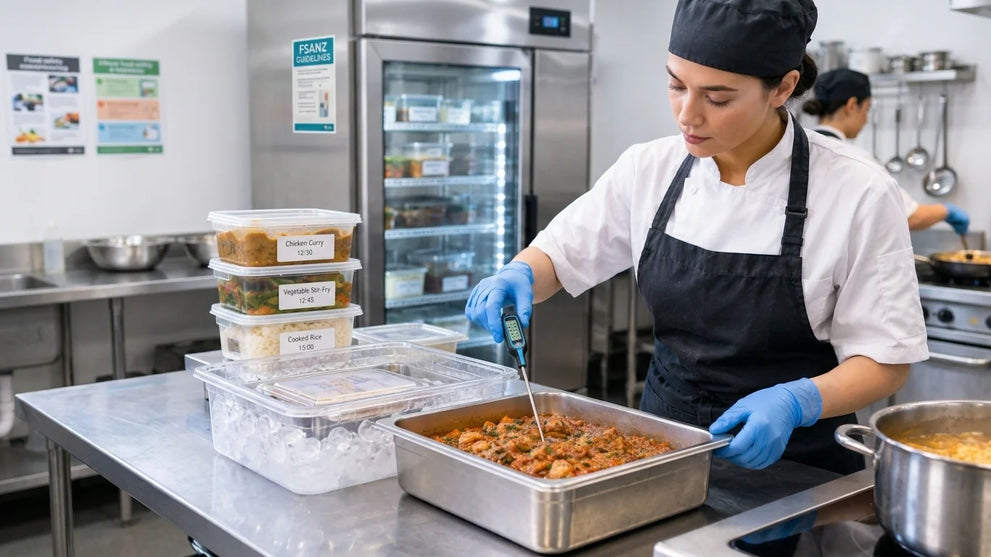
Australian Food Safety: Cooling & Reheating
Cooling and reheating food correctly are essential responsibilities for Australian restaurants, cafés, catering businesses and commercial kitchens. If cooked food cools too slowly or is reheated incorrectly, harmful microorganisms can grow and increase the risk of food poisoning. Safe temperature control helps protect customers, maintain food quality and support compliance with Australian food safety requirements.
Under Standard 3.2.2 of the Australia New Zealand Food Standards Code, businesses must manage potentially hazardous food carefully during cooling and reheating. The main temperature requirements are clear: cool cooked potentially hazardous food from 60°C to 21°C within two hours, then from 21°C to 5°C within a further four hours. When reheating food for hot-holding, heat it rapidly to 60°C or above, ideally within two hours.
Businesses must also understand the separate 2-hour/4-hour rule, which applies when potentially hazardous food is between 5°C and 60°C. Knowing which rule applies, monitoring temperatures and training staff are practical steps towards safer food handling. The official FSANZ cooling and reheating guidance explains these requirements in more detail.
Australian Food Cooling and Reheating Requirements
Potentially hazardous food includes foods that require temperature control to limit the growth of harmful microorganisms. Examples include cooked meat, poultry, seafood, dairy-based dishes, cooked rice and prepared meals containing ingredients that need refrigeration.
For most potentially hazardous food, the key temperature limits are:
-
Cold storage: 5°C or below.
-
Hot holding: 60°C or above.
-
Temperature danger zone: Between 5°C and 60°C.
Food does not automatically become unsafe the moment it enters the temperature danger zone. However, the longer it remains in this range, the greater the potential for harmful microorganisms to grow. Businesses should therefore minimise the time food spends between 5°C and 60°C and follow the applicable cooling, reheating and time-control requirements.
These temperatures are practical controls, not a substitute for correct cooking, hygiene, cleaning and sanitising. Food that has been mishandled may remain unsafe even if it is subsequently cooled or reheated.
Standard 3.2.2 and Standard 3.2.2A: What Businesses Need to Know
Standard 3.2.2: Food Safety Practices and General Requirements establishes food-handling requirements, including the cooling and reheating of potentially hazardous food. Its cooling and reheating provisions are particularly important for businesses that prepare food in advance, refrigerate cooked dishes or reheat meals for hot-holding.
Standard 3.2.2A: Food Safety Management Tools adds requirements for eligible food service, catering and retail businesses that handle unpackaged, ready-to-eat, potentially hazardous food. Depending on the business category and activities, these requirements include food safety supervisor arrangements, food handler training and evidence that critical food safety controls are being managed.
Businesses should consult the official Safe Food Australia guide to understand the standards and how they apply to their operations.
When Requirements Depend on the Type of Food Business
Requirements can differ according to the activities a business carries out, its food handling practices and the applicable state or territory arrangements. A café that cooks and cools meals for later service, for example, needs a reliable cooling process. A catering business must also consider temperature control during transport and service.
Businesses should identify the rules that apply to their specific activities rather than assuming that one procedure covers every situation. Local councils and relevant state or territory food authorities can provide guidance about compliance and inspections.
How to Cool Cooked Food Safely
Large quantities of hot food can take too long to cool, particularly when stored in deep containers. The centre may remain warm even after the surface has cooled, allowing microorganisms to grow.
To improve cooling:
-
Divide large batches into smaller portions.
-
Use clean, shallow containers rather than deep pots.
-
Avoid stacking containers in a way that restricts airflow.
-
Place containers where cool air can circulate freely.
-
Use a blast chiller or other suitable rapid-cooling equipment where available.
-
Stir liquids such as soups, sauces and gravy with a clean, sanitised utensil.
-
Use an ice-water bath when appropriate, taking care to prevent contamination.
Food should be protected from contamination while being portioned and cooled. Staff should also avoid leaving large pots on benches for extended periods in the hope that they will cool naturally.
Follow the Two-Stage Cooling Process
Australian food safety requirements specify a two-stage process for cooling cooked potentially hazardous food intended for later use.
|
Cooling stage |
Required temperature change |
Maximum time |
|
Stage 1 |
From 60°C to 21°C |
2 hours |
|
Stage 2 |
From 21°C to 5°C |
A further 4 hours |
|
Total cooling period |
From 60°C to 5°C |
No more than 6 hours |
Both stages must be met. The first stage is not a two-hour allowance followed by an additional four hours to reach any temperature. Food must reach 21°C or below within the first two hours, then reach 5°C or below within the next four hours.
For example, if a batch of cooked soup reaches 60°C at 1:00 pm, it must reach 21°C or below by 3:00 pm. It must then reach 5°C or below by 7:00 pm.
A business may use a different cooling process only when it can demonstrate that the alternative will not adversely affect the food's microbiological safety. Simply missing the prescribed limits does not make an alternative process acceptable.
Monitor and Record Food Temperatures
Visual checks are not enough to confirm that food has cooled safely. Use a clean, sanitised probe thermometer to measure the temperature of the food, paying particular attention to the warmest part, which is often near the centre.
Record the food's identity, date, start time and temperature, the time it reaches 21°C, and the time it reaches 5°C. These details help staff verify whether both cooling stages have been completed within the required limits.
Follow the thermometer manufacturer's instructions and your business's cleaning and sanitising procedures. Clean and sanitise the probe between different foods to reduce the risk of cross-contamination.
Store Cooled Food Safely
Once food has cooled to 5°C or below, store it under refrigeration. Use clean, suitable containers, protect the food from contamination and label it according to your kitchen's food identification and stock-rotation procedures.
Avoid overloading refrigerators with large quantities of warm food, as this can interfere with effective cooling and affect other stored items. Arrange food so that air can circulate, and follow your business's procedures for storage times, date labelling and stock rotation.

How to Reheat Food Safely
When potentially hazardous food has been cooked, cooled and stored for later hot service, it must be reheated rapidly to 60°C or above before being placed in hot-holding equipment. The official guidance recommends aiming to achieve this within two hours or less.
Suitable reheating methods may include a stovetop, oven or microwave, depending on the food and equipment. The goal is to heat the food quickly and evenly rather than allowing it to warm gradually.
For example, a restaurant reheating a refrigerated curry for a hot buffet should check that the food has reached at least 60°C before transferring it to a bain-marie. The same principle applies to soups, sauces and other potentially hazardous dishes intended to remain hot for service.
This specific reheating requirement concerns food being reheated for hot-holding. Other cooking or reheating situations may have different requirements, so businesses should follow the applicable food safety procedures for the food they are preparing.
Using Probe Thermometers and Suitable Equipment
A probe thermometer provides a practical way to check whether reheated food has reached the required temperature. Insert the sanitised probe into the food's thickest or coolest part, avoiding contact with the container where possible.
For large quantities, check representative areas and follow your business's validated procedure to confirm that the food has heated evenly. If the required temperature has not been reached, continue reheating and check again.
Keep records of the reheating start time, completion time and final temperature where required by your food safety management arrangements. Staff should know how to use thermometers correctly and what to do when a reading falls outside the required limits.
Why Bain-Maries Should Not Be Used to Reheat Food
A bain-marie is designed to maintain food at a hot temperature, not to reheat cold food quickly. Using it to warm refrigerated food can allow the food to remain in the temperature danger zone for too long.
Instead, reheat food rapidly using suitable equipment, check that it reaches at least 60°C, and then transfer it to the bain-marie or other hot-holding unit. Keep the food at 60°C or above during hot-holding unless an applicable, demonstrated safe alternative control is being used.
Avoid repeatedly cooling and reheating the same batch. Repeated temperature changes make safe handling more difficult and can increase the time food spends in conditions that support microbial growth.
The 2-Hour/4-Hour Rule Explained
The 2-hour/4-hour rule is different from the two-stage cooling process. It is a guide for managing potentially hazardous food that has been between 5°C and 60°C, such as food removed from refrigeration for preparation, display or service.
The time is cumulative. Businesses must add together all relevant periods the food spends in this temperature range, including preparation, storage outside temperature control, transport and display.
|
Total time between 5°C and 60°C |
What the business can do |
|
Less than 2 hours |
Use or sell the food, or return it to the refrigerator for later use. |
|
2 hours to 4 hours |
Use or sell the food, but do not return it to the refrigerator for later use. |
|
More than 4 hours |
Do not sell or serve the food. Discard it. |
For example, if prepared sandwiches spend 45 minutes outside refrigeration during preparation and another 90 minutes on display, their cumulative time is 2 hours and 15 minutes. Under the rule, they can be used or sold but must not be returned to the refrigerator for later use.
The rule does not replace the mandatory two-stage cooling process for cooked potentially hazardous food. Businesses must identify which control applies to the situation and use a reliable method to track time.
For the full explanation, refer to the official FSANZ 2-hour/4-hour rule.

Common Cooling and Reheating Mistakes
Several routine kitchen practices can undermine food safety:
-
Cooling large batches in deep containers: Divide food into smaller portions and use shallow containers to help it cool faster.
-
Guessing temperatures: Use a sanitised probe thermometer instead of relying on touch, appearance or steam.
-
Putting warm food into crowded refrigeration: Use an appropriate rapid-cooling method and ensure airflow around containers.
-
Reheating food in hot-holding equipment: Reheat rapidly using suitable equipment before transferring food to a bain-marie.
-
Ignoring cumulative time: Track all relevant time spent between 5°C and 60°C when applying the 2-hour/4-hour rule.
-
Failing to act when a limit is missed: Do not automatically assume that further chilling or reheating will make the food safe.
If food does not meet the required cooling or reheating limits, staff should follow the business's documented corrective-action procedure and applicable food safety requirements. Do not serve the food simply because it looks or smells normal. Where safety cannot be established, discard it and review the process to prevent the problem from recurring.
Food Safety Records and a Practical Kitchen Checklist
Food safety records help businesses verify that procedures are being followed and identify recurring problems. Under Standard 3.2.2A, some businesses must substantiate critical food safety controls. Depending on the applicable requirements, a business may need to keep records or demonstrate to an authorised officer that food is being handled safely.
The NSW Food Authority's guidance on showing food is safe provides examples of records and monitoring practices. Businesses outside NSW should also check the guidance relevant to their own state or territory.
Sample Cooling and Reheating Temperature Log
|
Date |
Food or batch |
Start time and temperature |
Intermediate reading |
Final reading |
Staff initials / action |
|
23/10/2026 |
Cooked soup |
1:00 pm, 60°C |
3:00 pm, 21°C |
7:00 pm, 5°C |
AB / Within limits |
|
23/10/2026 |
Reheated curry |
11:00 am, start reheating |
11:45 am, check |
12:00 pm, 60°C or above |
CD / Ready for hot-holding |
Daily Kitchen Checklist
Before, during and after food preparation, confirm that:
-
Staff know the required cooling and reheating procedures.
-
Suitable, clean and sanitised probe thermometers are available.
-
Cooked food is divided into suitable portions for rapid cooling.
-
Food cools from 60°C to 21°C within two hours and from 21°C to 5°C within the next four hours.
-
Cooling temperatures and times are recorded where required.
-
Cooled food is stored at 5°C or below.
-
Food intended for hot-holding is reheated rapidly to at least 60°C.
-
Reheated food reaches the required temperature before entering hot-holding equipment.
-
Time outside temperature control is tracked when the 2-hour/4-hour rule applies.
-
Missed limits are reported and handled according to the corrective-action procedure.
Staff training is important because even a well-designed procedure can fail if employees do not understand it. Food businesses should make sure workers know how to measure temperatures, record readings and respond when food does not meet the required limits.
Conclusion
Cooling and reheating food safely require more than placing food in a refrigerator or warming it before service. Australian food businesses need to understand the prescribed temperature limits, follow the two-stage cooling process, reheat food rapidly for hot-holding and apply the 2-hour/4-hour rule correctly.
Using suitable equipment, checking temperatures with a probe thermometer, maintaining appropriate records and training staff can make these controls part of everyday kitchen practice. Businesses should review the applicable standards and local requirements regularly so that their procedures remain suitable for the food they prepare and serve.


