
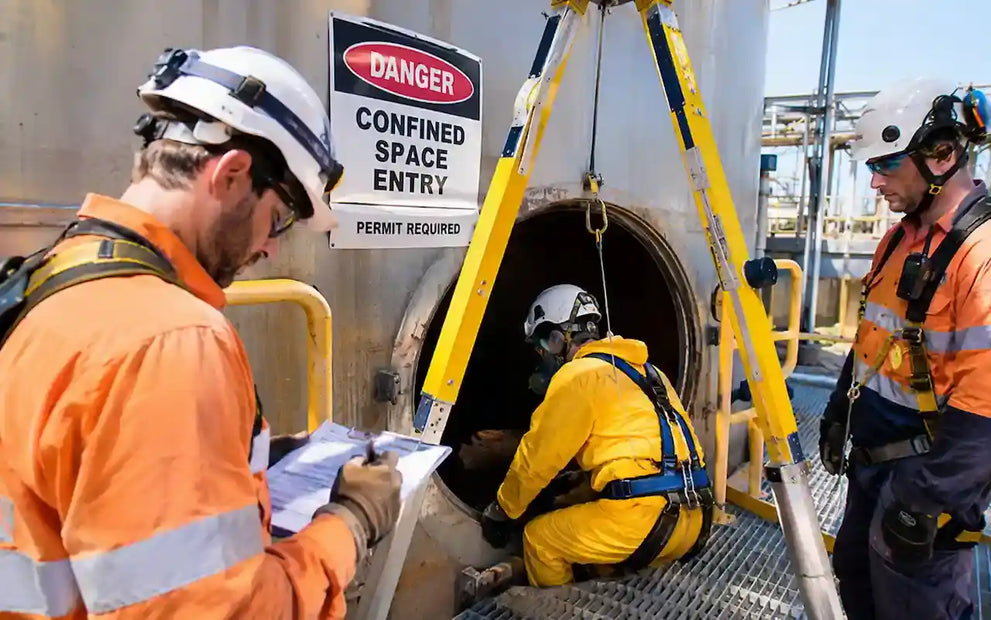
Confined space entry can expose workers to hazards that are difficult to see, including oxygen deficiency, toxic atmospheres, fire and engulfment. A written permit alone cannot make a hazardous space safe: the work requires competent assessment, effective controls, communication and a workable rescue plan.
For employers assessing confined space entry requirements in Australia, the essential question is not simply whether an area is narrow or enclosed. It is whether the space meets the applicable legal definition and whether entry can be avoided. This guide explains classification, permits, training, emergency preparation and a practical pre-entry checklist.
Australian rules differ between jurisdictions. The national model Code of Practice provides an important reference, but businesses must confirm the legislation and approved guidance applying at their site.
What Is a Confined Space Under Australian WHS Laws?
Legal definition and common examples
Under the model WHS definition, a confined space is enclosed or partially enclosed, is not designed or intended primarily for human occupancy, is at normal atmospheric pressure during occupancy, and presents or is likely to present specified risks from unsafe oxygen levels, airborne contaminants, fire or explosion, or engulfment. All relevant elements must be considered; the presence of a hatch or restricted access alone does not decide the classification.
Potential examples include wastewater pits, silos, storage tanks, pressure vessels, ducts and some underground structures. A room designed for ordinary occupancy is not automatically a confined space merely because ventilation is poor. Equally, a space can become hazardous because of residues, cleaning chemicals, process changes or work performed inside it.
| Work area | Possible classification | What to assess |
|---|---|---|
| Wastewater pit | Often a confined space | Atmosphere, inflow, access, rescue |
| Grain silo | May be a confined space | Engulfment, dust, moving plant |
| Industrial tank | Often a confined space | Residues, oxygen, isolation |
| Open excavation | Not automatically | Geometry, atmosphere and legal definition |
| Office storeroom | Generally not solely due to size | Ordinary occupancy and hazards |
Classification examples are indicative, not automatic legal determinations. Source: SafeWork NSW confined space definition and examples.
Hazards and employer duties
An atmosphere may change between inspections or during the task. Cleaning, welding, painting, biological activity, leakage and displaced oxygen can introduce new risks. Other hazards include heat, electrical energy, mechanical movement, falls, poor access and substances that can engulf a person. Risk assessments must consider both the space and the work proposed.
In model WHS jurisdictions, the PCBU must manage risks from entry and work in or near confined spaces, including inadvertent entry. Practical controls include eliminating entry where reasonably practicable, preventing unauthorised access, isolating hazardous services, providing safe access and exit, and preparing emergency procedures. The specific duties are explained in Safe Work Australia’s confined space guidance.
State and territory differences
Safe Work Australia publishes model laws and codes; each jurisdiction decides their legal status. Victoria operates under its own OHS framework and publishes a separate confined spaces compliance code. Employers with multiple sites should use the local regulator’s requirements rather than treating a single national template as sufficient. WorkSafe Victoria’s compliance code explains the Victorian approach.
The national model code was updated on 6 November 2026 to reflect terminology associated with workplace exposure limits commencing 1 December 2026. Employers should check current local instruments and any transitional provisions before relying on a fixed exposure terminology or threshold.
When Is a Confined Space Entry Permit Required?
Entry permit and authorisation
Under the model WHS framework, a PCBU must not direct a worker to enter a confined space for work unless an entry permit has been issued. A competent person must complete the written permit. The permit identifies the space, authorised workers, period of work and risk-control measures, and provides for acknowledgement that everyone has left the space. Site procedures should also specify who checks controls, authorises work and closes the permit.
A permit is a communication and authorisation tool, not permission to bypass controls. It should be available to those carrying out the work and reflect actual site conditions. If the job, atmosphere, personnel or controls change materially, stop work and reassess whether the existing authorisation remains appropriate.
| Permit element | Purpose | Practical check |
|---|---|---|
| Space and task | Identify the authorised work | Correct location and scope |
| Entrants and period | Limit access and duration | Names, shifts and validity |
| Hazards and controls | Confirm safe system of work | Isolation, ventilation, testing |
| Communication and standby | Maintain contact | Method tested before entry |
| Emergency arrangements | Enable planned response | Equipment and responders ready |
| Close-out | Confirm safe completion | All entrants accounted for |
Permit requirements are described by SafeWork NSW; additional site controls above are good-practice implementation checks.

Risk assessment, isolation and atmospheric testing
A competent person should assess whether entry is necessary, the nature of the space, potential atmospheric changes, the proposed work and emergency arrangements. Elimination comes first: remote cleaning, external inspection or redesign may avoid exposure. If entry remains necessary, use the hierarchy of controls to manage hazards rather than relying on PPE alone.
Isolate and verify hazardous energy and materials before entry. This can include electrical, mechanical, hydraulic and pneumatic sources, as well as pipework, valves and process feeds. Ventilation and atmospheric testing must be selected for the identified risks. Testing equipment should be suitable, maintained and used by competent personnel; a single satisfactory reading is not a guarantee that conditions will remain safe.
Entry permit versus SWMS
A confined space entry permit authorises specified entry under controlled conditions. A risk assessment identifies hazards and determines controls. A safe work method statement (SWMS) documents how high-risk construction work will be carried out and controlled where the relevant construction requirements apply. These documents may overlap, but one does not automatically replace another.
Work must stop if an alarm sounds, communication fails, isolation is compromised, rescue capability becomes unavailable or an unexpected hazard emerges. Workers should exit in accordance with the emergency procedure, report the change and obtain reassessment before any re-entry.
What Training and Safety Duties Apply to Confined Space Work?
Competence is role-specific
Confined space training in Australia should match the actual work, hazards, equipment and assigned responsibilities. Workers may need instruction in identifying hazards, permit conditions, atmospheric monitoring, isolation, communications, PPE, emergency signals and rescue arrangements. Employers should assess competence rather than assuming attendance at a general awareness course is enough.
Nationally recognised units such as RIIWHS202 Enter and work in confined spaces may be relevant to particular jobs or industries, but there is no basis for assuming one unit satisfies every site, role or jurisdictional requirement. Verify the applicable competency expectations, refresher needs, practical assessment and employer authorisation before assigning entry work.
Entrants, standby workers and supervisors
| Role | Core responsibilities |
|---|---|
| Authorised entrant | Follow permit and controls; monitor conditions; communicate and exit when directed |
| Standby person | Remain available, maintain contact, recognise danger and initiate planned response |
| Supervisor | Confirm people, equipment and controls; coordinate changes and stop work |
| Competent permit preparer | Assess and record authorised entry conditions; verify close-out |
Role allocation is a practical summary; exact legal responsibilities depend on jurisdiction and work arrangements. Refer to Safe Work Australia’s model guidance for specific duties.
Rescue and emergency readiness
Emergency procedures must be realistic for the space, likely hazards and access route. Confirm how a person will be retrieved, who will respond, how emergency services will be contacted and whether the equipment can be deployed promptly. A generic instruction to “call emergency services” does not by itself demonstrate that a site-specific rescue arrangement is workable.
Standby personnel must understand the emergency signals and their role. Untrained, impulsive entry can expose would-be rescuers to the same lethal atmosphere or engulfment hazard. Rescue equipment, communication methods and trained responders should be checked before entry, with drills appropriate to the risk and site conditions.

Training records and reviews
Maintain evidence of training, practical competency assessment, authorisations, equipment familiarisation, emergency exercises and relevant refresher activities. Review competence when duties, equipment, substances or rescue arrangements change. Supervisors should be able to demonstrate not only that workers completed instruction, but that they can perform their assigned tasks safely.
Confined Space Entry Safety Checklist for Employers
Six-step entry control process
Step 1 — Identify and assess. Record the space, proposed task and foreseeable hazards. Confirm whether the legal definition applies and whether the work can be completed without entry.
Step 2 — Avoid entry and establish controls. Consider remote methods first. Where entry is necessary, select isolation, guarding, ventilation, safe access and other controls appropriate to the assessed risks.
Step 3 — Confirm competence and authorisation. Verify entrant, standby and supervisor roles, training, the completed risk assessment and a valid written entry permit.
Step 4 — Test and verify. Check isolation, atmosphere, monitoring arrangements and the operation of relevant equipment before entry; continue monitoring where the risk assessment requires it.
Step 5 — Prepare emergency response. Test communications, confirm standby coverage, check rescue equipment and ensure trained responders can carry out the site-specific plan.
Step 6 — Monitor, close and record. Observe permit conditions throughout the task, stop work when conditions change, account for all entrants, close the permit and retain records for the applicable period.

Australian workplace examples
Wastewater pit: a maintenance team may face oxygen deficiency, hydrogen sulfide, inflow and difficult retrieval. Assess the atmosphere and isolation, verify communications and prepare a rescue method suited to the access opening. Do not treat an initial gas test as permanent assurance.
Industrial storage tank: cleaning or inspection can expose workers to residual chemicals, moving machinery and vapours introduced by the task itself. Verify cleaning, isolation, ventilation and compatible testing before authorising entry. Reassess if chemicals or work methods change.
Agricultural silo: grain and other bulk material can engulf a worker rapidly; combustible dust and moving equipment may create further hazards. Eliminate entry wherever possible and control material movement and energy sources. A harness alone is not a complete rescue strategy.
Employer readiness checklist
- Classify each space using the applicable jurisdictional definition.
- Check whether entry can be eliminated or minimised.
- Have a competent person complete and review the risk assessment.
- Confirm isolation, atmosphere controls and suitable monitoring.
- Issue a task-specific written permit with named authorised entrants.
- Assign trained entrants, standby personnel and supervisors.
- Test communications and verify site-specific rescue readiness.
- Provide clear signage and prevent unauthorised entry.
- Stop and reassess when conditions or scope change.
- Close the permit and retain required records.
What happens when controls are missing?
Inadequate entry controls can result in serious injury or death, especially where atmospheric hazards or engulfment are involved. Businesses may also face regulator action, work stoppages, investigation costs and other legal consequences depending on the circumstances. A completed form cannot compensate for untrained personnel, ineffective isolation or a rescue plan that cannot be carried out.
For broader workplace risk-management awareness, ACT offers Workplace Health and Safety (WHS) Certified Training. It is general WHS education and must not be represented as a substitute for confined space-specific competency assessment, site training or entry authorisation.
Workplace Health and Safety (WHS) Certified Training
Build awareness of workplace hazards and WHS responsibilities. Strengthen your understanding of safer workplace practices.
Conclusion
Safe confined space entry begins before anyone crosses the opening. Employers should confirm classification, avoid entry where practicable, assess hazards, authorise competent workers, verify controls and prepare rescue arrangements. Review the applicable state or territory requirements and make each permit reflect the real conditions of the job.


