
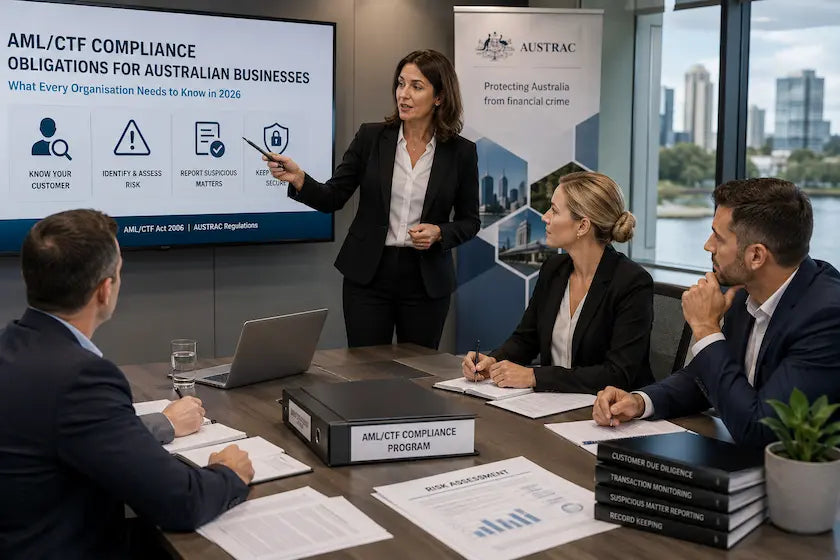
AML/CTF Compliance Is No Longer Just a Banking Issue
For many years, anti-money laundering and counter-terrorism financing (AML/CTF) compliance was viewed as something that mainly affected banks, casinos, and large financial institutions. That perception is changing rapidly.
Australia has strengthened its AML/CTF regime to address increasingly sophisticated financial crime and align more closely with international standards. Businesses across a broader range of industries are now expected to identify financial crime risks, understand who they are dealing with, maintain effective compliance programs, and report suspicious activities when required. Recent reforms also expand obligations to additional professional service sectors from 1 July 2026, including certain legal, accounting, real estate, trust and company services, and virtual asset-related services. These reforms significantly broaden the number of businesses that must prepare for AML/CTF compliance. (AUSTRAC)
For Australian businesses, compliance is no longer simply about avoiding regulatory penalties. It has become an important part of corporate governance, risk management, customer trust, and long-term business sustainability.
Whether you operate a financial institution, real estate agency, law firm, accounting practice, fintech company, cryptocurrency business, or another regulated organisation, understanding your AML/CTF obligations has never been more important.
What Is AML/CTF Compliance?
Anti-Money Laundering (AML) refers to the systems, controls, and procedures designed to prevent criminals from disguising illegally obtained funds as legitimate income.
Counter-Terrorism Financing (CTF) focuses on identifying and preventing the movement of money that could support terrorist activities.
Together, these measures help protect Australia's financial system from abuse while supporting law enforcement investigations into organised crime, corruption, fraud, tax evasion, cybercrime, human trafficking, and terrorism financing.
Rather than relying solely on government agencies to detect suspicious activity, Australia's AML/CTF framework requires regulated businesses to play an active role in identifying unusual customer behaviour, monitoring transactions, and reporting matters that may indicate criminal activity.
This shared responsibility has become one of the defining characteristics of Australia's modern financial crime prevention framework.
Why AML/CTF Compliance Matters More Than Ever
Financial crime continues to evolve.
Criminal organisations have become increasingly sophisticated in the way they move funds through legitimate businesses. Transactions that appear entirely routine on the surface may involve complex ownership structures, multiple jurisdictions, shell companies, or third-party intermediaries designed to conceal the true source of funds.
A property purchase, trust arrangement, cryptocurrency transfer, or company acquisition may appear commercially reasonable until examined more closely.
For this reason, regulators increasingly expect businesses to understand both their customers and the purpose behind significant transactions.
An effective AML/CTF program does more than satisfy legal requirements.
It helps businesses:
-
reduce exposure to financial crime
-
strengthen customer trust
-
improve corporate governance
-
demonstrate regulatory compliance
-
protect business reputation
-
reduce operational risk
Organisations that embed compliance into everyday operations often find that it improves overall business decision-making rather than creating unnecessary administrative burden.
Australia's AML/CTF Framework
Australia's AML/CTF framework is administered by the Australian Transaction Reports and Analysis Centre (AUSTRAC), Australia's financial intelligence unit and AML/CTF regulator.
AUSTRAC supervises reporting entities, collects financial intelligence, works alongside domestic and international law enforcement agencies, and provides industry guidance to help businesses comply with their legal obligations.
Australia's framework also aligns with recommendations developed by the Financial Action Task Force (FATF), the international body responsible for setting global standards for combating money laundering, terrorism financing, and proliferation financing.
This alignment helps strengthen Australia's financial system while supporting international cooperation against organised financial crime.
Useful official resources include:
-
AUSTRAC – https://www.austrac.gov.au
-
Financial Action Task Force (FATF) – https://www.fatf-gafi.org
-
Australian Attorney-General's Department – https://www.ag.gov.au
These organisations regularly publish guidance, updates, and educational resources that help businesses understand evolving compliance expectations.
Australia's AML/CTF Reforms: What Has Changed?
One of the most significant developments in recent years has been Australia's expansion of AML/CTF obligations beyond traditional financial institutions.
Under the latest reforms, a broader range of professional service providers will become regulated when they provide certain designated services.
This includes many businesses operating within:
-
legal services
-
accounting
-
real estate
-
conveyancing
-
trust and company services
-
dealers in precious metals and stones
-
additional virtual asset services
Businesses providing newly regulated designated services are expected to enrol with AUSTRAC and prepare for compliance obligations commencing from 1 July 2026. AUSTRAC has also introduced new enrolment processes and sector-specific guidance to help businesses prepare for implementation. (AUSTRAC)
For organisations entering the AML/CTF regime for the first time, preparation should begin well before regulatory deadlines.
Who Needs to Comply?
Many business owners mistakenly believe AML/CTF laws apply only to banks.
In reality, obligations depend on whether a business provides a designated service under Australia's AML/CTF legislation.
Existing reporting entities include financial institutions, lenders, remittance providers, gambling businesses, and digital currency exchange providers.
The reforms now extend obligations to additional professional service sectors where criminals may attempt to disguise ownership, move funds, or establish complex financial structures.
For example, an accounting firm establishing corporate structures, or a real estate business facilitating high-value property transactions, may unknowingly assist money laundering if appropriate customer due diligence is not performed.
Understanding whether your business provides designated services is therefore one of the first and most important compliance steps.
Building an Effective AML/CTF Compliance Program

A common misconception is that AML compliance simply involves collecting customer identification documents.
In reality, documentation is only one component of a much broader compliance framework.
Every reporting entity should establish an AML/CTF program that reflects the size, complexity, services, customers, delivery channels, and overall risk profile of the business.
An effective program generally includes:
-
a documented money laundering and terrorism financing risk assessment
-
policies and procedures
-
customer due diligence processes
-
transaction monitoring controls
-
reporting procedures
-
governance arrangements
-
staff training
-
ongoing review and improvement
Importantly, no two businesses face identical risks.
A regional accounting practice, a national property developer, and a cryptocurrency exchange each require different controls because their exposure to financial crime differs significantly.
A tailored, risk-based approach is therefore considered far more effective than relying on generic compliance templates.
Customer Due Diligence: Knowing Your Customer Beyond Identification

Customer Due Diligence (CDD) forms the foundation of Australia's AML/CTF regime.
While verifying identity remains essential, modern CDD extends much further.
Businesses should develop a reasonable understanding of:
-
who the customer is
-
who ultimately owns or controls the customer
-
why the customer requires the service
-
whether the proposed transaction aligns with expected behaviour
-
whether additional scrutiny is required
Consider a practical example.
A real estate agency receives instructions from an overseas buyer purchasing commercial property through several newly established companies.
All identification documents appear genuine.
However, the ownership structure is unusually complex, the source of funds is unclear, and representatives change throughout the transaction.
Individually, each issue may have an innocent explanation.
Taken together, however, they present elevated money laundering risk and justify further enquiries before the transaction proceeds.
This illustrates why modern AML/CTF compliance focuses on understanding customer behaviour—not simply collecting documents.
Beneficial Ownership: Looking Beyond the Immediate Customer
One of the most significant compliance challenges today involves identifying beneficial ownership.
Criminals often attempt to distance themselves from transactions through trusts, layered corporate structures, nominee directors, or third-party representatives.
Although a business may verify the identity of the immediate customer, regulators increasingly expect organisations to understand who ultimately owns or controls the entity involved.
Identifying beneficial owners helps reduce opportunities for criminals to conceal proceeds of crime behind legitimate-looking business structures.
For businesses dealing with complex ownership arrangements, this process may require additional documentation, verification, and ongoing monitoring.
Understanding beneficial ownership is no longer considered best practice—it has become an essential component of effective AML/CTF compliance.
Enhanced Customer Due Diligence: When Standard Checks Are Not Enough
Not every customer presents the same level of risk. While standard Customer Due Diligence (CDD) may be sufficient for many business relationships, some situations require businesses to take additional steps before providing designated services. This process is known as Enhanced Customer Due Diligence (ECDD).
Enhanced due diligence is appropriate when a customer, transaction, or business relationship presents a higher money laundering or terrorism financing risk. Examples may include complex ownership structures, cross-border transactions involving higher-risk jurisdictions, politically exposed persons (PEPs), or customers whose source of funds cannot be easily verified.
Additional enquiries might involve verifying the customer's source of wealth, understanding the purpose of a transaction in greater detail, requesting supplementary documentation, or obtaining senior management approval before proceeding.
Applying enhanced due diligence does not automatically mean a customer is involved in criminal activity. Instead, it demonstrates that your business has recognised elevated risk and taken proportionate steps to manage it responsibly.
Ongoing Customer Due Diligence Is Just as Important
Many businesses focus heavily on onboarding customers but overlook what happens after the relationship begins.
However, AML/CTF compliance is an ongoing obligation rather than a one-time exercise.
Customer circumstances can change over time. Businesses may expand internationally, ownership structures may evolve, transaction behaviour may become inconsistent, or new risks may emerge.
Ongoing Customer Due Diligence (OCDD) helps businesses determine whether customer activity remains consistent with what is known about them.
For example, if a customer who normally conducts small domestic transactions suddenly begins transferring substantial amounts overseas without a clear commercial explanation, this change may warrant further review.
Regular monitoring allows businesses to identify unusual patterns early and respond appropriately before risks escalate.
Recognising Suspicious Activity and Meeting Reporting Obligations
One of the most significant responsibilities under Australia's AML/CTF framework is recognising when activity appears suspicious.
Suspicious activity is not defined by a single transaction value or customer profile. Instead, it often involves behaviour that is inconsistent with what would reasonably be expected.
Examples might include customers who:
-
refuse to provide requested information
-
frequently change ownership or payment arrangements
-
attempt to structure transactions to avoid reporting requirements
-
use unnecessarily complex business structures
-
cannot reasonably explain the source of funds
-
instruct transactions that have no apparent commercial purpose
When reasonable grounds for suspicion exist, reporting entities may be required to lodge a Suspicious Matter Report (SMR) with AUSTRAC.
Importantly, businesses should avoid informing customers that an SMR has been lodged or is being considered, as this may constitute unlawful "tipping off" under Australian legislation.
Developing clear internal escalation procedures helps staff recognise unusual activity and ensures concerns are reviewed by appropriately trained personnel before reporting decisions are made.
Recordkeeping: More Than Just Good Administration
Accurate recordkeeping is often underestimated, yet it forms one of the strongest foundations of an effective AML/CTF program.
Maintaining comprehensive records allows businesses to demonstrate compliance, support internal reviews, respond efficiently to regulatory enquiries, and assist law enforcement investigations where required.
Good recordkeeping generally includes documentation relating to:
-
customer identification and verification
-
beneficial ownership information
-
risk assessments
-
customer due diligence decisions
-
transaction monitoring activities
-
staff training
-
compliance reviews
-
reports submitted to AUSTRAC
Well-maintained records also support business continuity by ensuring compliance knowledge remains available even when staff members change roles or leave the organisation.
Creating a Strong Compliance Culture Through Staff Training
Policies alone do not prevent financial crime.
Employees are often the first people to notice unusual customer behaviour, inconsistent documentation, or transactions that appear out of character.
Without appropriate training, these warning signs can easily be overlooked.
Effective AML/CTF training should help employees understand:
-
the purpose of Australia's AML/CTF framework
-
their individual responsibilities
-
customer due diligence procedures
-
recognising suspicious behaviour
-
internal reporting processes
-
confidentiality obligations
-
ongoing compliance expectations
Training should also be refreshed regularly to reflect legislative changes, emerging financial crime trends, and updates to organisational procedures.
Businesses that invest in ongoing compliance education often develop stronger risk awareness across the entire organisation rather than relying solely on compliance specialists.
Common AML/CTF Compliance Mistakes Businesses Should Avoid
Many compliance failures occur not because businesses intentionally ignore their obligations, but because internal processes have not kept pace with changing regulatory expectations.
Some of the most common mistakes include relying on outdated customer information, treating compliance as a one-off onboarding exercise, failing to document risk assessments, overlooking beneficial ownership, providing insufficient staff training, and using generic compliance templates that do not reflect the organisation's actual risk profile.
Another frequent issue is assuming that long-standing customers present little or no risk. In reality, customer behaviour and ownership structures can change significantly over time, making ongoing monitoring essential.
Businesses that regularly review and improve their AML/CTF program are generally better positioned to identify weaknesses before they become regulatory issues.
Practical Steps to Strengthen Your AML/CTF Program

Improving compliance does not always require large-scale organisational change. In many cases, practical improvements can significantly strengthen existing controls.
Begin by reviewing your current risk assessment to ensure it reflects the customers, products, services, delivery channels, and jurisdictions your business now operates in.
Next, examine customer onboarding procedures. Ask whether staff consistently collect sufficient information to understand both the customer and the purpose of the business relationship.
Regularly review internal reporting procedures so employees know exactly how to escalate suspicious matters.
Finally, schedule periodic program reviews. Financial crime methodologies evolve continuously, and compliance programs should evolve with them.
A proactive approach is usually far more effective than responding only after regulatory concerns arise.
Why Investing in AML/CTF Training Makes Good Business Sense
Regulatory compliance should never be viewed solely as a legal obligation.
Businesses with knowledgeable staff are generally better equipped to identify financial crime risks, make informed decisions, and protect their reputation.
Professional training also helps create consistency across teams, improves confidence during customer onboarding, and reduces uncertainty when unusual situations arise.
For organisations preparing for Australia's expanding AML/CTF obligations, structured training can provide valuable practical guidance on customer due diligence, beneficial ownership, suspicious matter reporting, recordkeeping, governance, and ongoing compliance responsibilities.
If your organisation is preparing for current or upcoming AML/CTF requirements, the AML/CTF Compliance Essentials Australia course from Australian Compliance Training provides practical, Australia-focused learning designed to help professionals understand their legal obligations and strengthen organisational compliance.
👉 AML/CTF Compliance Essentials Australia – Australian Compliance Training
Final Thoughts
Australia's AML/CTF landscape is entering a new phase. As regulatory obligations expand beyond traditional financial institutions, more businesses will need to adopt a proactive approach to compliance.
An effective AML/CTF program is not built around paperwork alone. It is built around understanding risk, knowing your customers, maintaining accurate records, training employees, and fostering a culture where unusual activity is recognised and managed appropriately.
Businesses that invest in compliance today are likely to be better prepared for future regulatory expectations while strengthening customer confidence and protecting their long-term reputation.
Ultimately, AML/CTF compliance is not simply about meeting legislative requirements. It is about contributing to the integrity of Australia's financial system and helping prevent organised crime from exploiting legitimate businesses.


